
Posted by Automation Distribution Staff on Oct 29th 2026
AI OCR for Date and Lot Code Inspection: How Deep Learning OCR Verifies Every Code at Line Speed
AI OCR for date and lot code inspection closes the gap that interval sampling and template-based OCR leave open on high-speed packaging lines. When a continuous inkjet (CIJ) nozzle clogs between manual checks, every unit printed until the next check is suspect, and the cost shows up later as quarantine, rework, retailer chargebacks, or a traceability failure.
This article breaks down how deep learning OCR differs from rule-based OCR, what Zebra Technologies' AI OCR solution is built from, and what controls engineers should specify when adding 100% code verification to a food, beverage, CPG, cosmetics, or pharmaceutical line.
What is AI OCR for date and lot code inspection?
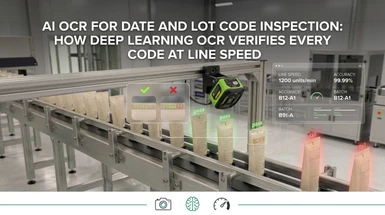
AI OCR, also called deep learning OCR (DL-OCR), is optical character recognition that uses a trained neural network to read characters based on patterns and context instead of matching segmented characters against a fixed font template. In Zebra's implementation, the deep learning model runs on the smart camera itself, reading the date and lot code on every unit and comparing it to the expected string in real time.
The practical difference is tolerance. A deep learning OCR model can read a code that is distorted, partially obscured, printed with a degraded CIJ head, laser-marked on foil, or sitting on a curved, glossy, or transparent substrate. These are the conditions that cause template OCR to throw missed reads and false rejects.
Date and lot codes carry real regulatory weight. They support traceability under the Food Safety Modernization Act (FSMA) and product records under the Modernization of Cosmetics Regulation Act (MoCRA), and major retailers issue chargebacks for missing or illegible codes. Verifying every unit, rather than sampling, is what removes the blind spot between checks.
Why does traditional OCR fail on packaging lines?
Traditional OCR fails on packaging lines because it assumes high-contrast, well-aligned characters on a clean, flat background. The classic pipeline (preprocessing, thresholding, character segmentation, then template matching or a per-font classifier) works in controlled conditions. On a production line, motion, vibration, glare, low contrast, and skewed presentation are normal operating conditions, not exceptions.
Common failure points include:
- CIJ dot-matrix degradation: drift, bleed, and fade break characters into disconnected dots that segmentation cannot group reliably.
- Reflective and transparent substrates: foil pouches, metallized film, and clear clamshells create specular glare and inconsistent background contrast.
- Curved surfaces: can ends, bottles, and tubes distort character geometry across the field of view.
- Code placement variation: shifted or smeared codes fall outside a tightly defined region of interest.
- Changeovers: new SKUs, label designs, fonts, or lighting conditions require font retraining and rule reconfiguration.
The hidden cost is engineering time. Every rule-based OCR job needs image preprocessing tuned to the substrate, manual rules for fonts and layouts, and rework whenever materials or lighting change.
| Factor | Rule-based OCR | Deep learning OCR |
|---|---|---|
| Recognition method | Segments characters, matches to templates | Neural network reads characters from pattern and context |
| Font setup | Font training per job | Pre-trained; no font training for typical date and lot codes |
| CIJ drift, bleed, fade | Frequent missed reads and false rejects | Tolerates degraded dot-matrix print |
| Curved, reflective, transparent surfaces | Heavy preprocessing and lighting tuning | Model trained on varied angles, textures, and conditions |
| SKU changeover | Reconfigure rules, retrain fonts | Update the expected string; model carries over |
How does deep learning OCR read codes that template OCR misses?
Deep learning OCR reads codes that template OCR misses because the model has already seen the variation. Zebra states its AI OCR tool is pre-trained on more than 200 font families and millions of real-world images covering varied angles, surface textures, environmental conditions, and marking methods, including CIJ, thermal transfer, laser, and etched codes. Instead of asking whether each isolated blob matches a stored character, the model interprets the full string in context, so a broken dot-matrix "8" or a partially glared "0" still resolves correctly.
Reading versus verifying
Reading the characters is half the job. Verification compares the decoded string against the expected date and lot for the current run, then sends a pass or fail result to the line controller over industrial Ethernet or discrete I/O to drive a reject mechanism. Best practice is to push the expected string from the PLC, MES, or printer controller at changeover rather than relying on operator entry, which removes a common source of "correctly printed, wrong code" escapes.
Why on-camera processing matters for cycle time
Deep learning inference is compute-intensive. Zebra runs it on an embedded neural processing unit (NPU) in the camera, which is how the company reports read times as low as 40 ms for typical date and lot codes and line rates up to 900 parts per minute. For context, 900 ppm leaves roughly 67 ms between units, so a sub-40 ms read preserves margin for trigger latency, image acquisition, and the reject output. Actual cycle time depends on exposure, region of interest size, and code length, so validate on your product.
What hardware and software make up Zebra's AI OCR solution?
Zebra's AI OCR solution pairs Zebra Aurora Focus software with the NS42 Smart Vision Sensor or the FS42 Fixed Industrial Scanner, both of which carry an embedded NPU for on-device deep learning. Automation Distribution carries the full Zebra fixed industrial scanning and machine vision lineup, including hardware, software licenses, and accessories.
Zebra Aurora Focus software
Aurora Focus is the single platform used to set up, deploy, and run Zebra Fixed Industrial Scanners and Machine Vision Smart Cameras. For OCR, you define a region around the code, select the pre-trained AI OCR tool, and configure the expected string and output logic. There is no font library to build.
Zebra FS42 Fixed Industrial Scanner
The Zebra FS42 Fixed Industrial Scanner builds on the FS40 platform with increased onboard memory and an NPU for resource-intensive jobs like DL-OCR and high-speed scanning. Its IP65/IP67 rating and chemical and oil-resistant housing suit washdown-adjacent food and beverage environments. The FS42 is the right fit when the same station also needs to decode 1D and 2D barcodes alongside the date and lot code. When reading FS42 part numbers, the decoder code matters: configurations such as the FS42-WA51G4-2C00W (wide angle, 5 MP, fast 2D decoder with DL OCR, red illumination) include deep learning OCR, while Z4 and F4 configurations carry standard and fast barcode decoders.
Zebra NS42 Smart Vision Sensor
The Zebra NS42 Smart Vision Sensor is purpose-built for machine learning workloads, with an embedded NPU that runs deep learning OCR and anomaly detection. It reads text from parts and labels without font training and is the choice when the inspection station should also flag print defects, label damage, or other anomalies beyond the code itself. Specify an NS42 configuration that includes the Deep Learning OCR toolset; configurations limited to standard machine vision and anomaly detection do not include DL-OCR.
Adding DL-OCR to existing Zebra smart cameras
Plants already running the Zebra VS40 or Zebra VS70 Machine Vision Smart Sensor can add deep learning OCR through the Zebra LIC-OCR002-0100 software license for the VS family. For new high-speed date and lot code stations, the NPU-equipped FS42 and NS42 are the platforms Zebra positions for this application. Round out the station with lights, lenses, brackets, and cables from the Zebra lensing, lighting, and accessories catalog.
How should engineers specify an AI OCR inspection station?
Specify an AI OCR station by working from the code and the line outward. Pre-trained OCR removes font training, but optics, triggering, and controls integration still decide whether the station holds up in production.
- Code size and position variation: determines field of view and whether a standard range or wide angle model fits your working distance.
- Substrate and marking method: test red and white illumination on actual production samples, especially foil, clear film, and curved can ends.
- Line rate and pitch: confirm the time between units covers trigger, acquisition, read, and output at maximum speed.
- Triggering: a photoeye or encoder-based trigger keeps the code centered in the region of interest.
- Expected string source: pull date and lot from the PLC, MES, or printer at changeover.
- Reject and data handling: define the reject mechanism, fail-safe behavior on no-read, and image logging for failed units to support root cause and compliance records.
What results does continuous code verification deliver?
Continuous verification moves code inspection from reactive to proactive. Instead of discovering a clogged printhead at the next scheduled check and quarantining everything since the last good sample, the station flags the first bad unit. Zebra reports near-100% accuracy and deployment in minutes rather than hours of font training, and cites these operational gains:
- Fewer rejects and less batch rework, scrap, and quarantine
- Reduced cost of shipping defective product and fewer retailer chargebacks
- Stronger support for FSMA and MoCRA traceability requirements
- Faster SKU and seasonal changeovers without font retraining
- Predictable throughput at full line speed
Related reading: How Deep Learning OCR Revolutionizes Traceability and Serialization in Manufacturing and Zebra's Advanced DL OCR Technology.
Frequently asked questions about AI OCR for date and lot codes
Does Zebra's deep learning OCR require font training?
No. Zebra's AI OCR tool in Aurora Focus is pre-trained on more than 200 font families and millions of images, so typical date and lot codes read without building a font library. You configure the region of interest and the expected string on the Zebra FS42 or NS42 and deploy.
Can AI OCR read CIJ codes on reflective or curved packaging?
Yes. Deep learning OCR tolerates CIJ drift, bleed, and fade and is trained on curved, glossy, reflective, and transparent surfaces. Illumination still matters, so test red and white lighting on production samples and add external lighting from the Zebra accessories range where glare is severe.
Should I use the FS42 or the NS42 for date and lot code OCR?
Both run deep learning OCR on an embedded NPU. Choose a DL-OCR configuration of the FS42 Fixed Industrial Scanner when the station also decodes barcodes. Choose the NS42 Smart Vision Sensor with the DL-OCR toolset when you also want anomaly detection for print or package defects.
How fast is Zebra AI OCR?
Zebra reports read times as low as 40 ms for typical date and lot codes and line rates up to 900 parts per minute. Actual performance depends on code length, region of interest, exposure, and trigger timing, so confirm with a feasibility test.
Does 100% code verification help with FSMA and MoCRA compliance?
It supports compliance by confirming every unit carries a legible, correct date and lot code and by logging images of failures for traceability records. Compliance itself depends on your full quality program, but eliminating sampling gaps removes one of the most common sources of coding escapes.
Automation Distribution is an authorized Zebra Technologies distributor carrying the FS42 Fixed Industrial Scanner, NS42 Smart Vision Sensor, Aurora software licenses, and the complete Zebra fixed industrial scanning and machine vision lineup. Browse the full Zebra machine vision and industrial scanning catalog or explore Zebra machine vision systems, or call 1-888-600-3080 to discuss your date and lot code inspection application.