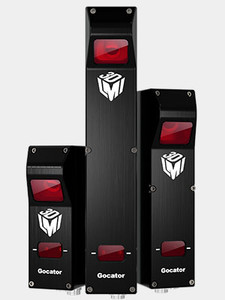
LMI Gocator 2600 Series 4K+ Resolution Smart 3D Laser Line Profilers
LMI TechnologiesThe remastered 4K+ resolution Gocator family. A 9-megapixel imager, X resolution down to 2.5 microns, and HDR Mode for single-exposure scanning of shiny and matte surfaces together. The Gocator 2600 Series is LMI Technologies' highest-resolution smart 3D laser line profiler platform.
Eight optical models cover the full inspection spectrum, from 2.5 micron X resolution on the Gocator 2610A for semiconductor ball grid arrays, out to a 2 meter field of view on the Gocator 2690A for large-target food processing and packaging lines. Every model returns up to 4192 data points per profile from the same 9-megapixel imager, runs measurement tools on the sensor itself, and outputs finished dimensional values over Gigabit Ethernet without a PC in the measurement loop.
This page is the selection guide for the series. Each model has its own page with full specifications, part numbers, and configuration options.
Choose Your Model
The single most useful question is part width, because it narrows the field faster than anything else. Once you know it, laser class and wavelength follow from the target material.
| Model | Field of View | Measurement Range | X Profile Data Interval | Z Repeatability | Best Suited For |
|---|---|---|---|---|---|
| Gocator 2610A | 10.2 - 10.8 mm | 5.0 mm | 2.5 µm | 0.22 µm | Semiconductor BGA dimensioning, ball coplanarity, microscopic defect detection, transparent adhesive verification. Highest X resolution in the Gocator portfolio. |
| Gocator 2618A | 20 - 23 mm | 12 mm | 5.0 - 5.4 µm | 0.38 µm | EV battery pre-weld seam gap and flush. Smallest and lightest sensor in the series at 1.43 lb. |
| Gocator 2629A | 71 - 93 mm | 45 mm | 18 - 23 µm | 0.30 µm | Large consumer electronics targets in a single pass. Tightest resolution band and fastest default scan rate of the mid-range models. |
| Gocator 2630A | 71 - 135 mm | 130 mm | 18 - 33 µm | 0.30 µm | General inline dimensional gauging. Automotive sub-assemblies, weld bead profiling, EV cell groupings. The widest sub-micron model in the series. |
| Gocator 2640A | 105 - 198 mm | 190 mm | 28 - 46 µm | 1.00 µm | Larger automotive components, food on standard conveyors, building materials. Longest clearance distance in the mid-range at 170 mm. |
| Gocator 2650A | 190 - 430 mm | 475 mm | 47 - 104 µm | 2.70 µm | Tire sidewall and tread profiling, automotive body panels, EV battery module measurement. |
| Gocator 2670A | 272 - 817 mm | 1060 mm | 67 - 197 µm | 10.00 µm | Lumber and panel lines, large structural assemblies, wide conveyors. Widest blue-laser model. |
| Gocator 2690A | 385 - 2000 mm | 1550 mm | 124 - 550 µm | 12.00 µm | Full-width food conveyors, carton and pallet volume gauging, bulk material profiling. |
The Two Decision Points That Matter Most
135 mm is where measurement precision changes
Z repeatability across the series does not decline gradually. It holds under a micron through the 2610A at 0.22, the 2629A at 0.30, and the 2630A at 0.30, then steps to 1.00 micron on the 2640A and climbs to 2.70, 10.00, and 12.00 microns on the wide-field models. The 2630A is therefore the widest field of view in the series that still measures with sub-micron repeatability, at 135 mm.
Measure the part before choosing the model. If it fits inside 135 mm, the Gocator 2630A gives roughly three times better Z repeatability than the next model up and costs nothing in coverage. Above 135 mm, the precision step is simply the price of the wider envelope. The Gocator 2640A field of view also does not narrow below 105 mm, so a small part gains nothing from it.
Coverage sensors and precision sensors are different tools
The 2650A, 2670A, and 2690A are built for whole-object work: profile shape, volume and area, warp and twist, presence and absence, and gross dimensional gauging across wide targets. They are not suited to fine feature measurement, micron-level gap and flush, or small defect detection. Specifying a wide sensor against a fine-measurement expectation is the most common way these deployments disappoint.
If an application needs both wide coverage and fine measurement, the answer is usually several narrower sensors rather than one wide one. Native multi-sensor alignment is built into every 2600 Series sensor, and an array of 2630A or 2640A units holds single-micron repeatability across the same total width that one 2670A covers at 10 microns.
Laser Class and Wavelength
Once the model is settled, two configuration choices remain. Neither changes the optical specifications in the table above.
Laser class
| Laser Class | When to Specify It |
|---|---|
| Class 2 | Lowest power. The usual choice where the sensor sits in an area operators can reach and no interlock scheme is planned. |
| Class 3R | More power for darker or lower-reflectivity targets, without the interlock obligations of Class 3B. |
| Class 3B | Highest power, for dark, absorptive, or fast-moving targets. Requires a remote interlock, key control, power-on delay, beam attenuator, and emission indicator, all of which are the integrator's responsibility to implement. |
Class selection matters more as field of view grows. A 430 mm laser line spreads the same light budget across more than three times the width of a 135 mm line, so on the wide models Class 3R or 3B is frequently what makes a scan usable on dark rubber, matte composites, or rough timber rather than an upgrade for difficult cases. Class 3B is available on every model except the Gocator 2690A.
Wavelength
Most of the series uses a 405 nm blue laser. Blue penetrates less into the surface it strikes, keeping the laser line tight on translucent, glossy, and organic materials where red scatters into the material and blurs the line. Three models are also offered with a 660 nm red laser, and one is red only.
| Wavelength Availability | Models |
|---|---|
| 405 nm blue only | 2610A, 2618A, 2650A, 2670A |
| 405 nm blue or 660 nm red | 2629A, 2630A, 2640A |
| 660 nm red only | 2690A |
On the three dual-wavelength models, published specifications are identical either way, so the choice is about target material. Red suits light-colored matte diffuse targets such as cardboard, timber, and many food products, where blue offers no advantage and red is the more economical build. Red is also the right call on a line already standardized on 660 nm sensors, since matching wavelength keeps optical behavior consistent station to station. If the target is shiny, dark, or translucent, specify blue.
The 2690A is red only for the same reason: at a 2 meter field of view the targets are typically light, matte, and diffuse, so blue would add cost without adding capability.
Full Specification Comparison
| Specification | 2610A | 2618A | 2629A | 2630A | 2640A | 2650A | 2670A | 2690A |
|---|---|---|---|---|---|---|---|---|
| Data Points / Profile | 4192 | 4192 | 4192 | 4192 | 4192 | 4192 | 4192 | 3700 |
| Scan Rate (Hz) | 1100 - 9000 | 700 - 10000 | 1150 - 9000 | 600 - 9000 | 600 - 9000 | 600 - 9000 | 600 - 9000 | 900 - 10000 |
| X Profile Data Interval (µm) | 2.5 | 5.0 - 5.4 | 18 - 23 | 18 - 33 | 28 - 46 | 47 - 104 | 67 - 197 | 124 - 550 |
| Z Linearity (± % of MR) | 0.015 | 0.015 | 0.03 | 0.03 | 0.04 | 0.04 | 0.05 | 0.08 |
| Z Repeatability (µm) | 0.22 | 0.38 | 0.30 | 0.30 | 1.00 | 2.70 | 10.00 | 12.00 |
| Clearance Distance (mm) | 19.5 | 44.5 | 110 | 110 | 170 | 330 | 495 | 325 |
| Measurement Range (mm) | 5.0 | 12 | 45 | 130 | 190 | 475 | 1060 | 1550 |
| Field of View (mm) | 10.2 - 10.8 | 20 - 23 | 71 - 93 | 71 - 135 | 105 - 198 | 190 - 430 | 272 - 817 | 385 - 2000 |
| Wavelength | Blue 405 | Blue 405 | Blue 405 or Red 660 | Blue 405 or Red 660 | Blue 405 or Red 660 | Blue 405 | Blue 405 | Red 660 |
| Laser Classes | 2, 3R, 3B | 3R, 3B | 2, 3R, 3B | 2, 3R, 3B | 2, 3R, 3B | 2, 3R, 3B | 2, 3R, 3B | 2, 3R |
| Protective Cover | Not available | Not available | Available | Available | Available | Available | Available | Available |
| Operating Temperature | 0 to 40 °C | 0 to 50 °C | 0 to 50 °C | 0 to 50 °C | 0 to 50 °C | 0 to 50 °C | 0 to 50 °C | 0 to 50 °C |
| Dimensions (mm) | 50 x 116 x 125 | 46 x 80 x 110 | 55 x 105 x 165 | 55 x 105 x 165 | 55 x 105 x 195 | 55 x 105 x 280 | 55 x 105 x 280 | 55 x 105 x 280 |
| Weight (lb) | 1.98 | 1.43 | 2.95 | 2.95 | 3.26 | 4.67 | 4.67 | 4.67 |
Scan rate ranges run from default configuration at full field of view and measurement range, to high-speed configuration with reduced field, optimized data spacing, and acceleration enabled. Specifications are stated for standard laser classes; LMI notes that Z linearity and Z repeatability may vary on other classes. All figures are measured on LMI's standard calibration target. Refer to the current Gocator 2600 Series datasheet for full specifications.
Two model-specific exceptions worth catching early. The 2610A operating range is 0 to 40 °C, not the 0 to 50 °C that applies to the other seven models, which matters in warm enclosures. And the optional protective cover is offered on the 2629A through 2690A but not on the 2610A or 2618A, so in high-particulate environments those two need a cleaning routine or an external shield.
What the Remastered 2600 Series Brings
LMI rebuilt the 2600 platform with four enhancements over the original generation. Legacy 2600 sensors drop into the same applications with significant performance improvements, and existing job files retain their configuration and scan speeds.
| Enhancement | What It Means |
|---|---|
| HDR Mode | High Dynamic Range scanning captures targets with mixed material finishes, such as reflective metallic surfaces alongside matte features, in a single exposure. This removes the multi-exposure sequence that previously slowed cycle time on EV battery, automotive, and consumer electronics targets. |
| Higher 4K+ Resolution | The 2610A reaches 2.5 micron X resolution for semiconductor BGA dimensioning and microscopic defect detection. The 2618A reaches 5 micron X resolution at 20 mm field of view for EV battery pre-weld seam gap and flush measurement. |
| Faster Default Scan Speed | Default configurations run at higher scan rates than the original 2600 platform. Existing job files retain their original configuration and scan speeds, so measurement setups do not need rebuilding. |
| Enhanced Surface Data Quality | A pre-processing pipeline reduces spatial noise on flat surfaces. Features that previously sat at the edge of the noise floor, such as thin adhesives, micro-gaps, and fine scratches, become reliably measurable. The 2629A delivers this data quality across a field of view above 70 mm for consumer electronics scanning. |
Industries and Applications
| Industry | Where the 2600 Series Fits |
|---|---|
| Semiconductor and Advanced Packaging | The 2610A's 2.5 micron X resolution is built for BGA dimensioning, ball coplanarity, surface defect detection on advanced packaging, and feature measurement on substrates and dies. |
| EV Battery Manufacturing | The 2618A is LMI's recommended sensor for pre-weld seam gap and flush measurement on cell stacks. The 2629A and 2630A handle cell-level dimensioning at higher throughput, and the 2650A covers module-level measurement. |
| Consumer Electronics | 4K+ resolution with HDR Mode handles the mixed finishes of assembled devices, including polished metal frames, matte plastics, and glass screens, in single-exposure scanning at production speed. |
| Automotive | HDR Mode handles mixed metallic and painted surfaces in a single scan. Gap and flush, weld bead profiling, sealant bead inspection, and body panel curvature across the 2630A, 2640A, and 2650A. |
| Food Processing | The 2670A and 2690A profile rows of baked goods, portioned assemblies, and irregular natural products across wide conveyor lines in a single sensor pass. |
| Rubber and Tire | The 2650A and 2670A blue-laser models handle dark rubber at wide field of view for sidewall and tread profiling without multi-sensor stitching. |
| Building Materials | The 2670A and 2690A profile lumber, panels, structural components, and large fabricated assemblies on wide-conveyor production lines. |
| Packaging and Logistics | The 2690A delivers 2 meter field of view carton and pallet volume gauging on full-width conveyors. |
Industrial Construction and Connectivity
| Specification | Detail |
|---|---|
| Interface | Gigabit Ethernet |
| Inputs | Differential encoder, laser safety enable, trigger |
| Outputs | 2x digital output, RS-485 serial (115 kBaud) |
| Industrial Protocols | EtherNet/IP, PROFINET, Modbus, ASCII, native Gocator protocol |
| Input Voltage / Power | +24 to +48 VDC, 15 watts, ripple ±10% |
| Housing | Gasketed metal enclosure, IP67 rated |
| Operating Temperature | 0 to 50 °C (2610A: 0 to 40 °C) |
| Storage Temperature | -30 to 70 °C |
| Vibration Resistance | 10 to 55 Hz, 1.5 mm double amplitude in X, Y, Z, 2 hours per direction |
| Shock Resistance | 15 g, half sine wave, 11 ms, positive and negative for X, Y, Z |
| Protective Cover | Available on the 2629A through 2690A. Protects camera and laser windows from dust, debris, and cleaning damage. |
Software, Integration, and Networking
- Browser-based configuration interface for sensor setup, measurement tool building, and real-time 3D visualization from any device with a browser
- Onboard measurement tools run gauging, geometric, and feature-extraction directly on the sensor without an external PC
- Native multi-sensor alignment and networking built into every 2600 Series sensor for synchronized multi-sensor systems
- Open source SDK and GDK for integration with your application, image processing pipeline, robot, or PLC, and for custom measurement tools
- LMI Master controllers provide synchronized power, laser safety, encoder, and trigger distribution across multi-sensor arrays
- Free Gocator Emulator for offline development and validation in a virtual sensor environment
- Compatible with the GoMax Smart Vision Accelerator for offloaded point cloud processing, particularly valuable at 4K+ resolution and high scan rates
- Compatible with the GoPxL Anomaly Detector for AI-based surface defect detection on 2D intensity or 3D height map data
- Power, I/O, and Ethernet LMI cordsets available in standard lengths and 90-degree variants
Frequently Asked Questions
What is the Gocator 2600 Series used for?
The Gocator 2600 Series is LMI Technologies' remastered 4K+ resolution 3D laser line profiler family, used across semiconductor advanced packaging, EV battery manufacturing, consumer electronics, automotive, rubber and tire, food processing, building materials, and packaging and logistics. The 9-megapixel imager and HDR Mode handle the mixed material finishes and fine features of modern manufactured products at production-line throughput.
Which Gocator 2600 model should I choose?
Start with part width. Under 10 mm points to the 2610A, up to 23 mm to the 2618A, up to 135 mm to the 2630A, and so on out to 2 meters on the 2690A. The critical boundary is 135 mm: at or below it the 2630A measures with sub-micron Z repeatability, and above it Z repeatability steps to 1.00 micron and beyond.
Which models are available with a red laser?
The 2629A, 2630A, and 2640A are available in both 660 nm red and 405 nm blue with identical published specifications. The 2690A is red only. The 2610A, 2618A, 2650A, and 2670A are blue only. Blue is preferred on translucent, glossy, or organic targets; red suits light-colored matte diffuse materials and lines already standardized on 660 nm sensors.
What does 'remastered' mean for the Gocator 2600 Series?
LMI rebuilt the platform with HDR Mode for single-exposure scanning of mixed shiny and matte targets, higher 4K+ resolution including the 2.5 micron 2610A and 5 micron 2618A, faster default scan speeds, and an enhanced pre-processing pipeline that reduces spatial noise on flat surfaces. Existing job files from the original platform retain their configuration and scan rates.
What is HDR Mode and when do I need it?
HDR Mode captures targets with mixed material finishes, such as reflective metallic surfaces alongside matte plastics, dark adhesives, or painted features, in a single exposure. Without it those targets need multiple exposures to avoid over- or under-exposed regions, which slows cycle time. It is especially valuable for EV battery scanning, consumer electronics, and automotive assemblies.
Which Gocator 2600 model has the highest resolution?
The 2610A, at 2.5 micron X resolution with 0.22 micron Z repeatability. That is the highest X resolution in the Gocator portfolio. The 2618A is the secondary precision model at 5.0 to 5.4 microns over a 20 mm field of view.
What is the difference between the Gocator 2400 and Gocator 2600 Series?
The Gocator 2400 Series uses a 2 megapixel imager with up to 1940 data points per profile. The 2600 Series uses a 9 megapixel imager with up to 4192 data points per profile, more than double the resolution, and adds HDR Mode, faster default scan speeds, and enhanced surface data quality. Choose the 2600 Series when you need 4K+ resolution, HDR Mode, or the 2.5 micron resolution of the 2610A.
Do I need a GoMax accelerator with the Gocator 2600 Series?
Not always, but often at higher scan rates and 4K+ resolution. A 2610A at 9 kHz generates roughly 38 million data points per second, and processing that volume in real time on a host PC consumes significant CPU. The GoMax Smart Vision Accelerator offloads point cloud processing, leaving host resources for measurement logic and AI inference. Contact Automation Distribution for sizing based on your configuration.
Which models offer a protective cover?
The 2629A through 2690A. The cover shields the laser and camera windows from scratches caused by dust, debris, and cleaning, and is recommended for machining, wood processing, food processing, and abrasive environments. It is not offered for the 2610A or 2618A.
Can I network multiple Gocator 2600 sensors together?
Yes. Native multi-sensor alignment and networking is built into every 2600 Series sensor. LMI Master network controllers provide synchronized power, laser safety, encoder input, and external trigger distribution across sensor arrays, enabling 360 degree inspection, wide-conveyor coverage, and multi-side simultaneous scanning.
Need Help Selecting a Gocator 2600 Model?
Automation Distribution's application engineers work directly with LMI Technologies to match the right sensor and accelerator to your inspection target. Whether you are scanning semiconductor BGAs, measuring EV battery seam gaps, profiling wide conveyor lines, or gauging carton volumes, we will help you get the configuration right the first time.
Request a quote or call 1-888-600-3080. Tell us the part width, the feature you need to measure, and the target material, and we will narrow the eight models to the right one.
Related Products
-

-
LMI Gocator 2300 Series Workhorse 3D Laser Line Profile Sensors
LMI Technologies
-
LMI Gocator 2880 Dual-Triangulation 3D Laser Line Profile Sensor
LMI Technologies
-
LMI Gocator 2100 Series Entry-Level 3D Laser Line Profile Sensors
LMI Technologies