
Posted by Automation Distribution Staff on May 20th 2026
Your First Cobot: A Practical Guide to Getting Started
Pick the Right Application, the Right Robot, and the Right Partners
Collaborative robots have moved from "interesting idea" to "table stakes" for a lot of manufacturers in the last five years. The technology works. The question most people are actually asking now is more practical: how do I pick my first application, choose the right robot, and figure out who I should be working with to make it happen?
There's no shortage of cobot content on the internet. Most of it is either "what is a cobot" 101 material or a vendor's sales pitch wrapped in a how-to. This guide is for the operations manager or shop owner who's already past that — you know what a cobot is, you've seen the videos, you're seriously considering one. What you need now is a clear-headed read on how to think about the decision.
This guide draws on what Automation Distribution sees across Universal Robots deployments — the most widely-deployed cobot platform in North America, and the brand most often specified into first-time installations. Automation Distribution is both an authorized Universal Robots distributor and a cobot integrator; we deploy cells directly for customers, and we work alongside specialist integrators across the country on projects where their application depth makes the difference. We'll cover what that means for your project below.
Two capabilities every cobot project needs
Before anything else, it helps to understand what a cobot project actually requires, because most first-time buyers conflate two distinct things into one.
The platform and parts capability. Knowing the cobot product lines cold — payload, reach, software versions, accessory compatibility, lead times, in-stock SKUs, what's been replaced or made obsolete. Cross-referencing end-of-arm tooling, safety hardware, signal towers, and the fieldbus I/O that ties the cobot to the host machine. Handling the bill of materials, managing the orders, and keeping the project moving from a procurement standpoint.
The application and integration capability. Walking the floor, designing the specific cell, building the fixturing, writing the programs, running the risk assessment, installing the hardware, training operators, and providing ongoing support. Knowing the particular quirks of how the application actually runs — the way medical device assembly differs from injection molding tending, the way food-and-beverage packaging differs from automotive sub-assembly.
Some companies — Automation Distribution included — offer both capabilities under one roof. Others specialize in one. Both arrangements work; the right choice for your project depends on the application and on the relationships you already have.
When ADI deploys a cell directly, both capabilities come from the same team: same point of contact for the BOM, the design, the install, and the post-deployment support. When a specialist integrator is involved — typically on cells where their accumulated application experience materially changes the outcome — ADI handles the platform side (UR hardware, EOAT, safety components, signaling, lead times, cross-references) and the integrator handles the application side. Both arrangements deliver good cobot deployments. Neither is "the right way."
Picking your first application: the 80/20 rule
The most common mistake first-time cobot buyers make is trying to automate their hardest job. The nightmare part with six setups. The aerospace bracket with the twelve-thou tolerance. The job nobody else can run because it's so finicky.
Don't start there.
A strong first cobot application has three properties:
Repetitive enough to matter. The application needs enough annual run time to justify the cell economically. This could be one long-running job or several shorter runs of the same part family. The number that matters is total hours under cobot control, not the specifics of any one part.
Simple enough to prove fast. Straightforward load/unload, minimal in-process handling, cycle times that give the cobot enough margin to work cleanly. Pick-and-place, machine tending, palletizing, and simple assembly are the four applications most often deployed as first cells — for good reason.
Painful enough to care. The application has to be solving a real business problem — a staffing headache, a quality risk, a capacity bottleneck — not just a technical curiosity. If nobody on your team has been complaining about the job for months, it's probably not the right job for your first cobot.
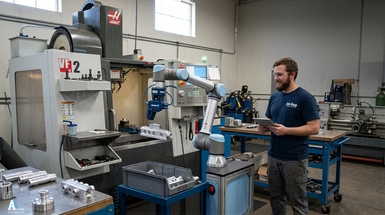
The four applications that match these criteria most reliably across industries: machine tending for CNC and injection molding; palletizing case goods or finished cartons; pick-and-place on packaging lines; and simple sub-assembly tasks like fastener driving, dispensing, or part insertion. Each of these has well-established deployment patterns, mature end-of-arm tooling options, and a community of integrators and distributor-integrators who specialize in them.
Choosing the right Universal Robots arm
Universal Robots' current lineup spans payloads from 3 kg to 30 kg and reaches from 500 mm to 1750 mm. For first-time deployments, the choice usually comes down to matching payload and reach to the application without overspending on capability you won't use in year one.
The most common first-cobot selections:
- UR10e — 12.5 kg payload, 1300 mm reach. The workhorse of first-time deployments. Handles most machine tending and packaging applications without strain. Good default choice when you're not sure.
- UR16e — 16 kg payload, 900 mm reach. Same compact footprint as the UR10e but with significantly more lifting capacity. Best for heavy part handling, multi-part picks, or high-payload palletizing in tight spaces.
- UR5e — 5 kg payload, 850 mm reach. Common choice for lighter assembly, electronics handling, and lab automation.
- UR20 / UR30 — Higher payload (20 kg / 30 kg) options for palletizing and heavy machine tending. Worth evaluating if your first application involves cartons over 12 kg or large castings.
A common error is over-specifying the cobot to "future-proof" the deployment. You'll learn more from running the right-sized cobot on your first application than from running an over-spec'd one that's harder to integrate. If a second cell is in the cards, that's the time to specify a different arm.
Beyond the arm: what else goes in the bill of materials
The cobot is the most visible part of the cell, but it's typically only 40 to 60 percent of the total hardware cost. The rest of the bill of materials is where deployments succeed or fail.
End-of-arm tooling (EOAT). The gripper, vacuum cup, magnetic tool, or custom end-effector that actually contacts the part. Robotiq and OnRobot are the two dominant EOAT brands for Universal Robots — both manufacture grippers, force sensors, and screwdriving tools that mount directly to UR's standard ISO 9409-1 tool flange with full UR+ software integration. Choice of EOAT is often the single most application-specific decision in a cobot build.
Safety hardware. Cobots are designed for collaborative operation, but a real risk assessment usually identifies specific scenarios — sharp tooling, heavy payloads, pinch points — where additional safety hardware is warranted. Leuze safety light curtains and area scanners are common additions to cobot cells where the cobot itself can't be slowed enough to handle every contact scenario. Whether your cell needs them is a question for the risk assessment, not a default decision.
Operator signaling. Patlite LR-series signal towers are the standard for cobot cell status indication — running, paused, faulted, awaiting attention — visible across the production floor. A cell without clear visual status indication tends to accumulate operator time waste; people walk over to check what the cobot is doing.
Host-machine integration. For machine tending applications, the cobot has to handshake with the CNC, the injection press, or whatever it's loading. This usually means I/O signals — start cycle, door open, part present, fault — wired through a small panel between the cobot's I/O block and the host machine's safety-rated I/O. SMC and WAGO components show up here often.
Fixturing. The part holders, presenters, and locating features that get raw parts into a position the cobot can pick from reliably. Fixturing is rarely off-the-shelf — it's usually custom designed for the application — and it's where good integration teams earn their fees. An over-engineered cobot with under-engineered fixturing won't run reliably; a modest cobot with well-designed fixturing will run for years.
The team conversation
The thing nobody mentions in the spec sheets: your people will have opinions about robots. Some will be excited. Some will be threatened. Some will assume they're being replaced. If you don't address this upfront, you'll create resistance that kills the project even when the technology works perfectly.
A few weeks before the cobot arrives, sit down with the team. Not a formal meeting — grab coffee, talk straight. The conversation has three parts: nobody's losing their job (you're adding capacity, not cutting people); the cell needs a champion (someone to learn the programming, run new setups, troubleshoot — and that role usually comes with a raise because it's a skill upgrade); and this is about running the operation you want, not the one you're stuck with.
Then ask who wants the role. The answer is rarely who you'd predict. Sometimes it's your most senior person who's tired of repetitive work and ready for a new challenge. Sometimes it's the youngest member of the team who's been waiting for the shop to invest in modern equipment. The point is to ask, and to make it clear this is an opportunity. People aren't afraid of robots — they're afraid of uncertainty. Address that directly and the team usually gets on board faster than you'd expect.
Honest obstacles
A few things that legitimately can go wrong, worth planning for:
Power and air. Some older facilities have marginal electrical service or air supply. If your compressor is already maxed out, you may need upgrades before adding a cell. Walk the utilities before you spec.
Part inconsistency. If your raw material varies wildly — castings with inconsistent stock, parts arriving in different orientations — you'll spend more time on gripper design and sensing. Solvable, but plan for additional engineering work and a longer commissioning curve.
Internal resistance. If you or your operations lead secretly don't believe this will work, it won't. Not because of the technology — because you'll find reasons not to use it. Mindset matters as much as hardware.
Maintenance discipline. Cobots are reliable but not magic. Grippers wear, sensors get dirty, programs need occasional updates. Shops with strong preventive maintenance culture have far less downtime than shops that run hardware until it fails.
Are you ready?
You're ready if:
- You have at least one machine, line, or workstation that could produce more if you had the labor to staff it.
- You're running part families or jobs with enough repeatability to amortize a cell setup.
- You're open to rethinking some fixturing and process flow around the cell.
- You have at least one person on your team willing to learn cobot programming.
- You can budget realistically for the full deployment — cobot, EOAT, safety, fixturing, integration — and accept a payback window measured in months, not weeks.
You should wait if:
- You're truly running one-off custom work with no repeatability.
- Cash flow is tight enough that a significant capital purchase would put the business at risk.
- You or your operations lead are fundamentally opposed to automation.
- You're planning to exit the business in the near term.
Who to talk to first
There are three reasonable starting points, depending on your situation.
If you already work with an integrator you trust — start there. They know your operation, they've done the work to understand your processes, and they're best positioned to scope the cell. Automation Distribution works with integrators across the country on Universal Robots deployments; if yours needs a competitive quote on UR hardware, EOAT, safety components, or signal towers, we're set up to support that workflow.
If you want a single point of contact through the whole project — talk to ADI directly, or to an integrator who handles the platform side as a generalist. Automation Distribution deploys cobot cells across machine tending, palletizing, packaging, assembly, and most other applications where Universal Robots are commonly used; a number of integrator partners we work with offer the same single-point-of-contact arrangement in their regions. Either way, the BOM, the cell design, the install, and the post-deployment support all come from the same team — which simplifies project management and tightens accountability when something needs attention.
If your application is unusually complex or specialized — consider a specialist integrator. Some cells benefit from accumulated experience that even a capable generalist team doesn't have: complex welding cells, fully validated medical device assembly, vision-heavy bin picking with custom algorithms, deeply customized food-grade environments. For those, a specialist integrator's domain expertise often makes the difference between a cell that works and a cell that works for years. When this is the right path, ADI partners with the integrator on the platform side — UR hardware, EOAT, safety, signaling — and the integrator handles the application engineering.
None of these three paths is "the right way." They reflect different starting conditions and different preferences for how a project is run. If you're not sure which fits your situation, the conversation can start with either ADI or an integrator — both have an incentive to point you toward the right arrangement, because a misfit project is bad for everyone involved.
Frequently asked questions
How much should I budget for a first cobot cell?
Budgets vary widely based on application complexity, EOAT requirements, custom fixturing, and whether vision or additional safety hardware is needed. A straightforward machine-tending cell with a UR10e, off-the-shelf gripper, and simple fixturing typically runs less than a cell involving custom EOAT, multi-station workflows, or vision-guided picking. The right way to budget is to scope the specific application — either with us or with your integrator — rather than working from generic industry averages.
Does ADI do integration, or just distribution?
Both. Automation Distribution is an authorized Universal Robots distributor and a cobot integrator — we deploy cells directly for customers across a broad range of applications. For projects that benefit from deep specialist expertise (complex welding, validated medical assembly, vision-heavy bin picking, deeply customized food environments), we work alongside integrator partners whose accumulated application experience adds value beyond what any generalist can offer. Which arrangement is right for your project depends on the application and on whether you already have an integrator relationship.
Which Universal Robots arm should I buy for my first cell?
For most first-time deployments, the UR10e is the default choice — 12.5 kg payload and 1300 mm reach cover the vast majority of machine tending and packaging applications. If your application involves heavier parts or carton handling in a smaller footprint, the UR16e offers more payload in the same arm size. For palletizing case goods or multi-carton picks, the UR20 or UR30 may be appropriate. The right answer depends on what you're actually moving — payload, reach, cycle time, and the surrounding cell layout all factor in.
How long does it take to deploy a first cobot cell?
From decision to running production, a straightforward first deployment typically takes between eight and sixteen weeks, depending on lead times for the cobot and supporting hardware, the complexity of fixturing, and the integration team's workload. Simple machine-tending cells can be quicker; cells involving custom EOAT or vision are often longer. Building schedule realism into the plan is more useful than chasing the shortest theoretical timeline.
Thinking about your first cobot?
Whether you want a turnkey cell deployed by our team, you're working with an integrator on the spec, or you're still figuring out which direction makes sense — start the conversation. Automation Distribution is the authorized US distributor for Universal Robots and a cobot integrator, and we work alongside specialist integrators across the country.
Start the Conversation Call 1-888-600-3080