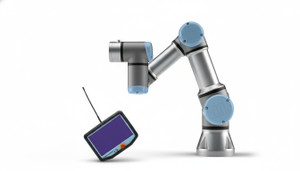

Turnkey Solution · Cobot Cell
Robotic Palletizing Cell
A cobot-driven end-of-line palletizing cell engineered for high-mix, high-volume operations. Vision-guided box detection, customizable grippers for any case style, and a reconfigurable footprint that fits into existing production lines. Deployed by Automation Distribution for food & beverage, manufacturing, and distribution operations replacing manual case stacking.
Why automate end-of-line palletizing
Manual palletizing is one of the most physically demanding jobs in a production facility. Workers spend a shift lifting cases that often weigh 30 to 50 pounds, building stable pallet patterns by hand, hundreds of cases per shift. Injury rates are high, turnover is constant, and the position is one of the hardest to staff reliably — particularly on second and third shifts.
A cobot palletizer doesn't just replace the labor. It changes the economics of end-of-line operations. Cycle times become predictable. Pallet quality becomes consistent. Lines can run lights-out where the application allows. And the work that operators do shifts from physical strain to monitoring and exception handling — which is both a safer job and a more sustainable workforce model.
The Robotic Palletizing Cell is built around this transition. Whether you're handling uniform cases on a single SKU, mixed-size loads in a high-mix run, or both depending on the day, the cell adapts in real time using vision-guided box detection and software-managed pallet patterns.
Typical applications
| Industry | What the cell handles |
|---|---|
| Food & beverage | Case palletizing for cartons, trays, shrink-wrapped multi-packs, and bag-in-box products. Common SKU mixes include beverages, dairy, dry goods, and snack foods. |
| Consumer packaged goods | End-of-line palletizing for personal care, household chemical, and packaged-goods cases moving from co-packer or contract manufacturer to distribution. |
| Manufacturing & industrial | Case and tray palletizing for finished components, tools, hardware, and assembled subcomponents shipped to OEM customers. |
| Distribution & 3PL | Outbound palletizing of mixed cases for retail and wholesale distribution. Mixed-SKU pallet building based on customer order patterns. |
| Print & paper products | Case and bundle palletizing for printed materials, paper goods, and packaging stock — applications where pallet patterns vary by job. |
How the cell works
The Robotic Palletizing Cell combines five hardware layers and a pallet-pattern software layer into a single integrated system.
Universal Robots cobot arm
The cell is built around a Universal Robots cobot sized to the application's payload and reach requirements. Two configurations cover the majority of palletizing deployments:
- UR20 (20 kg payload, 1750 mm reach) — The most-specified cobot for end-of-line palletizing. The 20 kg payload accommodates most case weights including multi-pack and bag-in-box products; the 1750 mm reach covers standard pallet heights without requiring a vertical lift axis on the cell.
- UR30 (30 kg payload, 1300 mm reach) — For applications involving heavier cases, multi-case picks, or particularly heavy pallet patterns. The shorter reach is paired with a vertical lift axis to maintain full pallet height coverage.
- UR16e (16 kg payload, 900 mm reach) — For lighter case applications or installations where footprint is constrained. Less common in palletizing but a valid choice for specific scenarios.
All UR cobots in the cell operate collaboratively — the built-in force limiting and contact detection allow safe operation alongside operators without a full safety cage in most configurations. The risk assessment determines whether supplemental safety hardware is warranted.
Vision-guided box detection
A vision system detects each incoming case as it arrives at the cell — its orientation, dimensions, and position on the infeed conveyor. This is what allows the cell to handle mixed-size cases on the same line and to recover gracefully when an upstream process delivers cases slightly out of orientation. For applications running a single uniform SKU, vision can be simplified to position verification; for high-mix or random-pattern palletizing, full vision-guided detection is essential.
End-of-arm tooling
Gripper selection is the single most application-specific decision in a palletizing cell, and it's where deployments most often need customization. The cell supports four primary EOAT types: vacuum grippers for top-load case handling, clamp grippers for side-grip on flexible or non-vacuum-friendly cases, fork grippers for tray and pallet-on-pallet handling, and custom-designed grippers for unusual case geometries or multi-case picks. Many deployments use a single gripper handling 20+ SKUs; some require a tool-change station between SKU families.
Cell frame, conveyor, & pallet handling
The cell sits on a fixed frame configured to match your facility's case-infeed direction, pallet location, and operator-access requirements. Pallet handling can be configured for single-pallet, dual-pallet (continuous run while one pallet is removed and replaced), or fully automated pallet supply with an integrated pallet dispenser. Slip-sheet dispensers and interlayer-sheet handling are available where pallet patterns require them.
Pallet pattern software
Pallet patterns are managed in software, not through mechanical setup. Operators create and modify patterns through a touchscreen interface — no PLC programming or robot teach-pendant work required. Pattern libraries support hundreds of pallet configurations, allowing the cell to switch between SKU pallet patterns programmatically. This is what makes the cell economically viable for high-mix operations where pattern changes happen multiple times per shift.
Why deploy a Robotic Palletizing Cell
- Eliminate hand stacking. The single most physically demanding job in most facilities. Reducing or eliminating hand palletizing reduces ergonomic injury risk and the workers' compensation costs that come with it.
- Solve a chronic staffing problem. End-of-line palletizing is one of the hardest positions to fill, particularly on off-shifts. A cobot palletizer can run lights-out on second and third shifts where applications allow, freeing labor capacity for shifts where human attention is more valuable.
- Improve pallet quality. Software-managed pallet patterns produce consistent, stable, well-formed pallets that survive transit better than hand-stacked pallets. Reduced damage in transit and fewer customer claims are real downstream benefits.
- Handle high-mix runs. Software pattern changeover means new SKU patterns are added in minutes, not in machine changeover time. The cell supports operations that switch between products multiple times per shift.
- Fit existing production lines. The compact, modular footprint integrates into existing end-of-line layouts without major facility modifications. Most deployments fit into the space previously used by manual palletizing operators plus one or two pallet locations.
- Predictable cycle times. A cobot maintains consistent cycle times across shifts. Throughput planning becomes deterministic rather than dependent on operator fatigue or shift coverage.
What Automation Distribution delivers
The Robotic Palletizing Cell is a turnkey deployment, not a kit. Automation Distribution provides:
- Application scoping. Our engineering team reviews your specific case types, SKU mix, throughput targets, and existing line layout before quoting. Palletizing applications vary widely — a uniform-SKU food & beverage operation looks very different from a mixed-case 3PL outbound operation — and the up-front review is what separates a cell that meets throughput from one that doesn't.
- Cell engineering & configuration. Cobot selection (UR20, UR30, or UR16e), EOAT design and specification, vision system configuration, conveyor and pallet handling integration, and connection to upstream packaging equipment.
- Risk assessment & safety hardware. Each deployment includes a formal risk assessment to determine appropriate safety configuration. Where supplemental safety hardware is warranted (light curtains, area scanners, perimeter guarding), it's specified, supplied, and integrated as part of the cell.
- Installation, commissioning, & operator training. The cell is delivered, installed on-site, commissioned with your initial SKU patterns, and your operators are trained on running it, swapping pallet patterns, and adding new SKUs.
- Ongoing support. Post-deployment support for adding new SKUs and pallet patterns, troubleshooting, and EOAT changes as your product mix evolves.
For specialized applications requiring deep vertical expertise — regulated food production with full sanitation requirements, validated pharmaceutical palletizing, complex multi-line integrations — we work with specialist integrator partners across the country. Either arrangement delivers a working cell; the right path depends on your specific application.
How this cell fits a broader automation strategy
Palletizing is often deployed as a first or early-stage cobot project because the application is mature, the ROI math is straightforward, and the ergonomic case is unambiguous. For background on how to think about that transition, see our guide to picking your first cobot.
For larger operations, the palletizing cell connects upstream and downstream with case packing, conveyor handling, scan tunnel verification, and outbound sortation systems — all of which are part of Automation Distribution's warehouse solutions catalog.
Frequently asked questions
What's the typical throughput of a Robotic Palletizing Cell?
Throughput depends on case weight, pick strategy (single-case vs. double-case picks), pallet pattern complexity, and cycle distance. Cobot palletizers typically run lower throughput than full industrial palletizers — the tradeoff is collaborative-safe operation, smaller footprint, and faster pattern changeover. Throughput is part of the application scoping conversation; we quote expected rates based on your specific case mix and line speed.
Which Universal Robots cobot should I specify?
The UR20 (20 kg payload, 1750 mm reach) is the most common choice for end-of-line case palletizing. Its reach handles standard pallet heights without an added vertical axis, and the payload covers most case weights including multi-pack and bag-in-box products. For heavier cases or applications using double-case picks to boost throughput, the UR30 (30 kg payload) is the better choice and is typically paired with a vertical lift axis. The UR16e is a valid choice for lighter case applications or footprint-constrained installations. The right cobot is determined during application scoping.
How long does deployment take from order to running production?
A typical Robotic Palletizing Cell deployment runs eight to sixteen weeks from order to running production, depending on EOAT complexity, the number of initial pallet patterns to be commissioned, lead times on cobot hardware, and any integration with upstream conveyors. Simpler applications with off-the-shelf grippers and a single SKU at deployment land at the shorter end of this range; cells involving custom EOAT or complex multi-line integration extend longer.
Can the cell handle mixed-size cases on the same line?
Yes. The vision system detects case dimensions and orientation in real time, and the pallet pattern software supports mixed-size pallet building. For high-mix operations — distribution centers building outbound mixed-SKU pallets, contract packagers running multiple programs per shift — this is one of the cell's primary value propositions. Where mixed-case handling is the primary use case, EOAT and pattern software are configured accordingly during scoping.
Do I need a safety cage or fence?
Most cobot palletizing cells operate without a full safety cage, taking advantage of the cobot's built-in collaborative safety features. However, real-world palletizing applications often warrant some supplemental safety hardware — light curtains around the pallet location to slow the cobot when operators enter, or area scanners to manage continuous-run scenarios where speed matters. Whether your cell needs additional safety is determined by the risk assessment, which is part of the deployment.
How do we add new SKUs and pallet patterns?
New SKUs and pallet patterns are added through the cell's touchscreen interface — no PLC programming or robot teach-pendant work required. A trained operator can introduce a new pattern in minutes. Automation Distribution provides post-deployment support for unusual case geometries or complex pattern requirements that benefit from engineering review.
What about MDCI Automation?
The Robotic Palletizing Cell is also available through our sister company, MDCI Automation. Same engineering team, same factory relationships, same deployment process — the difference is which company the project sits under for procurement and contracting.
Scoping a palletizing automation project?
Tell us about your cases, your throughput requirements, and your end-of-line layout. We'll review the application, confirm fit, and quote a deployment that matches your specific operation.
Request a Quote Call 1-888-600-3080Related Products
-

-
-
Universal Robots Cobot Inspection On-site Additional Day
Universal Robots
-