
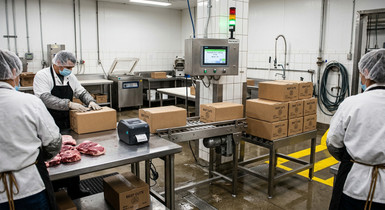
Posted by Automation Distribution Staff on Nov 17th 2026
Beef Processing Traceability: An Upgradable Automation Path for Small Plants
Beef processing traceability is no longer a big-packer problem. A 2026 Class I recall of roughly 29,628 lbs of imported Argentine beef that entered U.S. commerce without required FSIS reinspection, new "Product of USA" labeling rules, and federal and state money aimed at independent processors have put lot tracking, label accuracy, and digital records on the agenda for small and very small beef plants across Pennsylvania, the Mid-Atlantic, and the Northeast.
What is beef processing traceability automation?
Beef processing traceability automation is the use of sensors, controllers, barcode scanning, and machine vision to record where each lot of product came from, confirm it was cleared before use, and verify that every label matches the lot record before a case ships. It replaces clipboards, memory, and one person's diligence with records and interlocks that work the same way every shift.
For a small plant, the goal is not a full MES. The goal is answering three questions in minutes instead of hours: Where did this lot come from? Where did it go? Does every label on it tell the truth?
Why are small beef processors looking at traceability now?
Because the risk landscape changed in 2026, and most of it lands on process control, not contamination.
- The Argentine beef recall was a documentation failure. Product bypassed import reinspection and still reached retailers and distributors. No illnesses were reported, but FSIS classified it Class I. A paperwork step alone did not stop it.
- "Product of USA" now means born, raised, slaughtered, and processed in the U.S. The revised FSIS voluntary labeling standard took effect January 1, 2026. One lot of purchased or imported trim mixed into a domestic run can invalidate the claim.
- Mandatory country-of-origin labeling is back in discussion. A September 2026 executive order directed USDA to consider mandatory COOL for beef.
- Buyers are asking for it. Grocers, distributors, and institutional buyers increasingly want lot-level traceback before they sign.
- Funding is flowing to independents. USDA's $500 million SPUR program, USDA Rural Development's Meat and Poultry Processing Expansion Program, and state programs such as Pennsylvania's Very Small Meat and Poultry Processor Reimbursement Grant all target small and midsize processors.
One clarification matters: the FDA's FSMA 204 traceability rule does not cover USDA-regulated beef. Traceability automation is not a new federal mandate for meat plants. It is recall-cost insurance, origin-claim protection, and a requirement many customers already impose.
What pain points does traceability automation solve in a small beef plant?
The daily pain shows up long before an inspector or a recall does. These are the ones plant managers describe most often.
| Pain point | What it looks like on the floor | Automated fix |
|---|---|---|
| Manual lot entry | Lot numbers keyed by hand at receiving and packout; one typo breaks the trail | Scan-based lot capture and lot-tracking software |
| Slow traceback | A mock recall takes hours of digging through logs and paper | Lot records searchable in minutes |
| Broad recall scope | Without precise lot data, a recall covers a full day or week of production | Lot-level records that narrow the recall to what was actually affected |
| Label mistakes | Wrong lot or origin label applied, reprints, misbranding risk | Fixed industrial scanning and OCR label verification |
| Receiving depends on one person | When the receiving clerk is out, product moves into production unchecked | Receiving hold/release interlock with visual status |
| Packout bottleneck | Hand-scanning every case slows packout as volume grows | Fixed scanners reading cases in motion |
| Paper HACCP temperature logs | Missed readings, late entries, and records that are hard to review | IO-Link temperature sensing with automatic logging and alarms |
How does an upgradable traceability package work?
It starts small and grows on the same hardware. Most very small plants cannot justify a custom engineering project, and they should not have to rip anything out when they are ready for more. Automation Distribution structures the package in two stages built on one control platform, so every component bought in Stage 1 is still in service after the Stage 2 upgrade.

Stage 1: Digital records and lot-ready labels
Stage 1 replaces paper temperature logs and sets up the data structure for traceability without changing the production line. It is sized to fit the budgets very small processors typically work with.
- Cooler and processing-room temperature monitoring: Turck temperature sensors and transmitters, such as the Turck TS720-LI2UPN8-H1141 processor unit with a 316L stainless housing, analog output, switching outputs, and IO-Link.
- Washdown-rated I/O: The Turck TBEN-L5-8IOL (6814017) multiprotocol block module provides 8 IO-Link master channels in a fully potted IP65/IP67/IP69K housing rated for washdown, with PROFINET, EtherNet/IP, and Modbus TCP support.
- Control, display, and data logging: A Horner Automation XL10 Prime HE-XPV1E6-602 all-in-one PLC/HMI with a 10.4 in display, universal analog inputs that accept RTDs and thermocouples, dual Ethernet, and microSD storage for HACCP record logging. For tighter spaces, the 7 in Horner XL7 Prime HE-XPW1E6 runs the same Cscape application and supports browser-based WebMI screens.
- Enclosure with room to grow: A non-metallic, NEMA 4X-rated Fibox ARCA AR181610CHSC polycarbonate enclosure (18 x 16 x 10 in), specified with spare DIN rail space for Stage 2 hardware.
- Lot-ready labeling: A handheld barcode scanner at receiving and an industrial thermal label printer at packout. Every label carries lot and origin fields from day one, in a format a Stage 2 scanner can verify.
- Temperature alarm signaling: A Patlite LU7-02 70 mm modular signal tower, rated IP66 and Type 4/4X/13 for wet and washdown areas.
Stage 1 also starts tracking the numbers that matter later: manual lot entries per week, label reprints, and how long a mock recall takes. Those numbers show a plant exactly where Stage 2 pays off.
Stage 2: Verified traceability, added one module at a time
Stage 2 automates the lot and label process Stage 1 already put in place. It is split into modules so a plant can add one per budget cycle or grant round instead of facing a single large upgrade.
- Receiving hold/release station. Incoming lots are scanned and checked for clearance before they can move into production. A Turck TBIL-M1-16DXP IO-Link I/O hub (IP67/IP69K) connects dock-side inputs and outputs to the existing IO-Link master, and a Patlite signal tower shows hold, cleared, or quarantine status at the dock.
- Label verification station. A Zebra fixed industrial scanner reads every case label and checks lot and origin data against the lot record before the case leaves. The Zebra FS40 Fixed Industrial Scanner handles high-speed barcode track-and-trace. The Zebra FS42 Fixed Industrial Scanner adds the processing power for deep-learning OCR through a software license upgrade, so it can read printed origin text as well as barcodes. Both are configured in Zebra Aurora Focus.
- Lot-tracking software. Replaces manual lot logs with an automated record from receiving through shipping, so traceback becomes a search instead of a project.
- Conveyor integration. Interlocks physically stop product that has not been cleared or has failed label verification. This is the most site-specific module and usually the last one added.

Why build on one platform instead of buying point solutions?
Because standalone tools strand the investment. A battery-powered wireless temperature logger solves today's HACCP problem but cannot trigger a hold, feed a lot record, or talk to a label verification station. Building Stage 1 on IO-Link sensors, an industrial Ethernet I/O block, and a programmable PLC/HMI means the Stage 2 modules plug into what is already installed.
- One controller family: The Horner XL Prime line shares the Cscape programming environment across display sizes, so the Stage 1 application carries forward.
- One sensor and I/O family: Turck IO-Link devices, masters, and hubs share the same M12 connectivity and washdown ratings.
- One label format: Labels printed in Stage 1 are designed for Stage 2 verification, so no relabeling project is needed.
- One enclosure: Stage 2 hardware mounts in the spare rail space specified in Stage 1.
Frequently asked questions
Is lot traceability required for USDA-inspected beef plants?
FSIS requires HACCP records and recall procedures, but the FDA's FSMA 204 traceability rule does not apply to USDA-regulated beef. Most small plants adopt automated lot traceability to narrow recall scope, protect origin claims, and meet customer requirements rather than to satisfy a new mandate.
How does label verification protect a "Product of USA" claim?
A fixed industrial scanner such as the Zebra FS42 reads each case label and compares the lot and origin data to the lot record. If a case from a lot that does not qualify carries a "Product of USA" label, the system flags or stops it before it ships.
Can temperature sensors survive daily washdown in a meat plant?
Yes, when the sensing and I/O are specified for it. Stainless-housed sensors such as the Turck TS720-LI2UPN8-H1141, paired with IP69K-rated I/O like the Turck TBEN-L5-8IOL, are built for high-pressure, high-temperature cleaning environments.
Do I have to buy Stage 2 all at once?
No. Stage 2 is split into four modules (receiving hold/release, label verification, lot-tracking software, and conveyor integration) that can be added in any order. Each one connects to the Horner Automation controller and Turck I/O installed in Stage 1.
Can grant funding cover traceability equipment?
Many processor grant programs cover equipment purchases for expansion, food safety, and inspection readiness, including state programs in Pennsylvania and New York and USDA's Meat and Poultry Processing Expansion Program. Eligibility, deadlines, and allowable costs vary by program, so confirm the current rules with the administering agency before applying.
Automation Distribution is an authorized distributor of Turck, Horner Automation, Zebra Technologies, Patlite, and Fibox, serving independent processors across Pennsylvania, the Mid-Atlantic, and the Northeast. Browse controllers and operator interfaces, explore Zebra fixed industrial scanning and machine vision, or call 1-888-600-3080 to scope a Stage 1 or Stage 2 package for your plant.