
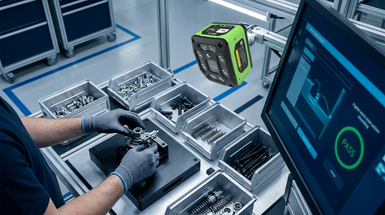
Posted by Automation Distribution Staff on Jul 6th 2026
Error-Proofing Work Cell Assembly with Zebra Vision
Error-proofing work cell assembly means confirming that every correct component was installed and the assembly is complete before it moves to the next stage — not discovering the miss at end-of-line test. Manual verification scans and visual checks are exactly where human error creeps in, and automating those steps has become one of the highest-return quality investments on the plant floor.
Why Is Assembly Verification a Bottleneck?
In most work cells, verification is still a manual discipline: the operator scans each component against the production order as it is installed, then performs a final quality check before the assembly moves on. Every one of those manual steps is a chance for human error — a skipped scan, a lookalike component, a check performed from memory under quota pressure — and each one slows throughput on the floor.
When an incorrect assembly slips through, the cost compounds downstream: rework or scrap, lost revenue, and customer dissatisfaction when the escape reaches the field. Manual-only oversight also caps how far the operation can scale — adding volume just adds more opportunities for the same errors. The fix is not more inspectors; it is automating the verification steps themselves.
How Does an Error-Proofed Work Cell Actually Work?
The automated verification workflow Zebra outlines for work cell assembly has three coordinated layers, each answering a different question:
1. Capture component data at the point of installation
Each component is scanned as it is installed and verified instantly against the production order. In manual cells this is typically a rugged handheld scanner in the operator's hand — Zebra's DS3600 Series covers high-density barcodes on small subcomponents and laser-etched direct part marks (DPM) on machined parts, so the worker verifies without breaking rhythm at the workstation. In hands-free or higher-throughput cells, the same verification point can be a fixed-mount device: the Zebra FS40 fixed industrial scanner decodes challenging DPM codes with integrated autofocus optics, and the C-mount Zebra FS70 handles long working distances, very small codes, and large parts.
2. Guide the operator with visual work instructions
A workstation tablet or display anchors the cell as the reference point for the build. It presents the digital production order and step-by-step visual instructions, confirms each component scan as it lands, and shows overall assembly progress — so the operator always knows the required steps are executing in the proper sequence rather than relying on memory or paper travelers. Guided workflow is the layer that prevents sequence errors before they happen; scanning verifies the part, the instruction layer verifies the process.
3. Finalize quality checks automatically with smart vision
The last manual step to fall is the final visual inspection. The Zebra NS42 smart vision sensor performs the assembly and quality verification automatically: its anomaly detection tools compare the completed assembly's image against a reference standard and flag any deviation — a missing clip, an unseated connector, a wrong-orientation component — before the unit moves down the line. The NS42 runs deep learning tools including anomaly detection and deep learning OCR on its own onboard processing, managed through the Zebra Aurora Focus software platform, replacing the slow, costly manual final inspection with a repeatable automated gate.
What Does Automated Verification Deliver?
Three outcomes follow directly from replacing manual inspection with automated verification. Quality management improves because every assembly passes the same objective gates — component identity confirmed at installation, sequence confirmed by the guided workflow, and completeness confirmed by anomaly detection. Traceability improves because every scan writes the component identifier against the production order, building a serialized record that supports targeted recalls and compliance documentation instead of batch-wide quarantines. And production efficiency improves because the verification steps that used to bottleneck the cell now run at the speed of the work itself, letting the operation scale without scaling its error rate.
Building the Cell: Zebra Machine Vision Hardware by Function
Automation Distribution carries the Zebra Fixed Industrial Scanning and Machine Vision portfolio that anchors the automated layers of this workflow:
- Automated final assembly verification: the NS42 smart vision sensor with anomaly detection and essential machine vision tools, PoE, and EtherNet/IP, PROFINET, and Modbus TCP industrial protocol support for direct PLC integration.
- Fixed-mount component verification: the FS40 for DPM and 1D/2D decoding with integrated optics; the FS42 when throughput or deep learning OCR demands its quad-core processor and onboard NPU.
- Engineered optics for difficult inspections: the C-mount FS70 fixed industrial scanner and VS70 machine vision smart camera, with lensing and illumination matched to the feature under inspection via our Zebra lensing, lighting, and accessories selection.
- 3D verification — seated height, flushness, gap: where a 2D image cannot confirm the condition, the Zebra AltiZ 3D profile sensor adds profile and point-cloud measurement.
All of these devices run on the same Zebra Aurora software platform, so one toolchain configures and manages every automated verification point in the cell. Zebra's DS3600 Series ultra-rugged handhelds and workstation tablets complete the operator-facing side of the workflow — contact our team to spec the full cell.
Frequently Asked Questions
What is anomaly detection in assembly verification?
Anomaly detection is a deep learning inspection tool that compares an image of the completed assembly against a known-good reference standard and flags deviations — missing, misplaced, or wrong components — without requiring a rule to be written for every possible defect. On the Zebra NS42, anomaly detection runs on the sensor's own processing hardware and is configured through Zebra Aurora Focus.
Should component verification use a handheld or fixed-mount scanner?
Handhelds like Zebra's DS3600 Series fit manual cells where the operator moves between bins, fixtures, and orientations. Fixed-mount scanners like the FS40 fit hands-free presentation points, higher line rates, and cells where the scan result gates the process through the PLC. Many cells combine both: handheld at the pick, fixed-mount at the fixture.
Can these devices read direct part marks on machined components?
Yes. DPM-rated decoder options on the FS40, FS42, and FS70 handle laser-etched and dot-peened Data Matrix codes, and Zebra's DPM handhelds cover the operator-side equivalent. On curved, oily, or low-contrast surfaces, controlled illumination is the deciding factor — our team can spec optics and lighting against sample parts before you commit.
How does automated verification improve traceability?
Every component scan is verified and recorded against the production order, building a serialized record of exactly which parts went into each assembly. If a defective component lot surfaces later, the recall targets the affected serial numbers instead of quarantining entire batches — and the same records serve customer and regulatory documentation requirements.
How does the vision sensor connect to the work cell PLC?
The NS42 and Zebra's FS-series scanners support EtherNet/IP, PROFINET, and Modbus TCP alongside Ethernet with PoE, serial, and USB, so pass/fail results can gate downstream operations — enabling a torque tool, releasing a transfer, or triggering a reject — within your existing controls architecture.
Spec Your Error-Proofed Work Cell
Automation Distribution is an authorized Zebra Technologies distributor for the Fixed Industrial Scanning and Machine Vision portfolio — smart vision sensors, fixed scanners, 3D sensors, software licenses, lensing, and lighting. Browse the lineup on our Zebra Technologies brand page and machine vision category, or call 1-888-600-3080 to walk through your cell layout, component marks, and inspection requirements with our team.