
Posted by Automation Distribution Staff on May 20th 2026
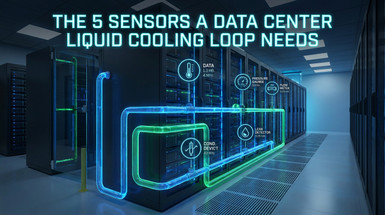
The 5 Sensors a Data Center Liquid Cooling Loop Needs
Inside the CDU: The Five Sensor Measurements That Determine Whether Your Liquid Cooling System Survives
A modern AI GPU dissipates more than 1,000 watts. The sensors inside the coolant distribution unit moving heat away from it are the difference between a stable cluster and a six-figure outage. Here's what those sensors actually measure, why each one matters, and where most cooling specifications get them wrong.
Liquid cooling has gone from optional to mandatory in any data center running AI or HPC workloads at scale. The reasons are physical: a single Blackwell-class GPU produces five to seven times the thermal load of a previous-generation server CPU, and the density of GPUs per rack has climbed in lockstep. Air cooling, no matter how aggressively engineered, hits a hard ceiling around 30 kW per rack. Above that, you either liquid-cool or you derate.
The two production architectures — direct-to-chip (D2C) cold plates and full-server immersion in dielectric fluid — both depend on a coolant distribution unit (CDU) that pumps fluid through the IT load and rejects heat to a building-side loop. The CDU is mechanically simple. The sensing and control inside it is not.
There are five process measurements every well-specified liquid cooling loop monitors continuously. Get all five right and the system runs predictably for years. Get any one of them wrong and you're one component failure away from a coolant breach over millions of dollars of compute hardware. The rest of this article walks through each measurement, what it's actually doing in the loop, and what experienced specifying engineers look for when they review a build.
1. Flow rate
What it does: Verifies coolant is actually moving through each cold plate manifold at the design flow rate, typically expressed in liters per minute per rack or per cold plate group.
What fails when it's missing: Flow loss is the earliest detectable failure mode in a cooling loop. A pump can degrade for weeks before it fails outright, a filter can clog progressively, an air pocket can form after maintenance — all of which show up as a flow-rate decline long before they show up as a temperature alarm. By the time the GPU thermal throttling kicks in, you've already lost compute performance and possibly damaged components.
Where specifications go wrong: Flow sensors are often specified only at the CDU primary loop and not at the rack manifold level. A central flow reading tells you the system is moving fluid; it doesn't tell you whether a specific rack's cold plates are seeing design flow. For high-density installations, distributed flow sensing at the manifold level is worth the extra hardware.
For water-glycol coolant loops typical of D2C builds, inline magnetic-inductive or ultrasonic flow sensors give the response speed needed for closed-loop control. Baumer, Turck, and SMC all manufacture sensor families that drop into 1/2" and 3/4" CDU plumbing without requiring custom adapters.
2. Pressure
What it does: Two distinct jobs. Absolute or gauge pressure protects the loop from overpressure conditions that can rupture quick-disconnects or damage cold plates. Differential pressure across filters and across the supply-and-return loop drives both filter-change scheduling and pump performance diagnostics.
What fails when it's missing: A pressure spike during a valve closure or a pump startup transient can exceed the rated pressure of cold plate quick-disconnects, which are typically the weakest link in the mechanical loop. Without overpressure detection and automated relief logic, a single transient can produce a slow leak that doesn't show up until hours later — by which point coolant has been dripping onto rack hardware. On the other side, missing differential pressure on a filter means the filter clogs progressively until flow drops enough to trip the flow alarm, which is later than the filter should have been changed.
Where specifications go wrong: Specifying only single-point gauge pressure and not differential pressure across maintenance items. Differential pressure transmitters are slightly more expensive but they replace a guess ("the filter is probably due for a change") with a measurement ("the differential has crossed the change threshold").
Pressure transmitters for cooling-loop service should be rated for the actual fluid chemistry (propylene glycol blends are mildly corrosive to some sensor wetted parts), should have a turndown ratio appropriate to the operating range, and should output 4-20 mA or IO-Link for clean integration with the controller running the loop. Both Baumer and Turck make pressure transmitter lines specifically targeted at hydronic cooling applications.
3. Temperature
What it does: Supply and return temperatures across the CDU are the primary control-loop feedback for the cooling system. Delta-T (supply minus return) is also the direct measurement of how much heat the loop is removing — which is what gets reported to the DCIM as cooling capacity and rolls up into the facility's PUE calculation.
What fails when it's missing: Without supply temperature, the CDU can't modulate to changing IT load. Without return temperature, you have no measurement of heat capture and no way to detect a fouling cold plate or a degraded thermal interface material at the GPU. Without rack-level temperature, you can't identify which row or cabinet is running hot.
Where specifications go wrong: RTD selection. Pt100 and Pt1000 RTDs are the default for cooling-loop temperature, but the Class B accuracy that's adequate for HVAC isn't tight enough for delta-T measurements where the supply-return difference may only be 6-10°C. For accurate heat-rejection accounting, Class A or 1/3 DIN RTDs are worth the upgrade.
Temperature sensors for liquid cooling should be inline or thermowell-mounted (not surface-mount) for response time, should match the rest of the loop's wetted-material specification, and should integrate directly with the loop controller for fast PID response.
4. Conductivity
What it does: Measures the electrical conductivity of the coolant itself, in microsiemens per centimeter. For propylene glycol-water blends typical of D2C systems, fresh coolant should be in a tight band; rising conductivity indicates contamination, ion leaching from system materials, or coolant chemistry breakdown.
What fails when it's missing: This is the measurement most often left out of cooling specifications, and it's also the one with the most catastrophic failure mode. Conductive coolant in proximity to energized hardware is a short-circuit waiting for the next quick-disconnect to weep. Conductivity drift is usually slow — over weeks or months — which is exactly why a continuous measurement matters: nobody is going to catch it by spot-checking samples.
Where specifications go wrong: Treating conductivity as a "nice to have" rather than a mandatory measurement, or specifying handheld spot-check meters instead of inline continuous monitoring. Hyperscalers building AI clusters at scale are converging on inline conductivity as a required measurement, not optional.
Conductivity sensors require periodic cleaning and calibration, and the better cooling-loop installations include a bypass loop with isolation valves to allow inline sensor service without taking the main loop offline.
5. Leak detection
What it does: Detects the physical presence of coolant where it shouldn't be — under racks, in drip trays at manifold connections, along piping runs, under the CDU itself. Two dominant technologies: conductive sense cables that trip when liquid bridges parallel conductors, and optical/photoelectric point sensors that detect liquid presence regardless of fluid conductivity.
What fails when it's missing: The failure mode here is obvious — undetected coolant accumulation under or around energized IT hardware. The non-obvious failure is using a conductive-cable detection method on a dielectric immersion fluid, which won't trigger because the fluid is intentionally non-conductive. Sensor technology has to match the coolant chemistry.
Where specifications go wrong: Point sensors only, with no distributed sensing along piping. A point sensor at the CDU catches a CDU leak; it doesn't catch a slow weep at a quick-disconnect three racks over. Best-practice installations combine distributed conductive or optical sense cable along piping with point sensors at every manifold connection and under every cabinet.
Baumer's FODK photoelectric leakage sensors and FFAK liquid level sensors handle both conductive and non-conductive coolant chemistries, which matters because the same data center may run water-glycol on D2C cooling and dielectric fluid on an immersion tank in the same hall.
Leak detection also has to drive an operator response — which is where signaling comes in. A leak alarm that only fires on a DCIM dashboard isn't enough; the operator in the hot aisle needs to see a visible alarm at the affected CDU or rack location. Patlite LR-series signal towers are the standard for this kind of location-specific operator signaling, with IP65 protection appropriate for the data hall environment.
How the five measurements connect to the rest of the control system
Sensors are useful only when their data reaches a controller that can act on it. The standard architecture for new-build CDUs in North America runs the five measurements into a programmable controller — most commonly the WAGO 750-8214 PFC200 for installations that need to talk to both the BMS (typically BACnet/IP or Modbus TCP) and legacy chiller hardware (often serial or CANopen).
The controller's job is to take the sensor data, run the cooling control logic, drive the variable-frequency pumps and modulating valves, push telemetry to the DCIM, and trigger local alarm signaling when any measurement exits its safe band. The network connecting all of this needs to be deterministic and ideally segmented from the IT network — see our guide to selecting industrial Ethernet switches for the WAGO 852-series options that handle this layer.
The full picture — sensors, controllers, network, signaling — is laid out on our data center liquid cooling components page, including the typical brand pairings for each layer.
Frequently asked questions
What's the difference between sensor specifications for direct-to-chip vs. immersion cooling?
The parameters measured are largely the same — flow, pressure, temperature, conductivity, leak — but the form factors, wetted materials, and detection methods change significantly. D2C systems use water-glycol blends at moderate flow rates and benefit from compact inline sensors with brass or stainless wetted parts. Immersion systems use dielectric fluids (single-phase or two-phase) and require sensors compatible with the specific fluid chemistry. Conductivity sensing also changes role: in D2C it monitors coolant degradation; in single-phase immersion the fluid is intentionally non-conductive, so the measurement focuses on contamination ingress rather than baseline conductivity drift. Confirm fluid compatibility on every sensor model before ordering.
Is conductivity monitoring really required, or is it optional?
For propylene glycol-water cooling loops in D2C installations, conductivity monitoring is rapidly becoming a requirement rather than a recommendation, particularly on hyperscale AI deployments. The failure mode it protects against — conductive coolant in proximity to energized GPUs — is catastrophic enough that the cost of inline monitoring is trivial relative to the risk. For smaller D2C installations and for single-phase immersion, periodic sample testing may be acceptable, but most experienced specifying engineers now include inline conductivity as standard.
How do these five measurements integrate with the building management system?
In a typical architecture, the sensors connect to a cooling-loop controller (the WAGO 750-8214 PFC200 or equivalent) which runs the closed-loop control. The controller exposes the sensor data and computed values (delta-T, heat rejection, alarm states) to the BMS over BACnet/IP or Modbus TCP, and to the DCIM through MQTT or OPC UA. Best practice is to keep the cooling control LAN physically or logically segmented from the IT production network — the cooling system should function even if the IT network is offline.
Can Automation Distribution support a multi-MW cooling build?
Yes. We supply the sensor, controller, I/O, signaling, and pneumatic hardware specified by MEP firms and CDU OEMs on projects ranging from single-CDU retrofits to full hyperscale deployments. The typical engagement is consolidated invoicing across Baumer, WAGO, Patlite, SMC, and Turck on a single PO, with project-level lead-time management and authorized factory support on every brand.
Specifying a liquid cooling build?
Send us your instrument list, P&ID, or rough scope. Our engineering team will cross-reference part numbers across Baumer, WAGO, Patlite, SMC, and Turck, confirm availability, and quote the full bill of materials on a single PO. See the full data center liquid cooling components page for the typical brand pairings at each layer of the system.
Request a Quote Call 1-888-600-3080