
Mar 10th 2026
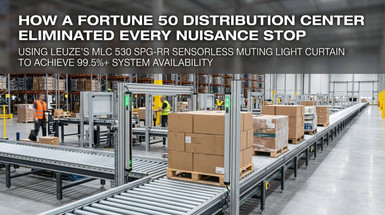
How a Fortune 50 Distribution Center Eliminated Every Nuisance Stop
Case Study · Safety Sensors
In high-throughput distribution environments, every unplanned stoppage costs money. When a Fortune 50 consumer goods company operating a large Midwest distribution center found itself dealing with daily nuisance stops on its outbound packaging conveyor lines, the team knew they had a problem — not a safety problem, but an efficiency one caused by their own safety hardware.
The Problem: Safety Sensors Working Against Production
The facility's outbound packaging zone relied on conventional safety light curtains with traditional muting — a widely used approach that uses external sensors to temporarily bridge the protective field as a pallet passes through. In theory, it's straightforward. In practice, the real world isn't that tidy.
Three culprits kept triggering false stops day after day: stretch-wrap film tails extending past the pallet's edge, partially loose barcode labels that protruded beyond the load, and vibration-induced drift in the positions of the muting sensors themselves. Each false trigger meant production halted, an operator had to physically intervene, perform a manual reset, and restart the line. This fault type had become the facility's single most frequent production interruption.
"The new light curtains have completely changed the performance of our outbound loading — we've eliminated all the nuisance errors. We'll be installing these on the expansion equipment and sharing the results with other company sites. Great improvement!"
— Facility Representative, Fortune 50 Consumer Goods Distribution Center
The Solution: Sensorless Muting with Smart Process Gating
System integrator Han-Tek brought in Leuze's answer to the problem: the patented, TÜV-certified MLC 530 SPG-RR safety light curtain. The key innovation is what the name says — sensorless muting. There are no external muting sensors to mount, align, or drift out of position over time.
The SPG (Smart Process Gating) architecture replaces external trigger sensors entirely, while the RR (Reduced Resolution) variant adds an extra layer of intelligence: it actively filters transient interruptions from stretch-wrap film tails, separator papers, cardboard flaps, and similar incidental materials that would cause a traditional system to fault. The curtain understands the difference between a nuisance and a hazard.
Han-Tek integrated the system into the facility's existing PLC logic, ensuring full safety compliance was maintained throughout. Pallets now move continuously through the safety field without triggering false shutdowns — while genuine access by personnel is still immediately detected and stopped.
How Smart Process Gating Works
Traditional muting relies on external sensors to "vote" on when a pallet is present. SPG takes a fundamentally different approach, using two independent signals that must occur together before the protective field is bridged:
|
CS — Control Signal Sent by the PLC when the transport system signals that a load is approaching the guarded zone. No physical sensor required. |
PFI — Protective Field Interruption Generated automatically when the light curtain itself detects the physical object breaking the beam — a real, present pallet, not a ghost signal. |
Both signals must align for gating to activate. The result is a system that cannot be accidentally bypassed by materials, vibration, or sensor drift — and cannot be intentionally defeated by an operator attempting to reach into the hazard zone.
Results: From #1 Fault to Zero Faults
Following installation, the impact was unambiguous. What had been the single most frequent fault type at the facility was completely eliminated:
The outcome was significant enough that the facility standardized the Leuze SPG light curtain for all future expansion equipment and shared their findings internally with other company sites.
Key Advantages at a Glance
|
Sensorless Design No external muting sensors, brackets, or wiring to install or maintain. |
RR Nuisance Filtering The Reduced Resolution variant ignores films, flaps, and papers that fool traditional systems. |
Certified Safety Type 4 / PL e / SIL 3 — the highest safety rating for light curtain applications. |
|
Compact Footprint Simplified machine layout — fewer components, less wiring, cleaner integration. |
Low Maintenance No sensor realignment or field calibration ever needed after installation. |
PLC Compatible Works with your existing control architecture — no safety controller replacement required. |
Why This Matters for Your Operation
If your facility runs pallet conveyor systems with muting-based safety light curtains and you're experiencing recurring nuisance stops, the root cause is almost always the same: traditional muting hardware is sensitive to the unpredictable reality of real production loads. Stretch wrap never lands perfectly. Labels sometimes curl. Vibration happens.
Leuze's SPG architecture was designed with exactly this reality in mind. By removing external muting sensors from the equation and building intelligent signal filtering directly into the curtain, it trades fragility for robustness — without sacrificing the Type 4 / SIL 3 safety certification that your application demands.
For distribution centers, packaging lines, and automated material handling systems, this translates directly to higher throughput, lower maintenance burden, and operator teams who can focus on running the line rather than clearing faults.
|
Shop Leuze MLC 530 SPG Light Curtains Available now at Automation Distribution — multiple protective field heights and resolutions in stock.
|
||||||