
Posted by Automation Distribution Staff on Jul 1st 2026
MTConnect & WAGO: Get Data Off Shop-Floor Machines
Most of the machines on a shop floor already generate the data a plant wants - cycle counts, run states, spindle speeds, fault codes, energy draw. The problem is that on older or standalone equipment, that data never leaves the machine. It sits in a closed controller with no path to a dashboard, an MES, or the cloud. In North American manufacturing, MTConnect is the standard built to get it out, and WAGO's PFC controllers and I/O are a practical way to do the extraction.
What is MTConnect?
MTConnect is an open, royalty-free standard for retrieving data from manufacturing equipment. Established in 2006 out of the machine-tool industry, it gives disparate machines from different vendors a common vocabulary and a common way to publish their data - so a monitoring application can read a Haas, a Mazak, and a custom-built cell through one consistent interface instead of a dozen proprietary ones.
Two characteristics define it. First, it is read-only and unidirectional: data flows from the machine up to the application, and MTConnect does not write back or control the machine. That makes it inherently safe to deploy on production equipment - you are listening, not commanding. Second, it runs on plain web technology - data is structured as XML and served over HTTP - so any application that can make an HTTP request can consume it. In the North American market, MTConnect is the dominant shop-floor monitoring standard, the rough counterpart to how OPC UA is favored across much of Europe.
How the adapter-agent model works
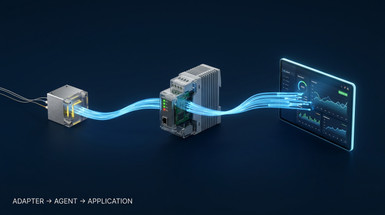
MTConnect moves data through three roles. Understanding them is the key to understanding where WAGO hardware fits.
The adapter
The adapter sits closest to the machine. It reads the machine's raw signals - digital states, analog values, register data - and translates them from their proprietary format into MTConnect's common terminology, typically as a simple pipe-delimited text stream. On a machine that exposes no native data, the adapter is also where physical signal acquisition happens: you tap the signals with I/O.
The agent
The agent takes the adapter's stream, structures it into valid MTConnect XML, and serves it over HTTP to anything that asks. The agent is the published interface - point a browser or an application at its address and you get the machine's current and historical data back in a standard format.
The application
The application is whatever consumes the agent's data - an OEE dashboard, an MES, a historian, a cloud analytics platform. This is the layer that turns raw machine signals into utilization reports, downtime tracking, and trend analysis.
MTConnect vs. OPC UA: which do you need?
This is the question most teams actually have, and the honest answer is that they solve different problems and increasingly work together.
| MTConnect | OPC UA | |
|---|---|---|
| Direction | Read-only (monitoring) | Bidirectional (read and write/control) |
| Origin / strength | Machine tools, discrete manufacturing | Process automation, broad device control |
| Regional preference | North America | Europe (and growing globally) |
| Best for | OEE, utilization, downtime monitoring | Closed-loop control, device interoperability |
If your goal is to monitor what your machines are doing - uptime, throughput, energy - MTConnect is the lighter, safer, North-American-standard choice. If you need to read and write, integrate at the control layer, or interoperate broadly across device types, OPC UA is the tool. A growing number of plants run both, and the two standards are formally bridged by an MTConnect-OPC UA companion specification. The practical takeaway: pick your data-acquisition hardware so it can speak both, and you are not locked into one strategy.
Where WAGO fits: the data-acquisition layer
WAGO's role in an MTConnect deployment is the layer that does the physical work - capturing the machine's signals and running the adapter and agent. The reason it works cleanly is the architecture of the WAGO PFC controllers: they run a real-time-capable Linux operating system. Because the MTConnect agent source code is freely available for Linux, the agent function runs directly on the controller, and the adapter is implemented as a function block in CODESYS, configured through the controller's web-based management. WAGO is a listed MTConnect integrator, and offers a preconfigured MTConnect interface for the PFC100 so that machine data - signal-tower states, energy consumption, motor speeds and the like - can be brought online without writing the agent from scratch.
Capturing the machine signals
On a closed machine, you tap the signals you can reach with modular I/O. WAGO's 750-series slice I/O gives you a module for nearly any signal type: a WAGO 750-430 8-channel digital input module for run/idle/fault states and cycle pulses, a WAGO 750-467 analog input module for 0-10 V sensor signals, and a WAGO 750-498 thermocouple input module for process and motor temperatures. The modules snap onto the same DIN-rail node as the controller, and their values land directly in the controller's process image.
Capturing energy and power data
Energy is one of the highest-value data points to pull off a machine, both for cost and for predictive maintenance - a rising power draw often signals a developing mechanical problem. The WAGO 750-494 3-phase power measurement module (480 VAC, 5 A) and the higher-voltage WAGO 750-495 (690 VAC) capture line-to-line voltage, current, real/reactive/apparent power, power factor, frequency, and harmonic analysis - and feed it all into the same data stream as the machine's discrete signals. For retrofits on existing circuits, the WAGO 750-494/000-005 power measurement module works with external shunts.
Running the adapter and agent
The captured signals run on a WAGO controller. The compact WAGO PFC100 controller is the cost-optimized, Ethernet-focused option that WAGO built its MTConnect interface around; an extended-temperature PFC100 variant handles harsher machine environments. For higher performance, more interfaces, or remote sites, the WAGO PFC200 controller family steps up to a 1 GHz CPU with serial, CAN, fiber, and cellular options. Both controller families run Embedded Linux, carry an onboard firewall and OpenVPN/IPsec, and speak MQTT and OPC UA in addition to hosting an MTConnect agent - so one hardware layer covers monitoring today and control-layer integration later.
Frequently asked questions
What is MTConnect in simple terms?
MTConnect is an open, royalty-free standard that lets manufacturing machines publish their data - run state, cycle counts, speeds, faults, energy - in a common format over standard web protocols (XML over HTTP). It is read-only, so it monitors machines without controlling them, and it is the dominant shop-floor data standard in North American manufacturing.
What is the difference between an MTConnect adapter and agent?
The adapter reads the machine's raw signals and translates them into MTConnect terms (often a pipe-delimited text stream); the agent takes that stream, formats it as valid MTConnect XML, and serves it over HTTP to applications. On a WAGO PFC100 controller, both run on the controller's Linux OS.
Can I use MTConnect on an old machine with no network connection?
Yes - that is the most common use case. Where a machine exposes no native data, you acquire the signals physically with modular I/O (digital, analog, power measurement) into a controller that runs the adapter and agent. A WAGO controller plus a stack of 750-series I/O turns a closed machine into an MTConnect data source.
MTConnect or OPC UA - can I run both?
Yes. MTConnect is best for read-only machine monitoring; OPC UA adds bidirectional control-layer integration. The two are bridged by a companion specification, and WAGO PFC200 controllers support OPC UA and MQTT alongside an MTConnect agent, so a single hardware platform covers both strategies.
Why capture machine energy data?
Energy data drives two outcomes: lower cost through visibility into consumption, and earlier fault detection, since an abnormal power draw frequently precedes a mechanical failure. A WAGO 750-494 power measurement module captures it at the machine and feeds it into the same data stream as run states and cycle counts.
Turn your machines into data sources with Automation Distribution
Automation Distribution is an authorized distributor of WAGO automation and connectivity products. Build your shop-floor data layer with a WAGO PFC100 or PFC200 controller, the 750-series I/O to match your signals, and the 750-494 power measurement module for energy. Call 1-888-600-3080 to scope a machine-monitoring or MTConnect project and match controllers, I/O, and power measurement to your equipment.