
Posted by Automation Distribution Staff on Apr 1st 2026
Stop Overpaying Carriers: How Package Dimensioning Scan Tunnels Eliminate DIM Weight Errors
If your warehouse or fulfillment operation is still measuring packages manually — or not measuring them at all — your carriers are almost certainly billing you more than they should. Not occasionally. On every shipment where your declared dimensions don't match what actually went out the door. Dimensional weight pricing means carriers charge based on whichever is higher: the actual weight of the package, or the space it occupies. At low volumes that gap is manageable. At hundreds or thousands of shipments per day, a single inch of measurement error repeated across your entire outbound flow becomes a structural cost leak that shows up on every invoice and compounds every week. The fix is not more careful manual measuring. The fix is removing the human from the measurement process entirely. That's what package dimensioning scan tunnels do — and if you haven't evaluated them recently, the technology and the price point have both moved significantly in your favor.
Is This Problem Affecting Your Operation?
You're a strong candidate for a package dimensioning scan tunnel if any of the following describe your current situation:
- Your team manually measures packages at pack stations or estimates dimensions at the time of shipping
- You regularly receive carrier invoices with weight or dimension adjustments you can't easily dispute
- Your WMS or shipping platform is calculating rates based on declared or catalog dimensions rather than verified, real-time measurements
- You process high volumes of mixed-SKU or variable-size parcels where package dimensions change frequently
- You've had freight claims denied because you couldn't document the condition or dimensions of a package at time of shipment
- Your operation is scaling — through e-commerce growth, new client accounts, or peak season volume — and manual processes are becoming a bottleneck
If two or more of those apply, the ROI case for automated dimensioning is almost certainly positive. The question is which system fits your throughput, your conveyor infrastructure, and your budget.
What Dimensional Weight Pricing Is Actually Costing You
Carriers including UPS, FedEx, and USPS calculate dimensional weight by dividing the cubic size of a package — length × width × height — by a carrier-defined DIM divisor. If that calculated weight exceeds the actual physical weight of the package, you pay the higher number. The math is unforgiving at scale. A package that measures 14 × 11 × 10 inches has a different DIM weight than one that measures 13 × 10 × 9 inches — and if your team is rounding up, estimating, or pulling dimensions from a product catalog rather than measuring the actual shipping carton, you are systematically overpaying. What makes this particularly costly is that the errors don't average out. Under-measurement and over-measurement don't cancel each other. Carrier billing algorithms always apply the higher value, so any systematic bias in your measurement process works against you. Manual measurement introduces that bias on every shift, for every packer, across every SKU. Automated dimensioning eliminates the variability. Every package gets the same measurement process, at the same accuracy, regardless of who packed it or what time of day it shipped.
How a Package Dimensioning Scan Tunnel Works
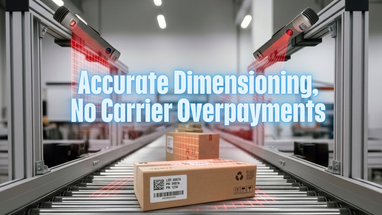
A scan tunnel is an automated, tunnel-shaped system that packages pass through on a conveyor. As each package enters, cameras, 3D sensors, and barcode readers capture data from all six faces simultaneously - top, bottom, both sides, front, and back. The system produces a complete data record for every package:
- Length, width, and height — captured by 3D sensors as the package moves through at conveyor speed
- Actual weight — captured by an inline scale integrated into the conveyor
- Barcode identity — read from any face of the package, regardless of label placement or orientation
- Surface images — timestamped photographs of the package entering and exiting the tunnel, creating a condition record for freight claims and carrier disputes
That complete record feeds directly into your WMS, TMS, or shipping platform in real time — before a label is printed, before a rate is selected, and before the package leaves your facility. For operations with carrier audit programs or parcel billing reconciliation workflows, this data trail is the difference between winning and losing a billing dispute. Without it, you are arguing against a carrier's measurement with no documentation of your own. With it, you have a timestamped, system-generated record for every shipment.
Where Scan Tunnels Are Deployed
Scan tunnels are typically positioned at the highest-value points in the package flow:
- Outbound shipping — confirming dimensions, weight, and label accuracy before a package is rated and manifested. This is where DIM weight errors are most costly and where catching them has immediate financial impact.
- Inbound receiving — automatically capturing every item received against a PO, verifying supplier packaging dimensions, and flagging discrepancies before product reaches storage. Operations that slot inventory by cube value benefit significantly from verified inbound dimensions.
- Returns processing — identifying and dimensioning returned parcels without manual handling, feeding condition and identity data into your returns management workflow.
- E-commerce and 3PL fulfillment — processing high volumes of mixed-SKU shipments at throughput rates that manual workflows cannot support, with dimension and weight data feeding client billing, carrier rate selection, and WMS slotting simultaneously.
The Zebra Aurora Velocity Scan Tunnel
Zebra Technologies is one of the most established names in logistics automation, and their Aurora Velocity scan tunnel is the current benchmark in vision-based scan tunnel systems for high-volume operations. The Aurora Velocity consolidates barcode reading, package dimensioning, damage detection, RFID capture, and weigh scale integration into a single modular platform — replacing what would otherwise require multiple separate systems with different interfaces, different maintenance contracts, and different data formats. For operations managers, the practical advantages of a unified platform are significant: One interface for exceptions — when a non-read or dimension error occurs, the Velocity platform's event capture system records video of the package entering and exiting the tunnel. Your team sees exactly what happened, where it happened, and what the package looked like — without pulling footage from a separate camera system or piecing together logs from multiple applications. Scalability without rearchitecting — the Velocity platform's modular architecture means you can add weighing, RFID, hazmat detection, or print-and-apply capabilities as your operation grows without replacing the core system. The investment you make today scales with your volume. WMS integration out of the box — dimension, weight, and barcode data flow to your WMS and shipping platform in real time, enabling automatic carrier rate selection, label printing, sortation routing, and exception queuing based on actual package data rather than declared values. Damage documentation — machine vision cameras inspect package surfaces as they pass through the tunnel, creating a timestamped image record at point of shipment. For operations that regularly face freight claims, this is a meaningful risk reduction.
Lower-Cost Entry: Building with the Zebra 4Sight EV7 and GigE Vision Cameras
Not every operation needs a full Aurora Velocity deployment on day one. For facilities that want automated dimensioning and barcode capture at a lower initial investment — with a clear path to expand — Zebra's component architecture offers a practical alternative. The Zebra 4Sight EV7 vision controller is an industrial vision controller built for demanding multi-camera environments. It supports up to four GigE Vision and four USB3 Vision camera connections, handles deep learning inference for advanced inspection tasks, and runs Zebra's Aurora software platform for application development and deployment. Its fanless design means no air filters, no cooling maintenance, and reliable operation in the kind of dusty, high-throughput environments that kill consumer-grade hardware. Paired with Zebra's CV60 series GigE Vision area scan cameras — available in resolutions from 2.3 to 12.3 megapixels — and the Zebra 3S80 3D sensor for inline dimensioning, an EV7-based scan tunnel delivers the core capabilities your operation needs:
- Six-sided barcode reading across all package faces
- Real-time length, width, and height capture at conveyor speed
- Inline weight capture via scale integration
- Image-based condition documentation
This configuration is well-matched for operations building toward future expansion, systems integrators designing custom tunnel solutions for specific conveyor footprints, and facilities adding dimensioning to existing barcode reading infrastructure without replacing it entirely.
What Happens When Scan Tunnel Data Reaches Your WMS
The financial return on scan tunnel dimensioning is multiplied when the data integrates cleanly with the systems that act on it. In a fully integrated deployment: Your shipping platform receives verified dimensions and weight before a rate is selected — eliminating the gap between declared and actual values that generates carrier adjustments. Your WMS uses certified cube data for slotting, put-away logic, and storage utilization calculations rather than relying on catalog dimensions that may not reflect actual packaging. Your carrier audit process has a complete, timestamped record for every shipment, making it possible to identify systematic overbilling patterns and dispute individual adjustments with documentation. For 3PLs and contract logistics operators, that audit trail also supports client billing accuracy — giving you the data to bill correctly and defend your numbers when clients question charges.
Purchase Zebra Scan Tunnel Systems Through Automation Distribution
Automation Distribution is an authorized Zebra Technologies dealer, carrying the full Zebra machine vision and scan tunnel portfolio — including the Aurora Velocity scan tunnel, the 4Sight EV7 vision controller, the 3S80 and 3S40 3D sensors, CV60 series GigE Vision cameras, and Aurora software licenses. We work with operations managers, logistics directors, and systems integrators to evaluate which Zebra scan tunnel configuration fits their throughput requirements, existing conveyor infrastructure, WMS environment, and budget. Whether you are building a full Aurora Velocity deployment or starting with an EV7-based component build, we can help you get to the right solution without overbuilding for where you are today. If carrier overcharges, manual measurement bottlenecks, or freight claim exposure are costing your operation money, it's worth a conversation. Contact the Automation Distribution team or browse our full Zebra product catalog to get started.
FAQ: Package Dimensioning Scan Tunnels
What is a package dimensioning scan tunnel? A package dimensioning scan tunnel is an automated system that captures the length, width, height, weight, and barcode identity of packages as they move through on a conveyor. The system delivers a complete data record for each parcel — without manual measurement, without slowing the line, and without dependence on operator accuracy.
What is dimensional weight pricing and why does it matter? Dimensional weight pricing is a carrier billing method in which billable weight is calculated from a package's physical dimensions and compared against its actual weight. The carrier charges whichever is higher. For operations shipping high volumes of variable-size parcels, even small systematic measurement errors translate into significant overbilling that compounds across every shipment.
What does DWS stand for? DWS stands for Dimensioning, Weighing, and Scanning. A DWS system captures all three data points — package dimensions, weight, and barcode identity — in a single automated pass and feeds that data to downstream WMS, TMS, and shipping platforms.
What is the Zebra Aurora Velocity scan tunnel? The Zebra Aurora Velocity is a modular, vision-based scan tunnel system that combines six-sided barcode reading, package dimensioning, damage detection, RFID capture, and weigh scale integration in a single platform. It is designed for high-volume logistics and fulfillment operations and integrates with WMS and shipping systems via a centralized software interface.
What is the Zebra 4Sight EV7 and how is it used in a scan tunnel? The 4Sight EV7 is Zebra's industrial vision controller — a fanless, multi-camera imaging computer that processes image and sensor data from GigE Vision and USB3 Vision cameras in real time. In a scan tunnel application, it handles barcode decoding, 3D dimensioning calculations, and WMS integration, and can support up to 32 cameras through two network switch ports.
Can I build a lower-cost scan tunnel using Zebra components? Yes. The Zebra 4Sight EV7 paired with CV60 series GigE Vision cameras and a 3S80 3D sensor can be configured into a cost-effective multi-camera scan tunnel that delivers dimensioning, barcode reading, and inspection capabilities. Automation Distribution can help engineer the right component build for your throughput and budget.
Is Automation Distribution an authorized Zebra distributor? Yes. Automation Distribution is an authorized Zebra Technologies dealer carrying the complete Zebra machine vision portfolio including scan tunnel systems, vision controllers, 3D sensors, machine vision cameras, and Aurora software. Browse our full Zebra catalog here.
Carrier overcharges and manual measurement errors are problems you can solve this year. Contact Automation Distribution to discuss Zebra scan tunnel solutions and get pricing on the configuration that fits your operation.