
Posted by Automation Distribution Staff on Aug 5th 2026
Zebra AI Jam Detection for Sorters | Iris GTX + Aurora
Every controls engineer who has commissioned a photoeye-based jam detection scheme on a sorter knows the same failure mode: the line stops, someone walks out to the induct, and there is nothing there. The package cleared itself two seconds after the alarm fired. Vision-based jam detection exists to solve exactly that problem - not to detect blockages, which photoeyes already do, but to tell a real mechanical jam apart from a transient one.
What is AI-powered jam detection?
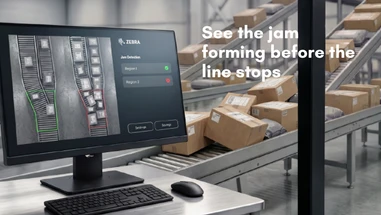
AI-powered jam detection is a machine vision application that watches a conveyor or sorter region continuously and classifies what it sees as either a true mechanical jam or a temporary, self-resolving blockage - then alarms only on the former. It replaces the binary logic of a photoeye or a light curtain ("beam blocked longer than X ms = fault") with a model that evaluates package flow in context: how many packages, what orientation, whether the pile is moving, whether the condition is clearing on its own.
In Zebra's implementation, that means an Iris GTX smart camera imaging the lane and a Zebra Aurora application doing the classification at the edge, on the camera. Zebra reports up to 30% increased throughput in outbound sorter applications where the system has replaced sensor-based jam logic. That figure is Zebra's, from their jam detection application brief, and it is worth reading as what it is: a best-case outcome on a line whose throughput was being suppressed by false-positive stoppages. If your line does not stop often, you will not see 30%.
Why photoeye-based jam detection generates false positives
The photoeye is not wrong. It is answering the question it was asked. A through-beam or diffuse sensor at a merge or a chute reports one bit: blocked or clear. The jam logic in the PLC turns that bit into a fault by adding a timer - if the beam stays blocked past the dwell threshold, call it a jam and stop the section.
That threshold is where the trouble lives. Set it tight and every slow-moving poly bag, every shingled pair of cartons, every low-friction mailer that hesitates on a curve throws an alarm. Set it loose to suppress the nuisance trips and you delay detection of the real jams - the ones that crush product and back up the induct. There is no setting that gets both, because the sensor has no way to distinguish a pile that is resolving itself from a pile that is not. It cannot see orientation. It cannot see motion. It sees a beam.
The real cost is not the stoppage. It is the labor.
A false jam alarm pulls an associate off a pick wall or a pack station and walks them to a sorter that is already running again by the time they arrive. Multiply by shift, by lane, by peak. Alert fatigue follows: when most alarms are nothing, the response time on the alarms that are something gets worse. Vision-based classification is, functionally, a labor allocation tool wearing a sensor's clothes.
How does vision-based jam detection tell a true jam from a false one?
By adding the two dimensions a photoeye does not have: spatial context and time. A camera looking down a sorter lane does not evaluate a single point - it evaluates a defined region, and it evaluates that region across frames.
Region-based monitoring, one region per lane
The application defines regions of interest over the lanes in the camera's field of view and reports state per region. On a multi-lane outbound sorter, one camera can cover several lanes, each with independent status. This matters for scaling: you are not putting a sensor and a timer block on every diverter - you are putting a camera over a zone and drawing regions in software. Adding a lane is a configuration change, not a hardware change.
Temporal context: is the pile resolving or is it stuck?
Two cartons riding skewed through a curve and two cartons wedged against a rail can look nearly identical in a single frame. Across a sequence of frames they do not. The skewed pair keeps moving; the wedged pair does not. The classifier is looking at flow, not at a snapshot, which is why it can hold a warning state on a marginal condition and only escalate to a fault if the condition persists. That is the whole game: the false jam is a condition with a resolution trajectory, and the true jam is a condition without one.
Where the processing happens
On the camera. The Iris GTX runs an Intel Atom x6211E with 4GB of memory and 32GB of eMMC storage, and ships pre-loaded with the Aurora Design Assistant run-time. The inference and the region logic execute on the device, and the device drives its outputs and its industrial protocol connection to the PLC or WCS. There is no vision PC in the loop unless you want one - which matters for a mezzanine install where you do not have a cabinet or an Ethernet drop to spare. For PC-based or multi-camera deployments, the 4Sight EV7 vision controller covers that architecture instead.

Specifying the hardware: what a jam detection cell actually consists of
Automation Distribution is an authorized Zebra Technologies distributor and carries the full machine vision and fixed industrial scanning portfolio. For a jam detection build, these are the line items.
The camera: Iris GTX
The Iris GTX is the smart camera Zebra specifies for this application. It is a C-mount, IP67-capable smart camera with embedded dual-core processing, and it is sold in a matrix of sensor resolution, color vs. monochrome, and license level (partially licensed vs. fully licensed for Aurora Design Assistant and the Aurora Imaging Library). For lane coverage, resolution is the variable that decides how many lanes one camera can hold at your working distance. Representative part numbers Automation Distribution carries:
| Part number | Sensor | Licensing |
|---|---|---|
| GTX2000 | Mono 1920x1200 | Partially licensed |
| GTX2000+ | Mono 1920x1200 | Fully licensed |
| GTX8000 | Mono 4096x2160 | Partially licensed |
| GTX8000C | Color 4096x2160 | Partially licensed |
| GTX12000C+ | Color 4096x3072 | Fully licensed |
A note on color: jam detection keys on geometry and motion, not on hue, so monochrome is usually the correct and cheaper answer. Specify color only if the same camera is being asked to do a second job - label presence, package type sortation, something where chroma carries information. Do not buy color "for future flexibility." You will pay for photosites you never use and lose sensitivity in the process.
The software: Aurora Design Assistant
Zebra Aurora is the platform layer. Aurora Design Assistant is the flowchart-based IDE - you build the application by wiring steps rather than by writing code, and you build the operator HMI in the same environment. The relevant licensing detail for a jam detection build is the Classification feature, which is what gates the AI-based classification steps. Run-time licenses are sold as feature bundles and as USB hardware keys; Automation Distribution carries both formats, including DXRTA000S3Y000U for GMF, Interface, and Classification, and the Aurora Design Assistant X run-time for MV, Codec, GMF, Interface, and Industrial Communication.
Check the license bundle against your application before you order. Cameras ship either partially or fully licensed, and the difference between "the camera arrived and we were running Monday" and "the camera arrived and we spent a week on a license amendment" is one column on a quote. Call 1-888-600-3080 and we will read the bundle against your step list.
Optics, lighting, and mounting
This is the part of the BOM that gets underestimated and then decides whether the project works. Lane coverage is a lens problem before it is a camera problem: your field of view, working distance, and mounting height determine focal length, and a mezzanine install typically means a longer working distance than anyone assumed at quote time. Overhead facility lighting varies by shift and by season, and a classifier trained under one illumination condition will drift under another - which is the argument for controlled LED bar lighting even in an application that "has plenty of light." Automation Distribution carries the full accessory line at Zebra lensing, lighting, and accessories: LGHT-series LED bar lights, Computar C-mount lenses, L-mount brackets, deflective mirrors, LENS-XIP IP67 lens covers, light control cables, and PNP/NPN GPIO breakout blocks.
If Iris GTX is not the right fit
Iris GTX is the jam detection camera because the application needs classification headroom and a wide, high-resolution field. If your requirement is narrower - a presence check, a fixed inspection at a station - the VS series is the more proportionate spec: the VS20 for compact networkable basic inspection, the VS40 for assembly-line inspection with integrated illumination options, and the VS70 for fully customizable C-mount applications. All of them run under the same Aurora software platform, which is the practical argument for staying inside the portfolio: one toolchain, one set of tribal knowledge, one training curve for the techs who inherit it.
Frequently asked questions
Does vision-based jam detection replace my photoeyes?
Not the safety-rated ones, and not necessarily the ones doing tracking or singulation. It replaces the photoeye-plus-timer logic that was being asked to make a jam/no-jam judgment call it was never suited for. Anything performing a safety function stays exactly where it is - a smart camera is not a substitute for a safety device.
How many sorter lanes can one Iris GTX cover?
It depends on resolution, lens, and mounting height, not on a fixed number. The constraint is pixels per package at your working distance: you need enough resolution across the lane for the classifier to resolve package boundaries. A GTX8000 at 4096x2160 holds a much wider region than a 1920x1200 unit at the same height. Send us your lane pitch and mezzanine clearance and we will work the optics with you.
Do I need a vision PC, or does it run on the camera?
It runs on the camera. The Iris GTX has embedded dual-core processing and ships with the Aurora Design Assistant run-time pre-loaded. A vision controller such as the 4Sight EV7 is for PC-based architectures, multi-camera aggregation, or applications using GigE area scan cameras and frame grabbers instead of smart cameras.
Do I need to train a model myself?
You will need representative images from your line, and that requirement is not negotiable regardless of what any vendor's demo shows. The classification steps in Aurora Design Assistant are built for engineers rather than data scientists, and the flowchart environment means you are configuring rather than coding. But budget commissioning time for image collection across your actual package mix - poly, corrugated, jiffy mailers, the oversized items that only show up during peak. A model trained on a clean sample of one carton type will do exactly what you would expect the first time a mailer goes through sideways.
Is the 30% throughput increase realistic?
It is Zebra's published figure and it is stated as an upper bound. The honest way to size it for your facility: pull your jam alarm counts and stoppage durations for a month, estimate what fraction were nuisance trips that cleared on their own, and multiply. If your false positive rate is low, the payback is in labor allocation and alert fatigue rather than throughput. If your associates are walking to phantom jams several times a shift, the number gets interesting quickly.
Specifying a jam detection cell
Automation Distribution is an authorized Zebra Technologies distributor carrying the complete machine vision and fixed industrial scanning portfolio - Iris GTX smart cameras, the VS series, 4Sight vision controllers, Aurora Design Assistant and Aurora Imaging Library licenses, and the lensing, lighting, and mounting hardware that makes the install work. Browse the full Zebra machine vision selection or the complete Zebra Technologies catalog, or call 1-888-600-3080 to walk through lane count, working distance, and license bundle before you cut the PO. We would rather spend twenty minutes on the optics now than have you find out at commissioning.