
Posted by Automation Distribution Staff on Jun 22nd 2026
Legacy Control System Upgrade: A Phased Approach
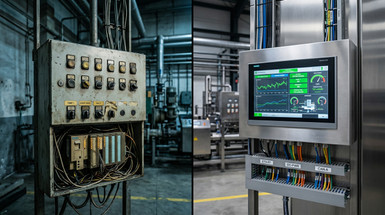
Your facility's control systems are aging. The question most plant managers never get around to answering is: what do I actually have, what's at risk, and where do I start? That question has a structured answer - and it doesn't require a capital project proposal or a call to a systems integrator to get there.
Why Legacy Control Systems Are a Bigger Risk Than Most Facilities Realize
Industrial control systems are designed to run for decades - and they do. That longevity is also the problem. A PLC installed in 2005 has been running your production line reliably for 20 years. It has also been accumulating risk the entire time: discontinued firmware, a manufacturer that no longer supports the hardware, replacement parts available only on eBay, and an operator interface running on Windows XP that hasn't seen a security patch since 2014.
The risk isn't theoretical. According to industry research cited in a recent Automation World article, extending asset lifetime and improving efficiency are the overwhelming drivers behind modernization decisions - but 99% of facilities also cite operational efficiency and better asset utilization as motivators. Those are not goals you achieve by waiting for a failure event.
What stops most facilities from acting isn't disagreement about the need - it's the assumption that modernization means a complete system overhaul. It rarely does. Incremental, phased upgrades are not only viable; they're often the smarter financial path, especially when competing capital priorities make large CapEx projects difficult to approve.
What "Phased Modernization" Actually Means in Practice
Phased modernization is not a compromise. It is a strategy. Rather than replacing every system simultaneously - with the production risk, capital outlay, and organizational disruption that entails - a phased approach targets the highest-risk, highest-ROI components first and sequences everything else against a rolling plan.
The typical sequence in well-executed modernization projects follows this logic:
Phase 1: EOL component identification and replacement
Before anything else, know what you have. Walk the facility and photograph every control panel nameplate. Log every PLC, HMI, drive, and safety relay model number and cross-reference each against the manufacturer's lifecycle status. Components flagged as end-of-life get prioritized for replacement - not because they've failed, but because the cost of a reactive repair after failure dwarfs any savings from deferring the upgrade. Planned replacements happen during scheduled maintenance windows. Unplanned failures happen during peak production.
Phase 2: Network infrastructure and remote visibility
Managed industrial Ethernet switches and secure remote access are the infrastructure layer that unlocks every capability that follows. Real-time production data. Remote diagnostics. Predictive maintenance alerts. The ability for your team - or a systems integrator like MDCI Automation - to troubleshoot from anywhere without an on-site visit. This phase is often the highest-leverage investment in the entire modernization sequence because it enables every subsequent layer to work.
Phase 3: HMI modernization
Windows 10 reached end of support in October 2025. Any operator interface still running on it is an unpatched security vulnerability and a support orphan. Modern touchscreen HMIs reduce operator training time, surface real-time production data directly at the machine, and connect cleanly to the network infrastructure established in Phase 2.
Phase 4: Safety system audit and upgrade
Safety upgrades should run in parallel with hardware phases, not be deferred to the end. Outdated safety relays, missing light curtains, and non-compliant interlocks are both a liability and a regulatory exposure. Current ISO 13849 and IEC 62061 standards require documented functional safety assessments. If your last safety review was more than three years ago, this phase belongs in Phase 1, not Phase 4.
Phase 5: Automation expansion
Once the infrastructure is modernized, the path opens to collaborative robots for labor-constrained applications, IIoT connectivity for predictive maintenance, machine vision for quality inspection, and energy efficiency upgrades that qualify for utility rebate programs. These are not pipe dreams - they are standard deployments that Automation Distribution's customers execute every quarter. But they require the foundation that Phases 1 through 4 establish.
The Three-Step Planning Framework That Makes This Manageable
Nick Hein, PE, lead engineer at Huffman Engineering, put it directly at a recent industry conference: "This should not start with a conversation with two people behind a desk saying, 'This is what we should do.'" The following three-step framework - drawn from CSIA-certified integrator practice - is how modernization projects actually get done:
1. Make a list.
Start with a high-level inventory of every control panel across every site. Work down to the model numbers of every smart device: PLC, HMI, Ethernet switches, drives. This is the foundation of everything that follows. Without it, you're guessing.
2. Walk your system.
Spend time on the floor with the operators who run these systems daily. They know exactly where the pain is - workarounds they've developed, components that fail repeatedly, alarms that get silenced because nobody knows what they mean. Get management, operations, and your automation team in the same room at the same time. That conversation generates more useful upgrade prioritization data than any spreadsheet.
3. Map out an upgrade plan.
From the inventory and the floor walk, build a prioritized list. Assign each item a phase, a rough timeline, and a budget tier. Identify funding sources - CapEx, OpEx, utility rebates, or grant programs depending on your industry. Set a short-term and long-term execution schedule and hold to it. The goal, as Hein puts it, is "a maintainable, documented, future-ready system." That goal only happens with a written plan.
Products That Support Each Phase of Your Upgrade
Automation Distribution carries the components most commonly specified across all five phases of a legacy upgrade program. A few highlights by phase:
EOL replacement (Phase 1): WAGO's 750-891 Modbus TCP controller is a modern drop-in option for facilities migrating off legacy fieldbus PLCs - dual Ethernet ports, IEC 61131-3 programming, and compatibility with over 250 WAGO I/O modules.
Network infrastructure (Phase 2): Industrial managed Ethernet switches and TURCK and WAGO I/O connectivity products support the transition from serial fieldbus architectures to modern Industrial Ethernet topologies including EtherNet/IP, PROFINET, and EtherCAT.
Safety systems (Phase 4): Automation Distribution's industrial safety solutions portfolio includes Leuze safety light curtains (MLC 500, ELC 100 series), Schneider Electric Harmony XPS safety relays, and ABB Jokab safety devices - all certified to current ISO 13849 and IEC 62061 standards.
Automation expansion (Phase 5): Universal Robots cobots are the most widely deployed collaborative robot platform for facilities addressing labor gaps and throughput constraints. UR cobots require no safety fencing for most applications, can be redeployed as production needs change, and integrate with standard industrial I/O, MODBUS TCP, PROFINET, and OPC-UA.
Start with a Free 3-Minute Assessment
The hardest part of a legacy upgrade program isn't the execution - it's getting started with a clear picture of where you stand. Automation Distribution built a free interactive assessment tool that walks you through the three-step framework above and generates a prioritized upgrade roadmap specific to your facility, your industry, and your operational challenges.
The assessment takes about 3 minutes. At the end, you get a phased roadmap with product category links matched to each phase and clear recommended timelines - something you can share with your operations lead or present to management as a starting framework.
Take the Legacy System Assessment
Answer 10 questions about your facility and get a personalized, phased upgrade roadmap - free.
Start the assessment →Frequently Asked Questions
How do I know if my control system is end-of-life?
Check the manufacturer's website directly for the lifecycle status of your PLC, HMI, and drive model numbers. Allen-Bradley, Siemens, Mitsubishi, Omron, and Schneider all publish active, discontinued, and end-of-life designations by model. If your model shows "discontinued" or "not recommended for new designs," start planning your replacement path. If you can't find the information, call the manufacturer's support line or contact Automation Distribution's team at 1-888-600-3080.
Do I have to replace everything at once to modernize?
No. Phased modernization is specifically designed to avoid that. You replace the highest-risk, highest-ROI components first and sequence the rest. Most facilities find they can begin meaningful modernization with a Phase 1 EOL inventory and targeted component replacements without any system downtime beyond scheduled maintenance windows.
What safety standards apply to my control system upgrade?
ISO 13849-1 and IEC 62061 are the primary functional safety standards for machine control systems in the US and globally. OSHA 29 CFR 1910.217 and 1910.212 govern machine guarding requirements. For regulated industries (pharma, food, water), FDA 21 CFR Part 11, FSMA, and EPA requirements add additional compliance layers. The industrial safety solutions portfolio at Automation Distribution includes devices certified to current PLe / Category 4 and SIL 3 levels.
How long does a phased upgrade typically take?
It depends entirely on scope and facility size. Phase 1 - inventory and EOL identification - can be completed in a few weeks for a single facility. A full five-phase modernization program across multiple sites typically spans 2-4 years. The value of a phased approach is that each phase delivers measurable return on its own, so you're not waiting three years to see results.
What's the difference between upgrading and replacing a PLC system?
An upgrade replaces specific failing or obsolete components while maintaining the overall control architecture - a new processor module, a new HMI, a replacement drive. A replacement swaps the entire platform, requiring new programming, new I/O wiring, and full recommissioning. Upgrades are faster, lower-risk, and significantly less expensive. They are the right choice when the architecture itself is still sound; replacement is warranted when the platform is so architecturally limited that no migration path exists at acceptable cost.
Automation Distribution is an authorized distributor of WAGO, Leuze, TURCK, SMC, Universal Robots, Yaskawa, Schneider Electric, ABB, and dozens of other industrial automation brands serving PA, NJ, NY, DE, MD, DC, and VA. Browse our full industrial safety solutions catalog, explore Universal Robots cobots, or take the free legacy system assessment to generate your personalized upgrade roadmap. To discuss your application with a technical specialist, call 1-888-600-3080.