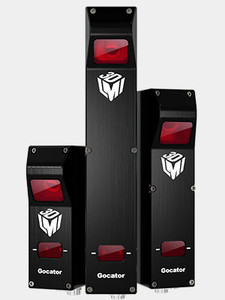
LMI Gocator 1300 Series High-Speed 3D Laser Point Profile Sensors
LMI TechnologiesThe fastest Gocator family. 32 kHz scan rate, sub-micron Z resolution, and the only Gocator product family designed for single-point displacement measurement instead of profile or surface scanning. When you need pure speed and Z accuracy on a single measurement point, the 1300 Series is the answer.
The Gocator 1300 Series is LMI Technologies' family of 3D smart laser point profile sensors - the only Gocator product line built for single-point displacement measurement rather than full 3D scanning. Seven optical models all share an industry-leading 32 kHz scan rate (over 6x faster than the next-fastest Gocator family) with measurement ranges from 20 mm up to 2 meters and Z resolution down to 0.4 microns. The 1300 Series is the right choice when your application is fundamentally a 1D measurement problem - displacement, thickness, height variation, presence/absence, position feedback - and you need it done at the highest possible speed with the simplest possible integration.
When to Choose a Point Profiler Over a Line Profiler
Most Gocator sensors capture a full 2D laser line profile across a target, generating hundreds of data points per scan that build into 3D point clouds as the part moves. The 1300 Series is different - it measures a single laser point, returning one Z value per scan. This sounds like a limitation, but it's actually a powerful advantage for specific applications:
| Use Point Profiler When... | Use Line Profiler When... |
|---|---|
| You need maximum scan speed (32 kHz) for closed-loop feedback or very fast production lines. | You need full cross-sectional profile data per scan. |
| You only need to measure displacement, thickness, height, or position at a single known point. | The feature location varies and you need to find it within the scan. |
| You want the simplest possible data output - one Z value per scan, easy to feed to a PLC or PID loop. | You need 3D surface reconstruction or area-based measurement. |
| Your target moves predictably so positional encoding handles the X dimension naturally. | Your target is stationary or moves irregularly. |
| You need the smallest possible measurement spot (down to 0.11 mm) for fine feature targeting. | You need the data points distributed across a wider area. |
Key Features
- 32 kHz scan rate on every model - the fastest of any Gocator family
- Z resolution down to 0.4 microns on the Gocator 1320
- Measurement range from 20 mm up to 2 meters across the family
- Clearance distance from 40 mm up to 562 mm for standoff-constrained applications
- Laser spot size down to 0.11 mm for fine feature targeting
- 660 nm red laser in Class 3R configuration
- Factory pre-calibrated - delivers real-world Z coordinates out of the box
- Browser-based GUI for setup and real-time visualization - no installed software
- Open-source SDK for integration with custom applications, PLCs, robots, and image processing libraries
- Industrial protocol support - EtherNet/IP, PROFINET, Modbus, plus analog (4-20 mA) and serial output for legacy PLC integration
- Selcom Serial Output for replacing legacy Selcom point sensors without changing host integration
- Multi-sensor networking via LMI Master controllers
Gocator 1300 Series Model Comparison
All seven 1300 Series models share the 32 kHz scan rate, 660 nm red laser, and Gigabit Ethernet interface. Models differ primarily in clearance distance, measurement range, and Z resolution. The wider the measurement range, the larger the laser spot and the lower the Z resolution - this is fundamental optical physics.
| Specification | 1320 | 1340 | 1350 | 1365 | 1370 | 1380 | 1390 |
|---|---|---|---|---|---|---|---|
| Scan Rate | 32 kHz | 32 kHz | 32 kHz | 32 kHz | 32 kHz | 32 kHz | 32 kHz |
| Clearance Distance (mm) | 40 | 162.5 | 200 | 562 | 237.5 | 127 | 500 |
| Measurement Range (mm) | 20 | 95 | 200 | 375 | 412.5 | 1651 | 2000 |
| Linearity Z (+/- % of MR) | 0.05 | 0.05 | 0.05 | 0.11 | 0.07 | 0.18 | 0.10 |
| Linearity Z (+/- mm) | 0.01 | 0.05 | 0.1 | 0.4 | 0.3 | 3.0 | 2.0 |
| Resolution Z (mm) | 0.0004 | 0.0005 - 0.0010 | 0.0015 - 0.0035 | 0.0025 - 0.0040 | 0.0025 - 0.0070 | 0.0100 - 0.0450 | 0.0250 - 0.0600 |
| Laser Spot Size (mm) | 0.11 | 0.37 | - | 1.80 | 0.90 | - | 2.60 |
All Gocator 1300 Series models use a 660 nm red laser. Linearity Z, Resolution Z, and Repeatability Z may vary by laser class. Specifications based on Class 3R laser configuration. Refer to the official Gocator 1300 Series user manual for full specifications including spot size details for the 1350 and 1380 models.
How to Choose Your Model and Part Number
Gocator 1300 Series models split into three working envelope categories: short range (1320), mid range (1340, 1350, 1370), and long range (1365, 1380, 1390). All models are stocked in Class 3R, 660 nm red laser, Top Mount configuration. Contact Automation Distribution for custom laser classes, mount orientations, or non-standard optical configurations.
| Model | Part Number | Best Suited For |
|---|---|---|
| Gocator 1320 Sub-micron, finest spot |
311320C-3R-01-T | Highest-precision displacement measurement on small targets. 0.4 micron Z resolution, 0.11 mm laser spot. Electronics, medical device features, semiconductor displacement, fine-feature thickness gauging. |
| Gocator 1340 General mid-range |
311340C-3R-01-T | General-purpose mid-range displacement and thickness measurement. Inline part height gauging, sub-100 mm measurement range with usable sub-micron Z resolution. |
| Gocator 1350 Wider mid-range |
311350C-3R-01-T | 200 mm measurement range at a clean 0.05 percent linearity. Larger assembled components, taller machined parts, position feedback in robotic stations. |
| Gocator 1365 Long standoff |
311365C-3R-01-T | Applications requiring a long 562 mm clearance distance - measurement through machine guards, high-temperature workpiece avoidance, hard-to-reach inspection locations. |
| Gocator 1370 Wide range at good linearity |
311370C-3R-01-T | Wide 412 mm measurement range with the best linearity among the wide-range models (0.07 percent). Mid-size structural components, larger machined assemblies. |
| Gocator 1380 Extreme range, short standoff |
311380C-3R-01-T | Unique model - 1651 mm measurement range with a tight 127 mm clearance distance. Bulk material level sensing, silo and hopper measurement, tank level monitoring where the sensor must be close to the target. |
| Gocator 1390 Maximum range |
311390C-3R-01-T | Maximum measurement range in the 1300 Series at 2 meters. Bulk material profiling, large structural part position feedback, conveyor pile height monitoring. |
Typical Applications
| Closed-Loop Feedback The 32 kHz scan rate makes the 1300 Series the right Gocator for real-time closed-loop position feedback in robotic stations, servo systems, and continuous manufacturing processes. |
Thickness Measurement Inline material thickness on metal, glass, plastic film, paper, and other web products at production line speed. |
Height and Displacement Single-point height gauging on assembled parts - presence/absence, snap-fit engagement, fastener seat depth, weld bead height. |
| Bulk Material Level The 1380 and 1390 long-range models measure material levels in silos, hoppers, bins, and conveyor pile depth. |
Vibration and Runout The 32 kHz scan rate captures high-frequency mechanical motion - shaft runout, machine vibration analysis, dynamic deflection. |
Selcom Sensor Replacement Direct drop-in replacement for legacy Selcom point sensors using the 1300 Series' built-in Selcom Serial Output protocol. |
Industrial Construction and Connectivity
| Specification | Detail |
|---|---|
| Interface | Gigabit Ethernet |
| Inputs | Differential encoder, laser safety enable, trigger |
| Outputs | 2x digital output, RS-485 serial, Selcom serial, analog (4-20 mA) |
| Industrial Protocols | EtherNet/IP, PROFINET, Modbus, ASCII, Selcom serial, native Gocator protocol |
| Laser | 660 nm red, Class 3R standard (Class 2M or 3B available on selected models) |
| Housing | Gasketed metal enclosure, IP67 rated |
| Mount Orientations | Top Mount standard; Side Mount available on selected models for installation envelope constraints |
Software, Integration, and Networking
- Browser-based configuration GUI - set up the sensor, build measurement tools, and visualize real-time data from any device with a web browser.
- Onboard measurement tools - run gauging, range, and threshold tools directly on the sensor without an external PC.
- Open-source SDK and native drivers - integrate with your application, robot, or PLC using C-based libraries supported across every Gocator model.
- Legacy Selcom Serial Output - drop the 1300 Series into existing Selcom-based control systems without rewriting host integration code.
- Multi-sensor networking via LMI Master controllers (Master 100, 400, 800, 1200, 2400) for synchronized power, laser safety, encoder, and trigger distribution.
- Free Gocator Emulator for offline development and validation in a virtual sensor environment.
Compatible Accessories
Round out your Gocator 1300 deployment with factory-correct hardware available through Automation Distribution: LMI Cordsets in straight and 90-degree orientations for power, I/O, and Ethernet; LMI Master network controllers for multi-sensor systems with synchronized power and trigger distribution.
Frequently Asked Questions
What is the Gocator 1300 Series used for?
The Gocator 1300 Series is LMI Technologies' family of 3D smart laser point profile sensors, used for high-speed single-point displacement, thickness, height, and position measurement. Typical applications include closed-loop feedback for robotic stations and servo systems, inline material thickness gauging on metal/glass/film/paper webs, presence/absence and assembly verification, bulk material level monitoring, shaft runout and vibration analysis, and direct replacement of legacy Selcom point sensors. View the Gocator 1300 Series at Automation Distribution.
What is the difference between a point profiler and a line profiler?
A point profiler (1300 Series) projects a single laser point and returns one Z measurement per scan. A line profiler (2100, 2300, 2400, 2500, 2600 Series) projects a laser line and returns hundreds of Z measurements across the line per scan. Point profilers are faster (32 kHz versus a few kHz for line profilers) and produce simpler data, making them ideal for closed-loop feedback, single-point gauging, and high-frequency measurement tasks. Line profilers produce 3D cross-section data that builds into surface point clouds, making them ideal for full part inspection, gap and flush measurement, weld profiling, and feature-finding applications.
How fast is the 32 kHz scan rate in practical terms?
32 kHz means 32,000 Z measurements per second from a single sensor. At that rate, the 1300 Series can measure micron-level displacement changes 8 times faster than a typical 4 kHz line profiler's frame rate. For closed-loop feedback applications - servo positioning, robot guidance, web tension control - this means the control loop receives position data at rates that exceed the bandwidth of mechanical actuators, eliminating sensor latency as a limiting factor in loop tuning. For vibration and runout measurement, 32 kHz captures dynamic motion up to several kHz of mechanical frequency content.
Why does the Gocator 1380 have a short clearance distance but a huge measurement range?
The Gocator 1380 is the unique model in the family - 127 mm clearance with a 1651 mm measurement range, the widest in the series. This unusual geometry is purpose-built for bulk material level sensing where the sensor must mount close to the target structure (silo wall, hopper rim, conveyor frame) but needs to see all the way to the material surface deep inside the volume. The tradeoff is lower Z linearity and resolution than the shorter-range models - which is acceptable for level monitoring where the application doesn't require micron-level precision.
Can the Gocator 1300 replace a legacy Selcom point sensor?
Yes. The 1300 Series includes built-in Selcom Serial Output protocol support specifically for drop-in replacement of legacy Selcom point sensors in existing control systems. Connect the 1300 Series to the same RS-485 serial network as the Selcom sensor was on, configure the protocol through the browser interface, and the host PLC receives measurement data in the format it expects - no host integration code changes required. This is the simplest possible migration path for plants standardizing on modern Gocator hardware.
Which Gocator 1300 model has the highest accuracy?
The Gocator 1320 delivers the highest Z resolution in the family at 0.4 microns (0.0004 mm), paired with 0.01 mm linearity over its 20 mm measurement range and the smallest laser spot size at 0.11 mm. The 1320 is the right choice for the most precise displacement measurement applications - electronics, medical device features, semiconductor manufacturing, and any application where micron-level Z accuracy matters more than long-range coverage.
Can I network multiple Gocator 1300 sensors together?
Yes. LMI Master network controllers (Master 100, 400, 800, 1200, and 2400) support 4, 8, 12, or 24 Gocator connections with synchronized power, laser safety, encoder input, and external trigger distribution. Multi-sensor configurations enable simultaneous multi-point measurement on the same target - useful for parallel thickness measurement, multi-channel runout, or large-part dimensional gauging at multiple inspection points.
What laser class is the Gocator 1300 Series?
All standard stocking configurations of the Gocator 1300 Series ship with a Class 3R, 660 nm red laser. Class 2M and Class 3B options are available on selected models for application-specific requirements. Class 3B requires more rigorous laser safety controls including remote interlocks, key controls, and beam attenuators. Contact Automation Distribution at 1-888-600-3080 for non-standard laser class requirements.
Need help selecting a Gocator 1300 model?
Automation Distribution's application engineers work directly with LMI Technologies to match the right point profiler to your displacement measurement target. Whether you are scoping high-speed closed-loop feedback, inline thickness gauging, bulk material level sensing, or Selcom sensor replacement, we will help you get the configuration right the first time.
Request a quote or call 1-888-600-3080
- Datasheet:
- View
Related Products
-

-
LMI Gocator 2300 Series Workhorse 3D Laser Line Profile Sensors
LMI Technologies
-
LMI Gocator 2100 Series Entry-Level 3D Laser Line Profile Sensors
LMI Technologies
-
LMI Gocator 2880 Dual-Triangulation 3D Laser Line Profile Sensor
LMI Technologies