LMI Gocator 2D Smart Cameras - Industrial Vision with Edge AI
LMI Technologies

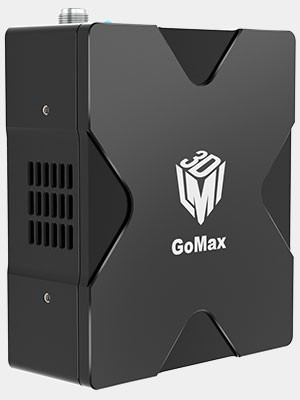
Add GPU-driven AI and processing power to any Gocator sensor - without an industrial PC. GoMax Smart Vision Accelerators offload point cloud processing, 3D measurement, and AI inference from your host computer to a compact, fanless, edge-native appliance.
The GoMax Smart Vision Accelerator family is LMI Technologies' dedicated edge computing platform for accelerating Gocator 3D smart sensors. GoMax connects to any Gocator sensor (line profiler, snapshot, or line confocal) and takes over a portion of the sensor's onboard data processing - including data generation, 3D measurement, AI inference, and PLC/robot communication - eliminating the need for an industrial PC in the inspection cell. The current generation includes three models built around different NVIDIA Jetson platforms: the legacy GoMax NX based on the Jetson Xavier NX, and the next-generation GoMax ORIN and GoMax ORIN+ based on the Jetson Orin NX (100 TOPS) and Jetson AGX Orin (200 TOPS) modules respectively. The ORIN+ is the only GoMax model that supports the GoPxL Anomaly Detector, LMI's AI-based defect detection solution.
| Model | NVIDIA Platform | AI Performance | Anomaly Detector Compatible? | Best For |
|---|---|---|---|---|
| GoMax NX Legacy / cost-effective |
Jetson Xavier NX 384 CUDA cores, 48 Tensor cores |
Entry-level GPU acceleration | Yes (with appropriate firmware) | Existing GoMax NX installations, single-sensor or small multi-sensor networks where AI is not required. |
| GoMax ORIN Recommended starting point |
Jetson Orin NX 8-core Arm Cortex-A78AE CPU, NVIDIA Ampere GPU |
100 TOPS | Yes (recommended for AI workloads) | Single and multi-sensor acceleration with up to 2x faster processing than GoMax NX. Right choice when AI Anomaly Detection is not in scope. |
| GoMax ORIN+ AI-ready, server-class |
Jetson AGX Orin 12-core Arm Cortex-A78AE CPU, NVIDIA Ampere GPU |
200 TOPS | Yes (best for demanding AI workloads) | AI-based defect detection, demanding multi-sensor networks, applications requiring server-class processing in a compact edge appliance. |
All three GoMax models share the same compact, fanless, ruggedized form factor and the same browser-based configuration interface. Upgrading from GoMax NX to ORIN or ORIN+ preserves the existing Gocator sensor configuration.
Gocator sensors are smart - they run measurement tools onboard without an external PC. But at high scan rates, high resolution, or in multi-sensor networks, the data volume can exceed what the sensor's onboard processor handles in real time. Conventionally, this required adding an industrial PC to the inspection cell to offload the heavy lifting. GoMax replaces that PC with a compact, fanless edge appliance built specifically for Gocator data:
| Faster Cycle Times Offloading data generation, 3D measurement, and PLC/robot communication from the sensor lets it operate at higher scan rates than the onboard processor alone can sustain. Particularly valuable on 4K+ resolution sensors (Gocator 2600) and high-speed profilers (Gocator 2500). |
Multi-Sensor Acceleration Generate a unified 3D point cloud from multiple Gocator sensors without overloading a host PC. Add multiple GoMax units to scale up acceleration across large multi-sensor networks - ring scanning, 360-degree inspection, wide-conveyor coverage. |
| Edge AI Without the Cloud The GoMax ORIN+ runs the GoPxL Anomaly Detector entirely on-device - train AI models on real production data and run inference locally without cloud dependency, subscription fees, or data egress. |
No PC, No OS Maintenance GoMax is a dedicated appliance - no Windows updates, no driver conflicts, no antivirus, no IT footprint. Powered through a single connection and configured through a web browser. |
Not every Gocator deployment needs acceleration. The sensor's onboard processor handles many applications natively. Add GoMax when one or more of these conditions applies:
All three GoMax models share the following common characteristics:
| Feature | Detail |
|---|---|
| Form Factor | Compact, fanless, ruggedized metal enclosure |
| Configuration | Web browser-based interface - no software install on host PC |
| Network | Distributed peer-to-peer architecture for multi-sensor and multi-GoMax networks |
| Sensor Compatibility | Any Gocator line profiler, snapshot, or line confocal sensor |
| Mounting | DIN rail clip or wall/frame mount |
| Software | GoPxL IIoT Vision Inspection Software (browser-based, hardware-agnostic) |
| Setup | Plug, power, and activate acceleration through web browser - no driver installation or OS maintenance |
Detailed dimensions, power, and environmental specifications vary by GoMax model. Contact Automation Distribution at 1-888-600-3080 for the official datasheet for your selected model.
The combination of GoMax ORIN+ and the GoPxL Anomaly Detector is LMI's flagship edge AI inspection stack. Train deep-learning defect detection models on your real production data, deploy them on the GoMax ORIN+, and run inference locally on every part - all without cloud dependency, subscription fees, or data leaving your facility.
The Anomaly Detector identifies complex surface defects that traditional rule-based vision tools cannot describe - cosmetic flaws, novel defect patterns, multi-variant surface anomalies on automotive, food, building materials, tire, and consumer goods production. The 200 TOPS of AI performance on the ORIN+ handles both training and inference on-device.
GoMax works with the full Gocator portfolio available through Automation Distribution. The Gocator 2500 Series (20 kHz scan rates), Gocator 2600 Series (4K+ resolution), and Gocator 6300 Series (precision telecentric profilers) all benefit most directly from GoMax acceleration. The Gocator 3200 and Gocator 3500 snapshot sensors are typical pairing candidates given their data-heavy single-shot 3D capture. Also stock LMI Cordsets for sensor-to-GoMax connections.
GoMax is LMI Technologies' dedicated edge computing appliance for accelerating Gocator 3D smart sensors. It is a compact, fanless device built around an NVIDIA Jetson platform that connects to any Gocator sensor (line profiler, snapshot, or line confocal) and offloads point cloud processing, 3D measurement, AI inference, and PLC/robot communication from the sensor's onboard processor. GoMax eliminates the need for an industrial PC in your inspection cell. View the GoMax family at Automation Distribution.
All three are fanless edge accelerators that connect to Gocator sensors through a browser-based interface. They differ in NVIDIA Jetson platform and AI performance. The GoMax NX uses the older Jetson Xavier NX (384 CUDA cores, 48 Tensor cores). The GoMax ORIN uses the Jetson Orin NX (100 TOPS). The GoMax ORIN+ uses the Jetson AGX Orin (200 TOPS - server-class processing in an edge form factor). Critically, only the GoMax ORIN+ supports the GoPxL Anomaly Detector for AI-based defect detection. If your application requires AI defect detection, the ORIN+ is the only option.
Yes - that is the primary purpose. Traditional Gocator deployments at high scan rates or in multi-sensor networks required an industrial PC to handle the data volume and run measurement tools. GoMax is a purpose-built appliance that performs the same processing tasks in a fanless, ruggedized, DIN-rail-mountable form factor. No Windows, no driver maintenance, no antivirus, no IT footprint. The host system can be a simple HMI or PLC.
TOPS (Tera Operations Per Second) is the standard measure of AI inference performance on NVIDIA Jetson and similar edge AI platforms. One TOPS equals one trillion operations per second. The GoMax ORIN at 100 TOPS handles single-sensor AI workloads and traditional Gocator measurement tool acceleration. The GoMax ORIN+ at 200 TOPS handles AI training and inference simultaneously, supports the GoPxL Anomaly Detector, and provides headroom for multi-sensor AI deployments. In practice, the ORIN+ is approximately 2x faster than the ORIN for AI workloads and provides the processing margin required to train deep-learning models on real production data while running inference in parallel.
Yes. GoMax connects to any Gocator line profiler, snapshot, or line confocal sensor through standard Ethernet. There is no firmware change required on the Gocator side. Connect GoMax to the same network as the sensor, activate acceleration through the web browser, and the sensor begins offloading processing to GoMax automatically.
Yes. GoMax uses a distributed peer-to-peer networking architecture specifically designed for multi-unit scaling. Add additional GoMax units as your sensor network grows or as processing demand increases. Configuration is managed centrally through the browser interface.
No. GoMax is a fully edge-native device. All processing, including AI inference and AI model training (on the ORIN+), happens locally on the device. No data leaves your facility unless you choose to send it externally. This is a major advantage for security-sensitive OEMs, regulated industries, and customers in jurisdictions with data residency requirements.
Automation Distribution's application engineers work directly with LMI Technologies to size the right GoMax acceleration tier for your Gocator deployment. Whether you are accelerating a single high-resolution sensor, building a multi-sensor network, or deploying AI-based defect detection with the Anomaly Detector, we will help you get the configuration right the first time.
Request a quote or call 1-888-600-3080

LMI Technologies