
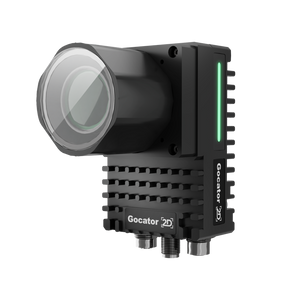
LMI Gocator 2D Smart Cameras - Industrial Vision with Edge AI
LMI Technologies


AI-powered 3D defect detection that trains and runs entirely on your factory floor. No cloud, no separate GPU server, no monthly subscription. Train on your own OK/NG examples, deploy on GoMax, retrain anytime your process changes.
The GoPxL Anomaly Detector is LMI Technologies' AI-powered 3D defect detection toolset, designed to identify complex surface defects that traditional rule-based vision tools cannot describe. Where conventional inspection requires writing precise threshold logic for every possible defect type, the Anomaly Detector learns what "good" parts look like from your own production data and flags anything that deviates - novel defect patterns, cosmetic flaws, multi-variant surface anomalies that would require dozens of hand-tuned rules in a traditional system. The entire training and inference workflow runs onboard the GoMax Smart Vision Accelerator, eliminating cloud dependency, subscription fees, and data egress concerns. Anomaly Detector is the first release in LMI's GoPxL Pro Tools series and integrates with the full Gocator portfolio: G2 line profilers, G3 snapshot sensors, G4 coaxial confocal, and G5 dual-axis confocal sensors.
LMI's licensing model for Anomaly Detector is designed to make evaluation easy and production deployment straightforward:
| Component | Cost | Required For |
|---|---|---|
| Anomaly Detector Firmware | Free | Download from LMI's product downloads page. Required for both evaluation and production deployment. |
| REPLAY Mode Evaluation | No license required | Train and test models on previously recorded scan data. Use to evaluate fit before purchasing a license. |
| Licensed LMI Dongle PN 301295 |
Per-unit license fee | Required for LIVE production use with active Gocator sensors. One dongle per GoMax unit. Plug into the GoMax USB port to enable production operation. Training and inference share the same license. |
This means engineers can download the firmware, run it on GoMax in REPLAY mode against sample scan data, validate that the AI model performs adequately for the inspection task, and only then commit to purchasing the licensed dongle for production deployment. No upfront cost to evaluate. No commitment until the technology proves itself on your specific application.
Traditional vision inspection works by writing explicit logic: "If the measured height exceeds 5.2 mm, flag as defect." This works perfectly for dimensional gauging where the tolerances are known. But for surface defect detection - scratches, dents, contamination, novel manufacturing flaws - traditional tools struggle because:
| Traditional Tools | GoPxL Anomaly Detector |
|---|---|
| Require manual threshold tuning specific to each part. Detection rules must be written for each defect type. | Learns from OK/NG examples. No manual thresholds. The model figures out what "different" looks like. |
| Fail on novel defects that don't match the programmed rules. New defect types require new code. | Detects any deviation from the learned "OK" baseline, including defect types never seen in training. |
| Excel at blob detection and segmentation but struggle with subtle cosmetic flaws and material variation. | Built for exactly the subtle, multi-variant, hard-to-describe defects that conventional rules cannot capture. |
| Tuning is a manual engineering task that takes hours or days for each new part. | Training is data-driven: provide examples, run training, deploy. New part variants retrain in minutes. |
The Anomaly Detector does not replace traditional measurement tools - it complements them. Use GoPxL's traditional dimensional and feature tools for what they do best (gauging, presence/absence, blob detection) and add Anomaly Detector for the surface quality decisions that those tools cannot reliably make.
Most AI vision platforms require sending your production data to a cloud service for model training, then downloading the trained model back to the factory floor for inference. This architecture has four real problems for industrial customers:
The Anomaly Detector solves all four by running entirely on GoMax hardware in your facility. Training datasets stay on-premises. No data egress. Retrain as often as your process requires with no incremental cost. The model lives on your hardware - if LMI disappeared tomorrow, your deployed system would continue running. This is what "edge AI" actually means: complete AI workflow at the edge, no cloud dependency, no subscription.
To deploy Anomaly Detector in production, you need three things:
| Component | Details |
|---|---|
| 1. Compatible Gocator Sensor | Any Gocator G2 (line profilers - 2100, 2300, 2400, 2500, 2600, 2880), G3 (snapshot sensors - 3200, 3500), G4 (coaxial line confocal), or G5 (dual-axis line confocal). Note: GoPxL can accelerate only a single G3 sensor per GoMax. |
| 2. GoMax Accelerator | GoMax NX, GoMax ORIN, or GoMax ORIN+. Selection depends on scan resolution, cycle time, and pre- or post-processing requirements. Higher-throughput and higher-resolution applications benefit from ORIN or ORIN+; lower-throughput applications can run on the legacy NX. |
| 3. Anomaly Detector Dongle | LMI part number 301295. USB dongle that plugs into the GoMax unit. Required for live production operation. One dongle per GoMax. Training and inference share the same license. |
Current GoMax accelerator units ship with the Gocator Classic firmware installed. To use GoPxL Anomaly Detector, upgrade the accelerator with the Anomaly Detector firmware available from LMI's Product Downloads page.
Within the broader GoPxL Anomaly Detector toolset, the Surface Anomaly Detector is the primary tool engineers configure. It provides:
| Automotive Paint and surface finish inspection, weld bead quality, sealant bead consistency, gap and flush variation outside dimensional limits, panel surface defects, cast part surface anomalies. |
Food Processing Baked goods surface quality, meat and poultry inspection, packaging seal integrity, foreign object detection, product shape anomalies. Edge AI training preserves food safety data privacy. |
| Building Materials Lumber surface defect detection (knots, splits, cracks), panel surface quality, structural component anomalies, mineral product surface variation, finished material grading. |
Tire Manufacturing Sidewall surface defect detection, tread anomaly identification, label and marking verification, rubber surface quality, manufacturing flaw detection during curing. |
| EV Battery Electrode coating defects, cell case scratches and dents, weld quality anomalies, foreign object detection on production lines, surface contamination identification. |
Consumer Electronics Mobile device cosmetic inspection, polished surface defect detection, adhesive bead anomalies, assembly surface quality, finished product cosmetic QA. |
The GoPxL Anomaly Detector is LMI Technologies' AI-powered 3D defect detection toolset, designed to identify complex surface defects on parts produced in automotive, food, building materials, tire, EV battery, and consumer electronics manufacturing. The toolset combines traditional GoPxL measurement tools with AI-based defect detection that learns from your own OK and NG production examples - no manual threshold tuning required. The entire training and inference workflow runs onboard a GoMax Smart Vision Accelerator, eliminating cloud dependency. View the GoPxL Anomaly Detector at Automation Distribution.
Yes. The Anomaly Detector firmware is available as a free download from LMI's product downloads page. Engineers can install it on a GoMax accelerator and run the tool in REPLAY mode against previously recorded scan data without any license. This lets you fully evaluate the AI capability on your specific application before committing to purchase. The licensed dongle (LMI part number 301295) is required only for LIVE production operation with active Gocator sensors.
A single Anomaly Detector dongle license covers both training and inference operations on the GoMax unit where it is plugged in. There is no separate "training license" or "production license" - one dongle unlocks the full workflow. Plug the dongle into the GoMax USB port and the tool licenses automatically. One dongle per GoMax unit; multi-GoMax deployments require one dongle per accelerator.
All three GoMax models (NX, ORIN, ORIN+) support the Anomaly Detector when running the appropriate firmware. The right choice depends on scan resolution, cycle time, and pre- or post-processing requirements. Higher-throughput and higher-resolution applications benefit from the GoMax ORIN (100 TOPS) or ORIN+ (200 TOPS); lower-throughput applications can run on the legacy NX. The ORIN+ is the recommended choice for demanding production AI workloads where multiple models need to run in parallel or where training time matters. Contact Automation Distribution at 1-888-600-3080 for application-specific sizing.
All current Gocator families work with Anomaly Detector when accelerated by GoMax: G2 line profilers (Gocator 2100, 2300, 2400, 2500, 2600, 2880, 6300), G3 snapshot sensors (Gocator 3200, 3500), G4 coaxial line confocal (Gocator 4000 Series), and G5 dual-axis line confocal (Gocator 5500 Series). Note that GoPxL can accelerate only a single G3 snapshot sensor per GoMax unit. Multi-sensor line profiler installations are fully supported.
Cloud-based AI vision platforms require uploading your production scan data to a third-party cloud service for model training. This creates data security concerns, ongoing bandwidth costs, retraining latency, and vendor lock-in. The GoPxL Anomaly Detector runs entirely on GoMax hardware in your facility - training data stays on-premises, retraining is unlimited and free of incremental cost, and the deployed system continues running regardless of LMI's future cloud service decisions. This is what edge AI actually means.
The Anomaly Detector requires a dataset of OK (good) and NG (defective) example scans. Exact dataset size requirements depend on the complexity of the defect signatures and the variability of your production - simple defects with clean signatures may train successfully on a few dozen examples; complex multi-variant defects may need hundreds. The tool's synthetic NG frame generation feature can augment your training set by generating simulated defect examples, which is particularly helpful when real NG samples are rare. Contact Automation Distribution for application-specific guidance on dataset requirements.
No - it complements them. Traditional GoPxL tools (dimensional gauging, geometric measurement, blob detection, presence/absence) remain the right choice for inspection tasks that involve precise dimensional tolerances or clearly defined features. The Anomaly Detector is purpose-built for the inspection tasks that traditional tools struggle with: surface defects, cosmetic flaws, novel anomaly patterns, multi-variant surface conditions. Most production inspection systems use both: traditional tools for the measurable features and Anomaly Detector for the qualitative surface decisions.
Yes. Because training and inference share the same license, you can retrain the model anytime your production process changes - new part variants, material suppliers, defect types, or quality standards - using the same dongle. No additional license purchase. No data uploaded to the cloud. No waiting for a third-party training queue. Retraining happens locally on the GoMax in minutes, then the updated model deploys to production. This is critical for processes that evolve over time.
GoPxL Pro Tools is LMI Technologies' product line for advanced inspection capabilities that extend the core GoPxL platform. Anomaly Detector is the first release in this series, with additional Pro Tools planned for future release. The Pro Tools series leverages the AI and GPU compute capabilities of the GoMax acceleration platform to enable inspection tasks that go beyond traditional rule-based 3D measurement.
Automation Distribution's application engineers work directly with LMI Technologies to size Anomaly Detector deployments, recommend the right GoMax acceleration tier, and walk through the REPLAY-mode evaluation workflow with your scan data. No upfront commitment required to validate the technology on your application.
Request a quote or call 1-888-600-3080
LMI Technologies
LMI Technologies

LMI Technologies
LMI Technologies