

Turnkey Solution · Cobot Cell
Modular Co-Packing Cell with Cobot & 3D Vision
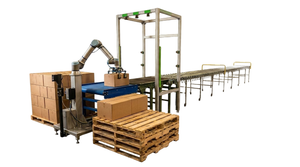
A reconfigurable, vision-guided cobot cell engineered for kitting, bundling, and promotional packaging in high-mix environments. Deployed by Automation Distribution for contract packagers, e-commerce fulfillment operations, and brand owners running variable-pack programs.
What this cell does
Co-packing has always been a high-mix, low-volume problem. Subscription box programs, retail display pack-outs, promotional bundles, e-commerce kits, beauty and meal-kit assemblies — every job is a different combination of SKUs in a different configuration, and the runs are often too short to justify dedicated automation. For decades the default solution has been human labor: a line of operators picking from totes and assembling into a tray, a carton, or a display.
The Modular Co-Packing Cell is a cobot-driven alternative built for exactly this problem. A collaborative robot arm equipped with 3D vision picks variable items from unsorted infeed — totes, bins, conveyors — and places them into a kit, carton, or display in a defined sequence. Changeovers between SKUs or pack configurations happen through reprogramming, not through tooling swaps. The cell runs lights-out where the application allows, and runs alongside operators where it doesn't.
The result: contract packagers and brand owners can take on shorter runs, faster changeovers, and higher-mix programs without proportionally scaling labor. Operators move from picking and placing to monitoring and verifying — which is both a better job and a more sustainable workforce model.
Typical applications
| Application | What the cell handles |
|---|---|
| Subscription boxes | Monthly assortments where every shipment is a different combination of SKUs. Beauty, snack, meal-kit, and curated retail programs. |
| Retail display pack-outs | Multi-SKU shipper displays for end-cap and PDQ programs. Frequent changeovers between promotional sets. |
| Promotional bundles | Limited-run pack configurations tied to seasonal, holiday, or co-marketing programs. Short runs that don't justify dedicated tooling. |
| E-commerce value packs | Multi-pack and variety-pack SKUs assembled at the warehouse rather than the factory, allowing flexible pack composition based on demand. |
| Gift & specialty kits | Branded gift boxes, corporate gifting programs, sample kits, and other high-presentation pack-outs requiring consistent placement and orientation. |
How the cell works
The Modular Co-Packing Cell combines four hardware layers and one software layer into a single integrated system.
3D vision system
A 3D vision camera identifies items in the infeed regardless of orientation, position, or partial occlusion. Unlike 2D vision systems — which require items to be presented in a known orientation or fixtured into a known position — 3D vision detects items in three-dimensional space, locating each piece's position, pose, and identity. This is what allows the cell to work with totes of mixed SKUs, conveyors of randomly oriented items, or bins where products are stacked rather than singulated. For most co-packing applications, 3D vision is the difference between a workable cell and one that requires constant operator intervention to clear faults.
Collaborative robot arm
A Universal Robots cobot — typically a UR10e or UR16e depending on payload and reach requirements — executes the pick-and-place motion. The cobot's built-in force limiting and contact detection make the cell safe for collaborative operation alongside human operators, which means no full safety cage is required for most applications. A formal risk assessment determines whether supplemental safety hardware (light curtains, area scanners) is warranted for the specific deployment.
End-of-arm tooling
The gripper, vacuum cup, or specialized end-effector is matched to the products being handled. For mixed-SKU co-packing, vacuum and adaptive grippers are most common because they handle a range of item geometries without changeover. For applications dominated by a single product family — bottles, cosmetics, food containers — purpose-designed grippers achieve higher cycle times. EOAT selection is part of the cell engineering and is finalized during application scoping.
Modular cell frame & infeed
The cell sits on a reconfigurable frame designed to accept different infeed methods (totes, conveyors, bins, tray dispensers) and different outfeed targets (cartons, displays, mailers, custom boxes). The "modular" in the cell's name refers to this reconfigurability — when a customer's program changes, the cell is reconfigured rather than replaced.
Cell software & reprogramming
The vision system and cobot are coordinated by cell software that handles the recipe — which items go in which order, into which pack configuration. New SKUs and new pack configurations are added through the cell's interface rather than through low-level reprogramming, which means a trained operator can introduce a new program without specialist support. This is the operational property that makes the cell economically viable for short-run programs.
Why deploy a Modular Co-Packing Cell
- Take on shorter runs. Programs that previously didn't justify dedicated automation become economically viable when changeovers are programmatic rather than mechanical.
- Reduce dependence on hand-pack labor. Co-packing has historically been one of the most labor-intensive parts of packaging operations. The cell shifts labor from picking to monitoring, reducing headcount per line and improving labor consistency across shifts.
- Improve pack consistency. Vision-guided placement produces uniform orientation, alignment, and presentation that hand-packing rarely matches. This matters most for high-presentation programs — gifting, retail display, premium kits.
- Run lights-out where applications allow. The cell can operate unattended for shifts where supervision isn't required, expanding capacity without expanding shift coverage.
- Scale across the operation. The cell's modular architecture allows the same base configuration to be replicated across multiple lines with application-specific tooling, simplifying maintenance and operator training.
What Automation Distribution delivers
The Modular Co-Packing Cell is a turnkey deployment, not a kit. Automation Distribution provides:
- Application scoping. Our engineering team reviews your specific SKUs, pack configurations, and infeed conditions before quoting. Co-packing applications vary widely in difficulty, and the up-front review is what separates a cell that runs reliably from one that doesn't.
- Cell engineering & configuration. Cobot selection, EOAT design, 3D vision system specification, infeed and outfeed configuration, and integration with any upstream or downstream conveyor.
- Risk assessment & safety hardware. Each deployment includes a formal risk assessment to determine appropriate safety configuration. Where supplemental safety hardware is warranted, it's specified, supplied, and integrated as part of the cell.
- Installation, commissioning, & operator training. The cell is delivered, installed on-site, commissioned with your specific initial pack programs, and your operators are trained on running it and adding new programs.
- Ongoing support. Post-deployment support for adding new SKUs, troubleshooting, and reconfiguration as your program mix evolves.
For specialized applications requiring deep vertical expertise — regulated food & beverage, validated medical kitting, complex multi-station integration — we work with specialist integrator partners across the country. Either arrangement delivers a working cell; the right path depends on your specific application.
How this cell fits a broader automation strategy
The Modular Co-Packing Cell is often deployed as a first or early-stage cobot project for operations transitioning from full hand-pack to mixed-mode automation. For background on how to think about that transition, see our guide to picking your first cobot.
For larger operations integrating co-packing into a broader fulfillment automation strategy, the cell can connect upstream and downstream with conveyor handling, scan tunnel verification, palletizing, and sortation systems — all of which are part of Automation Distribution's warehouse solutions catalog.
Frequently asked questions
What's the typical throughput of a Modular Co-Packing Cell?
Throughput varies significantly with pack complexity, item count per pack, and product geometry. Single-pick simple kits run faster than multi-item, multi-orientation premium packs. Throughput is part of the application scoping conversation — we quote expected cycle times based on your specific pack configurations rather than against a generic benchmark.
How long does deployment take from order to running production?
A typical Modular Co-Packing Cell deployment runs eight to sixteen weeks from order to running production, depending on EOAT complexity, the number of initial pack programs to be commissioned, and lead times on cobot and vision hardware. Simpler applications with off-the-shelf grippers and standard infeed configurations land at the shorter end of this range; cells involving custom EOAT or complex multi-station integration extend longer.
Which Universal Robots cobot is specified for this cell?
Most co-packing applications specify the UR10e — its 12.5 kg payload and 1300 mm reach handle the majority of mixed-SKU kitting programs without strain. For programs handling heavier items (e.g., beverage multi-packs, books, premium gift sets), the UR16e provides additional payload in the same footprint. The right cobot is determined during application scoping based on the actual pick weights and cycle requirements.
Can the cell handle products without barcodes or fiducials?
Yes. The 3D vision system identifies items by shape, dimensions, and visual features rather than relying on printed identifiers. Items without barcodes — bulk candies, unboxed cosmetics, food items, retail merchandise — are handled the same way as labeled items. Where SKU verification is required for compliance or quality (e.g., regulated industries), additional barcode or label readers can be integrated into the cell.
How do we add new pack programs to the cell?
New SKUs and new pack configurations are added through the cell's programming interface. A trained operator can introduce a new program without specialist support; for complex programs involving new item geometries or unusual pack configurations, Automation Distribution provides post-deployment program-development support as part of the ongoing service.
What about MDCI Automation?
The Modular Co-Packing Cell is also available through our sister company, MDCI Automation. Same engineering team, same factory relationships, same deployment process — the difference is which company the project sits under for procurement and contracting.
Scoping a co-packing automation project?
Tell us about your SKUs, your pack configurations, and your current operation. We'll review the application, confirm fit, and quote a deployment that matches your specific program mix.
Request a Quote Call 1-888-600-3080Related Products
-

-
-
Mobile Cobot Carts
Swivellink
-


