
Mar 9th 2026
Choosing the Right Circuit Protection for Your Control Panel
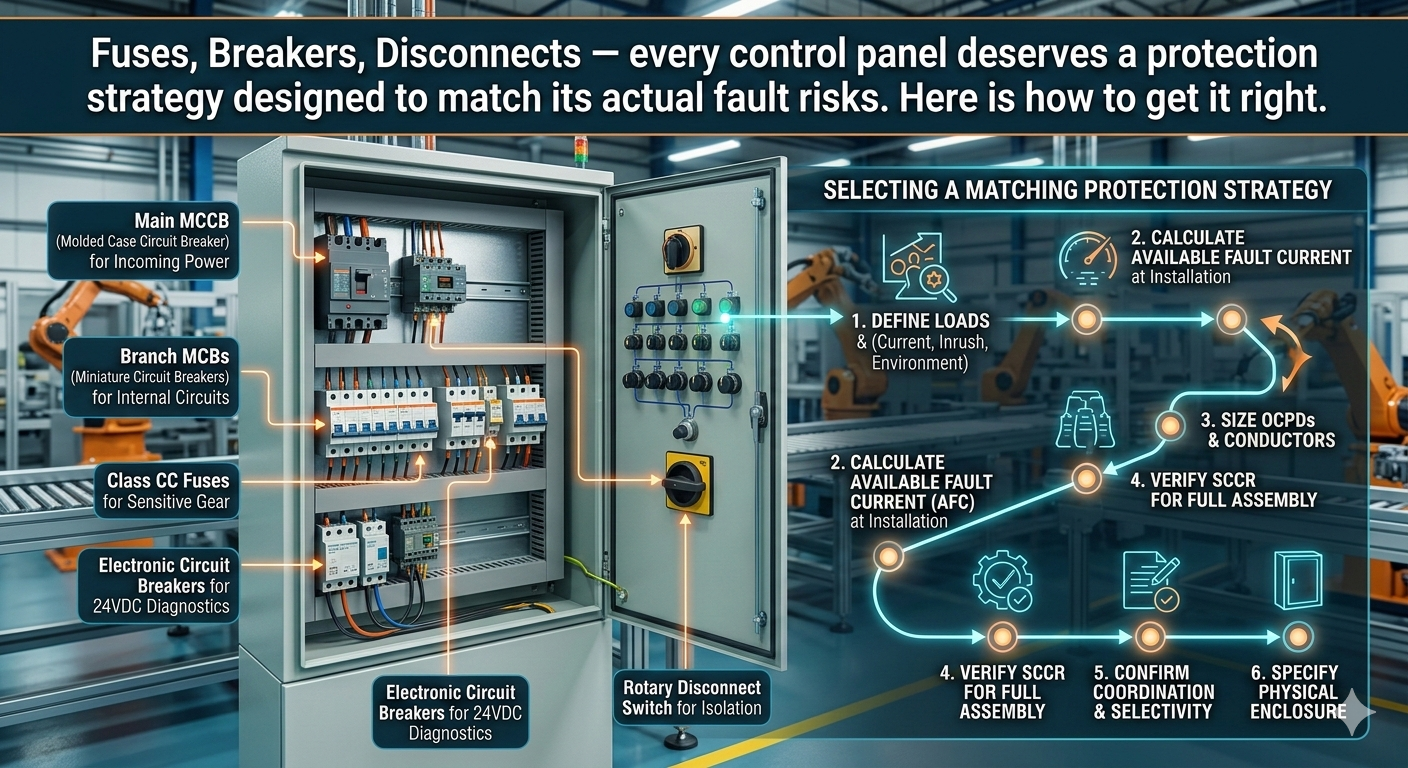
Fuses, breakers, disconnects — every control panel deserves a protection strategy designed to match its actual fault risks. Here is how to get it right.
The good news is that circuit protection is a well-developed discipline. The challenge is making sure you select, size, and coordinate your protective devices to match the actual demands of your application.
Understanding the Three Core Fault Types
Three failure modes account for the vast majority of electrical incidents in industrial control panels:
Overload: Current exceeds the rated capacity of a circuit — often caused by a motor pulling too much load or too many devices connected to a single circuit. Generates sustained heat that degrades insulation over time.
Short Circuit: Energized conductors contact each other or neutral directly. Produces an extreme current spike — often hundreds of times normal operating levels — within milliseconds. Can cause arc flash events.
Ground Fault: An energized conductor inadvertently connects to ground via damaged insulation, moisture, or mechanical failure. Can be difficult to detect without dedicated ground fault protection devices.
Short circuit and ground faults are particularly hazardous because they can produce arc flash events — explosive discharges of energy that generate intense heat, pressure waves, and projectile hazards. Selecting overcurrent protective devices (OCPDs) with adequate interrupt ratings is the first line of defense.
The Code and Standards Landscape
Electrical circuit protection is a legal and contractual requirement in most industrial applications. The three frameworks most relevant to control panel builders in North America are:
- NFPA 70 (NEC) — The National Electrical Code governs safe installation of electrical wiring and equipment. It defines how OCPDs must be applied and rated.
- UL 508A — The standard for industrial control panels. Governs panel construction, SCCR labeling, and component listing requirements.
- OSHA 29 CFR 1910.303 — Sets minimum federal requirements for electrical safety in general industry, including wiring design and protection.
The short circuit current rating (SCCR) of your overall assembly must be calculated and labeled correctly. Every component in the current path needs to be evaluated for its contribution to or limitation of fault current.
The Main Protection Device Categories
Each device category has distinct operating characteristics, appropriate use cases, and tradeoffs worth understanding before writing a bill of materials.
| Device Type | Standard | Typical Range | Interrupt Rating | Reusable? | Best For |
|---|---|---|---|---|---|
| Fuses | UL 248 | mA to 6,000A+ | Up to 200kA+ | No — replace after trip | High fault current environments; lowest cost OCPD |
| MCCBs | UL 489 | 15A – 1,200A+ | 22kA – 65kA | Yes — reset after trip | Main panel protection; power distribution |
| MCBs | UL 489 | 0.5A – 125A | Up to 14kA | Yes — reset after trip | Branch circuit protection within panels |
| Supplementary Protectors | UL 1077 | 0.5A – 30A | Limited | Yes — reset after trip | Additional protection downstream of a listed MCB |
| Disconnects | Varies | Any ampacity | N/A | N/A — isolation device | LOTO isolation; load isolation for service |
| Electronic Circuit Breakers | UL 508 | 0.5A – 40A | Varies by design | Yes — reset after trip | 24VDC distribution; diagnostics and remote reset |
Fuses vs. Circuit Breakers
Fuses offer superior interrupt ratings at lower initial cost and are the right call when available fault current is very high. Circuit breakers cost more upfront but eliminate the need to stock replacement fuses and allow personnel to quickly restore circuits after a trip without opening the enclosure. For most industrial control panels, a combination approach — MCCBs on the incoming line, MCBs for internal branch circuits — balances cost, convenience, and performance.
The Panel Design Process: A Practical Sequence
Selecting circuit protection devices is embedded in the broader panel design workflow. Here is the sequence that keeps designers out of trouble:
Establish what the panel must power and control — PLCs, drives, starters, I/O power supplies, HMIs. Document rated currents and inrush characteristics for each.
Determine the maximum short circuit current available at the point of installation. This comes from the utility transformer impedance, wire size, and run length. Your OCPDs must have interrupt ratings at or above this value.
Select overcurrent devices that allow normal load operation while protecting conductors and downstream equipment. Follow NEC and manufacturer guidelines for motor circuits, transformer primaries, and control circuits separately.
The assembly SCCR is limited by the weakest-rated component in the current path. If your incoming breaker is rated to 65kA but a downstream component is rated to 5kA, your assembly SCCR is 5kA.
Under fault conditions, the device closest to the fault should trip — not the main breaker. Verify trip curves and ensure proper selectivity so upstream devices do not operate unnecessarily.
Choose the right enclosure NEMA or IP rating for your environment. Heat, moisture, dust, and corrosive atmospheres can compromise protection devices just as easily as electrical faults.
Advanced Protection Considerations
Standard OCPDs handle the most common fault scenarios, but demanding applications often call for more specialized protection strategies.
Motor Circuit Protection
Motors draw large inrush currents at startup — often 6 to 10 times their full load amperage. Dedicated motor circuit protectors (MCPs) and properly sized overload relays are typically required in addition to branch circuit OCPDs.
Ground Fault Protection
Standard overcurrent protection cannot catch high-impedance ground faults that fall below trip thresholds. Dedicated GFCIs and equipment ground fault protection (EGFP) devices are required where personnel safety is a concern.
Electronic Circuit Breakers
ECBs offer precise adjustable trip points, active current limiting, and diagnostic visibility including remote reset via fieldbus or digital I/O. Ideal for dense 24VDC control panels fed by a single power supply.
Power Quality Protection
Surge protection devices (SPDs) guard sensitive electronics against voltage spikes from lightning, utility switching, or VFD transients. Standard practice for any panel housing programmable controllers or communication hardware.
Find the Right Circuit Protection at AutomationDistribution.com
Browse our full selection of fuses, MCBs, MCCBs, disconnects, and electronic circuit breakers or talk to an expert.