
Posted by Automation Distribution Staff on Aug 12th 2026
Control System Cybersecurity - Horner OCS Secure Access
Recent intrusions at U.S. water and wastewater utilities have made one thing clear to controls teams: when an attacker reaches a PLC, they are not stealing spreadsheets, they are reaching the physical process. Pumps, valves, setpoints, and safety interlocks all sit downstream of controller access. For plants running Horner OCS controllers, cybersecurity is no longer an IT afterthought - it is an operational requirement, and it starts with how the controller is architected and accessed.

What does "secure by design" mean for a control system?
Secure by design means the security of the system is a property of its architecture, not a feature bolted on afterward. In practice, it is the ability to understand your system, limit who and what can access it, maintain it over its lifecycle, and recover when something goes wrong. It is a defense-in-depth posture, not a single feature or a vulnerability count.
Control systems do not need more complexity to be secure - they need systems that are easier to secure, maintain, and understand. Every additional standalone device, software package, interface, and vendor dependency is another thing to inventory, patch, and monitor. Reducing that surface is itself a security control.
Why exposing a PLC to the internet is the core risk
The most common path to a compromised controller is a controller that was never meant to be reachable from the public internet but ended up that way. Traditional remote access - a forwarded port on the facility router, a shared VPN credential, an improvised third-party remote-desktop tool - trades security for convenience. The recurring concerns look like this:
- Internet-facing equipment and open inbound ports
- Port-forwarding rules on facility routers that expose programming ports
- Shared VPN credentials with no per-user accountability
- Multiple third-party remote-access tools installed on control-system PCs
- Limited control over who connects, and difficult-to-manage access paths
Each of these is a doorway. The goal is not to disconnect the facility - remote visibility and support are how modern plants run - but to connect it securely, so that access is authenticated, encrypted, logged, and limited to devices you have approved.
How to enable secure remote access without exposing the PLC
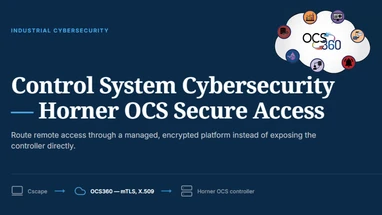
Route remote access through a managed, encrypted platform instead of exposing the controller directly. Horner's OCS360 Cloud Platform provides a controlled, encrypted path for authorized access rather than an open web server or an inbound connection on your firewall. OCS360 connects Cscape for remote troubleshooting, program and firmware upgrades, and WebMI visualization through the cloud, so there is no need to publish the PLC to the internet at all.
The controls that make this defensible:
- Managed cloud connection with mTLS and X.509 certificates - mutual authentication, so both ends prove identity
- End-to-end encryption across devices, servers, and engineering laptops
- Certified devices only - only approved hardware can connect to the server
- No direct public PLC exposure and no static IP requirement at the controller
- Robust audit logs and a single platform for both visibility and support
Because visualization runs through WebMI, operators and engineers get real-time monitoring, HMI access, alarm and event views, trending, recipe control, and remote programming without a device-level static IP and without a forwarded port. Fewer service calls need to become site visits, and every remote session leaves a record.
Why an integrated OCS architecture reduces the attack surface
An Operator Control Station (OCS) combines control, visualization, I/O, and communications in one platform programmed from one software environment, Cscape. That consolidation is a security advantage: fewer separate devices, fewer software packages, fewer vendor dependencies, and one thing to inventory, update, and patch instead of five. It also means password protection for controller programming and network access, user-level permissions tied to job responsibilities, and protected application access are configured in a single toolchain rather than spread across mismatched products.
Automation Distribution carries the full Horner OCS line to build that integrated architecture:
- The XL7 Prime and XL15 Prime all-in-one controllers, built on Horner's newer System on Module with 100% non-volatile memory and a faster CPU. Browse the full OCS XL Series and XL4 Prime Series.
- The Micro OCS (X-Series) embedded controllers with built-in logic engine, operator interface, networking, and I/O.
- Modular OCS-I/O for local expansion or remote I/O distributed over a CsCAN fieldbus.
A focused product ecosystem is easier to inventory, update, and maintain - which is exactly what a defensible automation environment requires.
A defense-in-depth checklist for control-system security
No controller, network, or cloud service secures a facility on its own. Effective protection is layered. Use the following ten areas as a working checklist to reduce exposure, control remote access, and improve your ability to recover from an incident:
- Protect controller access - change default passwords before commissioning, use unique per-user credentials, apply user-level permissions, and remove unused accounts.
- Avoid direct internet exposure - no PLC or HMI on the public internet, remove unneeded port-forwarding rules, and verify programming ports are not publicly reachable.
- Use secure remote access - route through an approved encrypted platform, individual accounts instead of shared credentials, MFA where supported, and logged sessions.
- Segment the automation network - separate OT from the business network, use industrial firewalls between zones, and keep general-purpose office PCs off the controllers.
- Reduce the attack surface - disable unused services and ports, remove obsolete devices, and favor integrated architectures with fewer connections to maintain.
- Maintain software and firmware - track advisories, keep firmware and tools at supported versions, test updates before deployment, and replace equipment that no longer receives security updates.
- Back up critical systems - keep current backups of programs, HMI applications, recipes, and network settings, with at least one copy stored offline and verified restorable.
- Control system changes - require authorization, record who changed what and why, and compare running programs against approved master copies when something looks off.
- Monitor for warning signs - watch for unexpected resets, mode changes, repeated login failures, and unfamiliar screens; train operators to report them immediately.
- Prepare an incident-response plan - define who can isolate the network, how to place the process in a safe state, and how to restore programs and configurations.
Frequently asked questions
Does Horner OCS360 require exposing the PLC to the internet?
No. OCS360 provides a managed, encrypted cloud path so authorized users reach Cscape, program and firmware upgrades, and WebMI visualization without a forwarded port or a static IP on the controller. Connections use end-to-end encryption and mTLS with X.509 certificates, and only certified devices can connect.
What is an OCS controller?
An OCS (Operator Control Station) is an all-in-one Horner controller that combines PLC control, HMI visualization, I/O, and communications in one unit programmed from a single environment, Cscape. Consolidating those functions reduces the number of separate devices and software packages you have to secure and maintain. See the full Horner OCS controller lineup.
How does an integrated controller reduce cybersecurity risk?
Fewer separate devices, interfaces, and vendor dependencies mean a smaller attack surface and a shorter inventory to patch and monitor. Password protection, user-level permissions, and protected application access are configured in one toolchain rather than across mismatched products, which makes the system easier to keep current across its lifecycle.
Do I still need network segmentation if I use OCS360?
Yes. Cybersecurity is defense-in-depth. A secure remote-access platform handles one layer, but you still want OT separated from the business network, industrial firewalls between zones, controlled change management, backups, monitoring, and an incident-response plan. No single product secures an entire facility.
Build a defensible control system with Automation Distribution
Automation Distribution is an authorized distributor of Horner Automation. Browse the full Horner OCS controller selection, or call 1-888-600-3080 to talk through secure remote access, OCS360 connectivity, and the right controller for your application.