
Aug 14th 2025
How to Add 2D Vision-Guided Robotics without Deep Expertise
Until recently, vision-guided robotics (VGR) was a tantalizing prospect for many manufacturers who want to use collaborative robots to automate more repetitive tasks in their production operations. But it was only feasible for large manufacturers or others with extensive engineering resources and deep experience in robotics and machine vision.
VGR was often highly complex and required custom implementations that could take weeks or months to configure. But the vision landscape has shifted dramatically and VGR is now immediately accessible to manufacturers of all sizes and experience levels, thanks to advancements in machine vision software.
A Simple Solution for Adding 2D VGR to Your Operations
In particular, the Aurora 2D VGR Assistant from Zebra Technologies represents a huge breakthrough that gives small and medium-sized manufacturers the opportunity to take advantage of vision-guided collaborative robots with minimal technical overhead or expertise.
Zebra’s intuitive software and tools make it far easier and faster to deploy VGR solutions that enable collaborative robots to perform tasks with visual guidance, including:
- Object positioning and movement
- Machine tending for CNC and injection molding
- Tools tasks such as drilling, screwing, fastening, and adhesive application
- Visual inspection and metrology
- Packaging, kitting, and package or label checks
- Barcode scanning and text capture via OCR

Challenges That Zebra’s 2D VGR Assistant Overcomes
For many manufacturers, collaborative robots are already playing a key role in repetitive tasks. However, empowering these robots to “see” their environment and interact precises and accurately with objects, tasks, and dynamic conditions requires vision guidance. That’s where things typically get complicated, and many smaller and medium-sized manufacturers struggle with several common issues:
- Limited in-house vision expertise to manage calibration or workflow setup
- Time-consuming configuration processes for each robot application
- Inconsistent integration protocols between robots and vision systems
- Frequent production changeovers in high-mix, low-volume environments
These barriers have kept vision-guided robotics out of reach for many teams, but solutions such as Zebra’s Aurora 2D VGR Assistant have changed all of that.
A Simpler Approach: Zebra’s Aurora 2D VGR Assistant
Zebra’s Aurora 2D VGR Assistant dramatically simplifies the process and time required to set up and manage vision-guided robotics, including calibration, configuration, testing, and validation. Built as an add-on to Zebra’s Aurora Design Assistant Integrated Development Environment (IDE), it brings advanced 2D robotic vision into an intuitive, flowchart-based platform.
Key advantages include:
- A browser-based user interface with guided workflows
- Step-by-step setup for robot-to-camera communication, calibration, and object teaching
- No programming expertise required
- Powerful capabilities for loading, unloading, machine tending, picking and packing
- Preloaded tools for dimensioning, inspection, barcode scanning and OCR
- Compatibility with leading collaborative robots such as Universal Robots
With this easy-to-use software adad-on, you configure and deploy robust 2D VGR applications in a fraction of the time it would take using traditional methods.
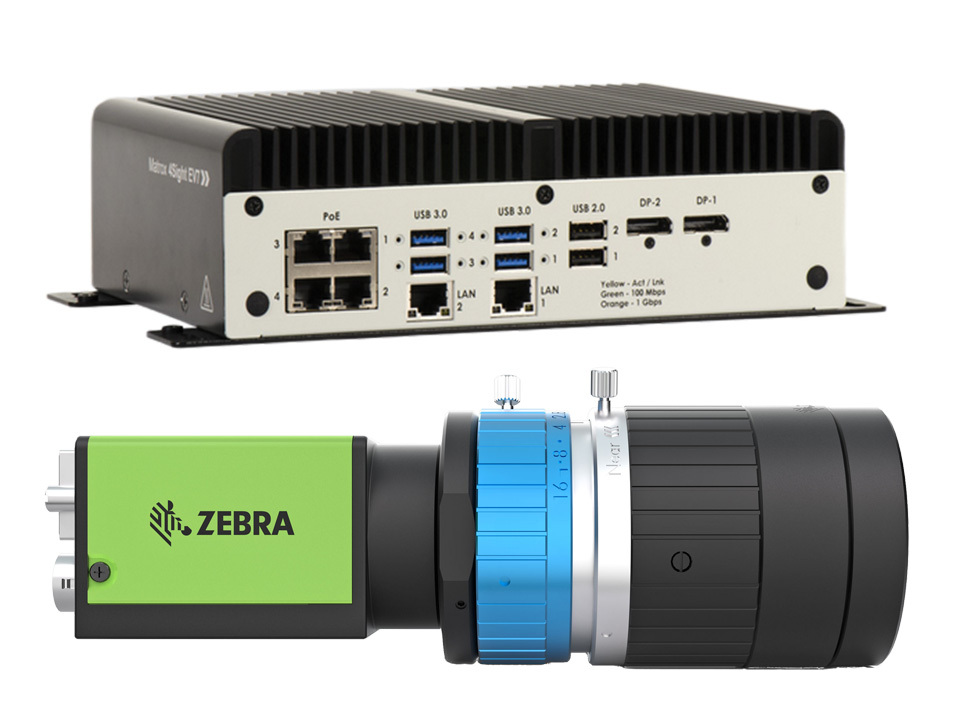
Step-by-Step Setup: From Camera to Calibration to Action
The Aurora VGR Assistant is structured around four key phases:
- Communication Setup
TCP/IP connection between the vision system and robot controller for data sharing - Camera Configuration
Simplified device setup with Zebra Imaging Capture Works, offering plug-and-play integration for GigE Vision-compliant cameras - Calibration
Robust tools for camera-to-robot calibration using manual or automatic workflows and visual quality metrics - Object Teaching and Testing
Allows users to visually define objects of interest and test robot picking behaviors—all from within a browser, without custom code.
This integrated process reduces trial-and-error and speeds up deployment while maintaining high repeatability.
Where 2D VGR Makes the Biggest Impact
With Aurora VGR Assistant, you can give your collaborative robots 2D vision and enable a wide range of tasks across industries:
- Machine Tending
Automatically load, unload and tend CNC or molding machines with flexible, vision-based part recognition - Packaging & Kitting
Identify and handle items arranged in trays or on conveyors, with support for barcode checks and packaging inspection - Tool Guidance
Guide tool tasks such as drilling, screwing, fastening or adhesive application while using the same vision system to inspect the results
For less structured environments or more challenging and complex tasks that warrant 3D vision capabilities, Zebra also offers 3D vision solutions with similarly simple and intuitive software, configuration, and application design. But this is where it can also be helpful to work with an outside resource that can provide you with additional application design and coding capabilities, as needed for much more advanced applications.
Making VGR a Practical Reality for Your Business
As manufacturers continue to face labor constraints, rising costs, and the pressure to increase output and quality, automation is no longer optional. And vision guidance is an ideal way to take your automation and robotics to a new level, allowing your collaborative robots to adapt in ways that were previously only possible with human oversight.
With Zebra’s Aurora 2D VGR Assistant, the technical and financial barriers to entry have been lowered significantly, and this opens the door to enable and scale automation faster, with less reliance on specialized expertise.
If your business is considering how to add or expand vision-guided robotics, then now is the time to check out Zebra’s hardware and software capabilities and see if this solution is right for your needs.
Want to see how this works in practice?
Connect with our automation experts at Automation Distribution get a complete walkthrough of Zebra’s Aurora VGR Assistant and learn how you can integrate 2D vision guidance into your production environment. To get started, contact us now.