
Jan 8th 2026
Manufacturing vs. Design: Which Is Really Harder?
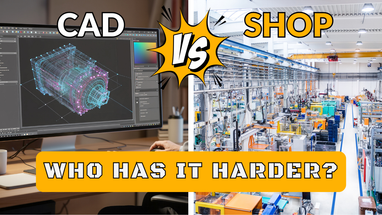
Spend enough time around engineers and you’ll hear the same debate over and over: “Who has it harder, design or manufacturing?” After years of watching drawings crash into reality on the shop floor, the honest answer is that they’re hard in very different ways—and most of the real pain comes from how poorly the two sides understand each other.
Two different types of “hard”
Design work is front‑loaded and abstract. Design engineers live in CAD, requirements, and spreadsheets. Their job is to make something that obeys physics, meets standards, hits cost targets, and should be manufacturable. They make decisions with incomplete information, and those decisions can lock in cost and quality for the entire product life. One bad tolerance call or material choice can cost more than the entire engineering budget.
Manufacturing work is continuous and concrete. Manufacturing engineers own what happens when those drawings hit steel: equipment capability, variation, operators, maintenance, safety, and throughput. Our world is scrap, rework, downtime, and “why is the line down again ten minutes before shift change?” While design is working toward milestones on a Gantt chart, manufacturing is judged shift by shift, hour by hour.
Why manufacturing often feels tougher
From the manufacturing side, it’s easy to feel like the work is “harder” because the consequences are immediate and highly visible. When something is wrong, it isn’t a simulation that fails—it’s:
-
A line that can’t hit rate.
-
A pallet of scrap parts no one wants to pay for.
-
Overtime because the changeover took an extra two hours.
-
A customer screaming because their order didn’t ship.
Plans rarely survive first contact with the production floor. Material variation, tool wear, operator differences, machine quirks, late trucks—none of this shows up in a neat FEA plot. Manufacturing engineering lives in that gap between the tidy model and dirty reality. A typical day might include:
-
Debugging a fixture that “worked in the CAD review” but is impossible to load with gloves on.
-
Chasing a dimensional issue that turns out to be a borderline tolerance stack‑up.
-
Rewriting work instructions on the fly because the current sequence only works for your one superstar operator.
-
Sitting in the morning meeting explaining why OEE dropped 8% yesterday and what you’re doing about it.
And when a design decision creates pain in production, manufacturing is usually the one dragged into the war room to explain why the line is behind, even if the drawing never should have been released in that form.
Where design clearly feels harder
That said, anyone who has spent time in design knows it carries its own heavy load. Good design engineers are already doing “manufacturing work” in their head:
-
Thinking through tolerance stacks, tooling, and process capability.
-
Choosing features that can be inspected, not just machined.
-
Balancing conflicting requirements from marketing, safety, regulatory, and operations.
-
Making calls under uncertainty that will be frozen into tooling and fixtures for years.
It’s one thing to make something that works once in a lab. It’s another to make something that works, can be built at rate, can be serviced, passes all regulations, and stays cost‑competitive. The best design engineers are constantly trading elegance for manufacturability, performance for cost, and novelty for risk.
The stress in design is quieter but very real: the pressure of knowing that a decision made this week may determine whether the plant struggles for the next five years. A missed requirement, a hidden failure mode, or an unrealistic tolerance might not show up until after tooling is cut and orders are booked. At that point, “just change the design” isn’t simple—it’s millions of dollars, months of delay, and a lot of angry people.
Why design and manufacturing clash
Most of the “who has it harder” tension comes from asymmetry in visibility and empathy.
-
Design often sees manufacturing only when something explodes—an ECO request, a frantic email, a line‑down situation. From that vantage point, it can look like “they just won’t follow the drawing.”
-
Manufacturing sees the downstream reality of every design shortcut and compromise, but rarely sees the constraints design was under when those choices were made. From that vantage point, it can look like “they don’t care how this is actually built.”
The result is a familiar pattern:
-
Drawings that ignore real tooling and fixturing constraints.
-
Assemblies that require three hands or an operator to defy gravity.
-
Fasteners you can’t reach without special tools, or features that can’t be inspected without contortions.
-
Tolerances that look fine on screen but blow up Cpk on the line.
When there’s no structured DFM/DFA process and no regular communication, both sides end up frustrated and defensive. Manufacturing feels like a permanent fire brigade; design feels like it’s being blamed for everything.
A better question: how do we share the hard parts?
Instead of arguing about whose job is harder, the better question is: how do we share the hard parts so the product is easier to build, ship, and support? In practice, that looks like:
-
Bringing manufacturing in early.
Not as a gatekeeper at the end, but as a voice during concept and preliminary design. If a manufacturing engineer has never seen the design until it’s “ready for release,” you’re almost guaranteed late changes, band‑aid fixes, and resentment. -
Putting designers on the floor.
CAD is powerful, but it’s no substitute for watching an operator wrestle with a part for eight hours. When design engineers see setups, changeovers, maintenance work, and real cycle times, they design differently—simpler, more robust, more humane. -
Sharing metrics, not siloing them.
If design is rewarded only for hitting feature and cost targets, and manufacturing is punished for every missed shipment, you’ve built conflict into the system. Align people around total product success: quality, cost, delivery, and safety. -
Normalizing feedback both ways.
Manufacturing should feel safe flagging recurring issues back into design reviews. Design should feel empowered to ask manufacturing what’s truly painful and where small changes could remove huge headaches.
So… which is harder?
From a manufacturing perspective, it feels like we carry more day‑to‑day stress: live numbers, live lines, live customers. Design, on the other hand, carries deeper technical and long‑term responsibility. Trying to crown a “winner” mostly just deepens the divide.
The reality is that modern products only succeed when both disciplines do the hard parts together:
-
Design that respects the chaos of a real factory.
-
Manufacturing that respects the complexity and constraints of real design work.
If you work in this world, you don’t need a poll to know how tough it can be on both sides. The real measure of a mature organization isn’t whether it can defend which role is harder—it’s whether design and manufacturing are willing to sit at the same table, share the pain, and build something better than either could alone.
Need help turning better designs into smoother production? Talk to the engineering team at Automation Distribution about your next project and get practical options for automating, simplifying, and de‑risking your line.