
Mar 4th 2026
No-Code Pick-and-Place Automation: How Zebra Is Making Vision-Guided Robotics Accessible for High-Mix Operations
For manufacturers running high-mix, low-volume production, automating pick-and-place has always been a tough equation. Zebra’s latest VGR solution changes the math.
The High-Mix Automation Problem
If you work in manufacturing, you know the scenario well. Your facility handles dozens—maybe hundreds—of different parts across short production runs. Pick-and-place tasks eat up labor hours, and the repetitive nature of the work makes errors inevitable. It’s exactly the kind of operation that should be automated.
But here’s the catch: traditional robotic automation requires significant programming effort for each new part or configuration. When you’re switching setups frequently and production volumes are modest, the time and cost to program, test, and validate a new vision job can be hard to justify. By the time the system is dialed in for one product, you’ve already moved on to the next.
This is the gap that Zebra Technologies is closing with its Aurora VGR Assistant—a no-code solution designed to make vision-guided pick-and-place not just possible for high-mix environments, but practical.
Aurora VGR Assistant: From Weeks to Hours
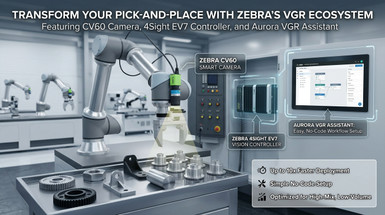
The Aurora VGR Assistant is integrated into Zebra’s Aurora Design Assistant, the company’s flowchart-based development environment for machine vision applications. What makes VGR Assistant different is that it eliminates the need for scripting entirely. Teams can design, test, and deploy complete vision-guided pick-and-place tasks for collaborative robots (cobots) without writing a single line of code.
The tool provides prebuilt flow steps, 2D pattern-finding capabilities, and reusable templates. An engineer can define how the system should identify a part, where to pick it, how to orient it, and where to place it—all through a visual interface. The software coordinates the camera, the cobot, and the PLC, handling the communication and synchronization that traditionally required custom integration work.
The result is striking: Zebra reports that deployment times can be reduced by up to 10x compared to conventional approaches. A vision job that might have taken weeks of engineering time can now be up and running in hours. And because the templates are reusable, switching to a new part or product becomes a matter of configuration rather than reprogramming.
The Hardware Behind the Intelligence
Software is only half the equation. The Aurora VGR Assistant is paired with Zebra’s purpose-built hardware to deliver a complete, production-ready solution.
The Zebra CV60 vision camera serves as the system’s eyes. Available in resolutions ranging from 2.3 to 12.3 megapixels, the CV60 delivers the image clarity needed for precise part identification and localization. It supports both USB 3.0 and GigE Vision interfaces, giving integration teams flexibility in how they connect the camera to the rest of the system. Whether you need to capture fine detail on small electronic components or identify larger items on a packing line, the CV60’s resolution range covers a wide spectrum of applications.
Processing the vision data is the 4Sight EV7 Industrial Vision Controller. Built for the demands of the factory floor, the EV7 handles multi-camera applications and communicates seamlessly with robotic systems through industrial protocols like Ethernet/IP and PROFINET. Its I/O capabilities and communication flexibility mean it can slot into existing production infrastructure without requiring a wholesale rearchitecture of your controls network.
Together, the CV60 and 4Sight EV7 form a hardware foundation that’s designed to be both powerful and adaptable—critical qualities when your production line doesn’t look the same from one week to the next.
Where This Solution Fits
Zebra positions this pick-and-place solution for a range of applications that share a common thread: they involve repetitive object handling where speed, accuracy, and flexibility all matter.
Packing and packaging: Cobots guided by 2D vision pick items from a conveyor or staging area and place them into boxes, trays, or cartons. The system identifies each item’s position and orientation, ensuring consistent placement even when items arrive in slightly varying positions.
Machine tending: Loading and unloading CNC machines, injection molds, or other processing equipment is a prime candidate for cobot automation. The vision system confirms part presence and orientation before the robot executes the load, reducing the risk of misfeeds or crashes that damage tooling.
Kitting and assembly: When building kits or sub-assemblies that require picking specific parts from multiple sources, vision-guided cobots can identify and select the right components without manual sorting.
Quality checks during handling: Because the 4Sight EV7 supports multiple cameras, manufacturers can combine pick-and-place operations with inline inspection. The same system that guides the robot can simultaneously verify part quality, read codes for traceability, or check for defects—adding value to every pick cycle without adding time.
Why This Matters Now
The manufacturing landscape is shifting. Customer demand for product variety continues to grow, which means shorter runs and more frequent changeovers. At the same time, finding and retaining skilled workers for repetitive manual tasks remains a persistent challenge across nearly every sector.
Vision-guided cobots offer a way to address both pressures simultaneously. They take over the repetitive, ergonomically taxing pick-and-place work, freeing human workers to focus on tasks that require judgment and problem-solving. And with no-code tools like Aurora VGR Assistant, the barrier to entry drops significantly. You don’t need a dedicated machine vision engineer on staff to deploy and maintain these systems.
The scalability factor is important too. Starting with a single cobot cell for one application and expanding to additional stations as you validate the ROI is a realistic path. The reusable templates and standardized hardware make each subsequent deployment faster and more predictable than the first.
Getting Started
If you’re considering vision-guided pick-and-place automation for your facility, the Zebra solution built around Aurora VGR Assistant, the CV60 camera, and the 4Sight EV7 controller is worth evaluating—particularly if you’ve previously ruled out automation because of the programming overhead.
The key questions to ask are straightforward: What pick-and-place tasks are consuming the most labor hours? Where are errors most frequent? And which operations would benefit most from faster changeover between product types? The answers will help you identify the highest-impact starting point.
The promise of this generation of tools is simple but compelling: pick-and-place automation that’s fast to deploy, easy to reconfigure, and built to scale alongside your operation.
Ready to Automate Your Pick-and-Place Operations?
Our team can help you find the right combination of Zebra vision cameras, controllers, and software to fit your production environment. Whether you’re exploring automation for the first time or looking to scale an existing setup, we’ll work with you to identify the highest-impact starting point.
Contact us today to discuss your application, request a demo, or get a custom quote on the Zebra Aurora VGR Assistant, CV60 camera, and 4Sight EV7 controller.