
Feb 4th 2026
The Hidden Cost of Going It Alone: Why Warehouse Automation Success Depends on the Right Partnership
Warehouse automation has reached an inflection point. While the technology to automate physically demanding tasks like palletizing has never been more sophisticated, the gap between the purchase of equipment and achieving operational excellence has never been wider. Recent implementations reveal a crucial truth that many operations managers overlook: the technology is only half the equation.
Consider the challenge facing modern fulfillment centers handling thousands of uniquely sized parcels daily. Workers manually lifting and stacking boxes weighing up to 20 kilograms represent not just an ergonomic liability, but a throughput bottleneck that compounds with every shift. The solution seems straightforward—deploy AI-powered robotic palletizers equipped with advanced 3D vision systems. Yet the path from concept to 99% uptime is littered with failed implementations that underestimated the integration complexity.
The Integration Challenge Nobody Talks About
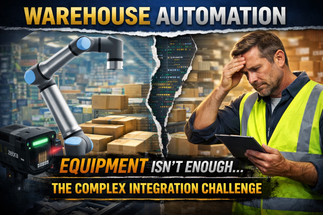
The recent success of automated palletizing systems achieving 450 pieces per hour while handling random box sizes demonstrates what's possible when vision technology, AI algorithms, and identification systems work in seamless concert. But here's what the case studies don't emphasize: achieving this harmony requires expertise that extends far beyond the equipment specifications.
Take barcode scanning integration as an example. A Zebra FS40 fixed scanner doesn't simply read labels—it must communicate parcel dimensions and routing data to downstream systems with split-second timing. The 3D vision system capturing high-resolution point clouds of moving objects needs this data synchronized perfectly to enable the AI to calculate optimal stacking patterns. One misconfigured parameter, one communication protocol mismatch, and your 450-pieces-per-hour target becomes a 200-pieces-per-hour reality with mysterious gaps and system faults.
This is where the distributor selection becomes critical, though it's often treated as an afterthought focused solely on price per unit.
Why Distributor Expertise Matters More Than Ever
The modern warehouse automation stack integrates multiple technologies—machine vision, robotics, data capture, industrial networking, and AI-driven control systems. When these components come from best-in-class providers like Zebra Technologies, the individual performance is excellent. But integration is where operational success is won or lost.
Forward-thinking distributors who specialize in automation solutions bring three critical capabilities that procurement departments often undervalue:
Application Engineering Support: Understanding that your facility needs to handle nearly two million parcels annually with varying dimensions requires translating operational requirements into technical specifications. The right distributor doesn't just sell you a scanner; they map your throughput targets, conveyor speeds, parcel size variability, and lighting conditions to ensure the scanning solution integrates properly with vision-guided robotics.
Systems Integration Knowledge: When your barcode scanner must communicate with 3D vision systems and robotic controllers in real-time, you need a partner who understands the entire ecosystem. Specialized distributors maintain relationships with robotics integrators, vision system providers, and automation software developers. They've seen the implementation patterns that work and, more importantly, the subtle incompatibilities that cause expensive delays.
Post-Implementation Optimization: Achieving initial operation is fundamentally different from achieving 99% uptime. Calibration drift, environmental changes, and operational variations require ongoing fine-tuning. Distributors with deep automation expertise provide the technical resources to optimize system performance over time, turning a functional installation into a competitive advantage.
The Total Cost of Ownership Calculation You're Missing
When evaluating automation investments, most financial models focus on equipment costs, installation, and projected labor savings. But the true differentiator in ROI comes from factors that appear weeks or months after go-live:
- Time to full production capacity
- System uptime percentage
- Maintenance efficiency
- Scalability for seasonal peaks
- Integration with future technologies
An operation that reaches 450 pieces per hour in three months with 99% uptime generates dramatically different returns than one that limps along at 300 pieces per hour for nine months before stabilizing at 95% uptime. The equipment might be identical; the partnership determines the outcome.
The Automation Distribution Advantage
This brings us to a critical strategic consideration: working with distributors who've built their business around automation solutions rather than general industrial supply. Companies like Automation Distribution have structured their organizations specifically to bridge the gap between equipment capabilities and operational results.
These specialized distributors invest in application engineers who understand both the technology and the operational context. When you're evaluating whether a particular vision system can handle your specific parcel mix at your required throughput, you need someone who's configured similar solutions, not someone reading from a product data sheet.
They maintain technical partnerships that matter for complex integrations. If your AI palletizing system requires tight coordination between Zebra scanning solutions, 3D vision systems, and robotic controllers, your distributor should have direct engineering relationships with all parties—not just a catalog and a phone number.
Perhaps most importantly, specialized automation distributors have skin in the game for your operational success. Their business model depends on successful implementations leading to expanded deployments and long-term technical partnerships. This alignment of incentives creates a fundamentally different relationship than transactional equipment sales.
Making the Partnership Decision
As you evaluate automation investments for tasks like random box palletizing, ergonomically challenging manual operations, or high-throughput fulfillment challenges, the distributor selection deserves equal weight to the technology selection.
Ask potential partners about their application engineering capabilities. Request case studies where they've integrated multiple technologies to solve complex operational challenges. Understand their post-installation support model and their relationships with complementary technology providers.
The era of simple equipment purchases is over. Modern warehouse automation requires orchestrating multiple sophisticated technologies into cohesive systems that deliver measurable operational results. The question isn't whether you can buy the components—you can source Zebra scanners, vision systems, and robotic controllers from numerous suppliers. The question is whether your partner can help you transform those components into a solution that achieves 99% uptime while handling whatever your operation demands.
In an industry where the difference between good and great performance translates directly to competitive advantage, choosing a distributor with deep automation expertise isn't just a procurement decision—it's a strategic imperative.