
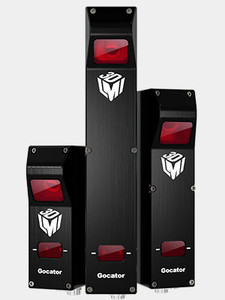
LMI Gocator 2300 Series Workhorse 3D Laser Line Profile Sensors
LMI Technologies


The only Gocator profiler with two cameras. Eliminates the occlusion shadow that single-camera laser profilers cannot see past. Built for log scanning, large complex objects, and any inspection target with protruding features that block conventional triangulation profilers.
The Gocator 2880 is LMI Technologies' dual-triangulation 3D laser line profiler - the only Gocator sensor that combines two cameras and one laser in a single integrated body to deliver complete 3D scan coverage of large, complicated, irregularly-shaped objects. Where conventional single-camera laser profilers cast an occlusion shadow behind protruding features (knots on logs, brackets on assemblies, raised seams on totes), the 2880's dual cameras see the laser line from two angles simultaneously, eliminating the shadow and capturing the full target geometry in a single pass. The 2880 is the standard sensor for primary log scanning in lumber mills worldwide and is equally at home on automotive assemblies, packaging, large totes, and any inspection target where conventional profilers leave data gaps.
Standard laser triangulation profilers project a laser line and use one camera, mounted at a known angle to the laser, to triangulate the Z position of each point along the line. The geometry works perfectly on flat or convex surfaces. But when the target has features that protrude up from the surface - a knot on a log, a raised boss on a machined part, the corner seam of a tote box - those features cast a shadow behind themselves where the camera cannot see the laser line. That shadow becomes a data gap in the 3D scan.
The Gocator 2880 solves this with two cameras at opposing angles, both viewing the same laser line. Where one camera is shadowed by a protruding feature, the other camera sees past it. The sensor automatically merges the two camera views into a single complete profile with no occlusion gaps. This is the dual-triangulation principle - and the 2880 is the only Gocator that implements it.
| Single-Camera Profiler | Gocator 2880 Dual-Camera |
|---|---|
| Occlusion shadow behind protruding features - missing data on the far side of knots, brackets, raised seams, edges. | Both sides of every protruding feature are captured in a single scan. No data gaps. |
| Multiple sensors required to cover both sides of a complex part. | One 2880 replaces two single-camera sensors in many applications - simpler integration, fewer cables, less calibration. |
| For 360-degree coverage on cylindrical parts, 4 or more sensors typically needed. | For 360-degree coverage on logs and cylindrical parts, only 2 or 3 sensors needed - the dual-camera design effectively doubles the angular coverage per sensor. |
| Specification | Value |
|---|---|
| Camera Configuration | Dual cameras, single laser, integrated body |
| Data Points per Profile | 1280 (megapixel imager) |
| Scan Rate | 380 - 5000 Hz |
| Field of View (FOV) | 390 mm (near) to 1260 mm (far) |
| Clearance Distance (CD) | 350 mm |
| Measurement Range (MR) | 800 mm |
| Resolution X | 0.375 mm - 1.100 mm |
| Resolution Z | 0.092 mm - 0.488 mm |
| Linearity Z | +/- 0.04 percent of measurement range |
| Laser | 660 nm red, Class 3R |
| Interface | Gigabit Ethernet |
| Inputs | Differential encoder, laser safety enable, trigger |
| Outputs | 2x digital output, RS-485 serial, analog (4-20 mA) |
| Industrial Protocols | EtherNet/IP, PROFINET, Modbus, ASCII, native Gocator protocol |
| Input Voltage / Power | +24 to +48 VDC, 13 watts, ripple +/- 10% |
| Housing | Gasketed aluminum enclosure, IP67 rated |
| Dimensions (L x W x H) | 498 x 75 x 49 mm |
| Weight | 2.56 kg |
| Operating Temperature | 0 to 50 degrees C |
| Storage Temperature | -30 to 70 degrees C |
| Vibration Resistance | 10 to 55 Hz, 1.5 mm double amplitude in X, Y, Z, 2 hours per direction |
| Shock Resistance | 15 g, half sine wave, 11 ms, positive and negative for X, Y, Z directions |
Specifications based on Class 3R laser configuration. Resolution X and Z values vary across the measurement range. Refer to the official Gocator 2880 datasheet for full specifications.
| Model | Laser Class | Wavelength | Mount | Part Number |
|---|---|---|---|---|
| Gocator 2880 | Class 3R | 660 nm red | Side | 312880D-3R-R-01-S |
Custom laser classes and mount orientations are available on request. Contact Automation Distribution at 1-888-600-3080 for non-standard configurations.
The Gocator 2880 was engineered for - and is the industry-standard sensor for - primary log scanning in sawmill operations. When logs pass through a measurement station on their way to the sawing line, the mill needs a complete 3D point cloud of the log to calculate volume, identify shape features (taper, sweep, crook), and determine optimal cutting patterns that maximize lumber yield per log.
Log surfaces are riddled with knots, bark protrusions, and other irregularities that occlude single-camera profilers. A single-camera ring of sensors would need 6 to 8 sensors to capture a complete log scan. With dual-camera 2880 sensors arranged in a ring configuration, mills capture the full 360-degree log surface using just 3 sensors - dramatically reducing system cost, calibration complexity, and maintenance burden. LMI Master network controllers handle the microsecond-synchronized triggering and laser safety interlock for the ring.
| Tote and Container Scanning Plastic totes and shipping containers have raised seams, corner reinforcements, and protruding handles that cast occlusion shadows on conventional profilers. The 2880's dual cameras capture the full geometry in a single pass for volume verification and damage inspection. |
Automotive Assemblies Complete body panel assemblies with raised bosses, brackets, and welded attachments produce occlusion shadows that single-camera profilers cannot capture. The 2880 measures gap and flush, body panel geometry, and assembly completeness without sensor stitching. |
| Large Castings and Forgings Irregular surfaces of castings, forgings, and rough-machined parts produce unpredictable occlusion patterns. The 2880's reduced-occlusion design captures the full part geometry for dimensional QA without complex multi-sensor systems. |
Bulk Material Profiling Aggregate piles, mining materials, and recycling streams have unpredictable surface geometry. The 2880's wide 1260 mm field of view and 800 mm measurement range capture wide piles with reduced data gaps. |
Round out your Gocator 2880 deployment with factory-correct hardware available through Automation Distribution: LMI Cordsets for power, I/O, and Ethernet; the GoMax Smart Vision Accelerator for multi-sensor ring acceleration; and LMI Master network controllers for synchronized multi-sensor log scanning systems.
The Gocator 2880 is LMI Technologies' dual-triangulation 3D laser line profiler, used primarily for primary log scanning in lumber mills, tote and container scanning, automotive assembly inspection, large casting and forging dimensional QA, and any application where target features cause occlusion shadows that single-camera profilers cannot capture. The dual cameras see past protruding features to deliver complete 3D coverage in a single scan. View the Gocator 2880 at Automation Distribution.
Standard laser triangulation profilers use one camera mounted at an angle to the laser. When the target has protruding features - knots on logs, raised bosses on parts, corner seams on totes - those features cast a shadow behind themselves where the single camera cannot see the laser line, creating data gaps in the 3D scan. The Gocator 2880 places two cameras at opposing angles, both viewing the same laser line. Where one camera is shadowed, the other sees past the feature. The sensor automatically merges the two views into one complete profile. This is the dual-triangulation principle.
Choose the Gocator 2880 when your target has features that protrude up from the surface and you need complete data on both sides of those features. Typical scenarios include log scanning (knots and bark), tote scanning (corner reinforcements and seams), automotive assemblies (raised bosses and brackets), and complex castings or forgings. If your target is flat, convex, or has features that don't significantly protrude (think: sheet metal, electronics, food products), a single-camera profiler like the Gocator 2400 Series or Gocator 2600 Series is the right choice.
Typically 3 Gocator 2880 sensors arranged in a ring configuration provide complete 360-degree coverage of a log passing through the measurement station. The dual-camera design effectively doubles the angular coverage of each sensor, reducing the sensor count from the 6 to 8 typically required for single-camera ring systems. LMI Master network controllers handle the microsecond-synchronized triggering, laser safety interlock, encoder distribution, and power delivery for the ring. Specific sensor count depends on log diameter, conveyor speed, and accuracy requirements - contact Automation Distribution for application-specific sizing.
Scan rates run from 380 Hz at the default configuration up to 5000 Hz with reduced regions of interest. For primary log scanning at typical conveyor speeds (1 to 3 meters per second), the 2880's scan rate easily keeps up with production throughput. For higher-speed inline inspection applications, the scan rate is comparable to other megapixel-imager Gocator profilers in the 2300 and 2400 Series.
The Gocator 2880 has one of the widest fields of view in the entire Gocator portfolio - 390 mm at the near edge of the measurement range and 1260 mm at the far edge, with an 800 mm measurement range and a 350 mm clearance distance. This wide envelope is purpose-built for large targets like logs, totes, and automotive assemblies that would require multiple sensors of any other Gocator family to capture in a single pass.
Yes. LMI Master network controllers (Master 100, 400, 800, 1200, and 2400) support 4, 8, 12, or 24 Gocator connections with synchronized power, laser safety, encoder input, and external trigger distribution. The multi-sensor ring configuration is the standard architecture for 360-degree log scanning. Each 2880 transmits 3D profile data to the host computer through standard Ethernet switches.
The 498 mm body length accommodates the dual-camera geometry. With two cameras mounted at opposing angles to one laser, the sensor needs sufficient baseline distance between the cameras to achieve the triangulation accuracy at the 800 mm measurement range. The 498 mm form factor is a deliberate tradeoff - longer than a single-camera profiler but still compact enough for ring mounting and integration into existing sawmill structures.
Automation Distribution's application engineers work directly with LMI Technologies to size dual-triangulation systems for log scanning, large-part inspection, and complex assembly QA. Whether you are scoping a primary log scanning ring, a tote inspection cell, or a single-sensor large-part station, we will help you get the configuration right the first time.
Request a quote or call 1-888-600-3080
LMI Technologies
LMI Technologies


LMI Technologies