
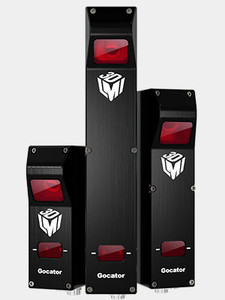
LMI Gocator 4000 Series Smart 3D Coaxial Line Confocal Sensors
LMI Technologies


The only smart 3D sensor that measures inside transparent materials. Patented dual-axis line confocal imaging captures 3D surface topography, 3D sub-surface tomography, and 2D intensity data simultaneously - in a single scan, on materials no other 3D sensor can reliably measure.
The Gocator 5500 Series is LMI Technologies' family of patented dual-axis line confocal sensors - the industry's first smart 3D line confocal sensors and the only sensors that simultaneously generate 3D topography, 3D tomography, and 2D intensity data in one pass. Where most 3D sensors measure only the top surface of a target, the 5500 Series uses Line Confocal Imaging (LCI) technology to look through transparent and translucent layers, measuring each material interface independently. Multi-layered cell phone glass, bonded automotive glass, wafer subsurface structure, brake pad surface roughness, polished bearings - the 5500 Series handles material structures that defeat every other 3D inspection technology. Three optical models (Gocator 5504, 5512, and 5516) cover semiconductor, automotive, consumer electronics, and precision manufacturing applications with sub-micron Z precision and scan rates over 10 kHz.
Every other Gocator family captures one fundamental data type - laser line profilers (2100, 2300, 2400, 2500, 2600, 6300, 2880) capture 3D surface topography; snapshot sensors (3210, 3500) capture 3D structured light topography; coaxial confocal sensors (4000) capture shadow-free topography plus 2D intensity. The 5500 Series captures three data types simultaneously in every scan:
| Data Type | What It Captures | What You Can Measure |
|---|---|---|
| 3D Topography | The surface shape of the target - heights, slopes, edges, geometric features. | Dimensional gauging, surface defect detection, geometric measurement, gap and flush. |
| 3D Tomography | Sub-surface layer structure on multi-layered, transparent, and translucent materials. Each material interface is measured independently. | Bonded glass layer thickness, adhesive layer measurement, semiconductor wafer subsurface, multi-layer film thickness, sub-surface defect detection. |
| 2D Intensity | A high-resolution 2D grayscale image of the target captured simultaneously with the 3D data. | Visual defect detection, surface texture analysis, OCR, pattern recognition, alignment fiducial detection. |
No other sensor in the Gocator portfolio - and no other smart sensor in the industry - delivers all three data types simultaneously. Tomography in particular is unique to the 5500 Series: it is the only family that can look through transparent materials and measure the layered structure inside.
Conventional confocal sensors use a single optical axis - illumination and detection share the same path through the lens. This works well for surface topography but limits signal quality and prevents simultaneous tomography capture. LMI's patented dual-axis Line Confocal Imaging (LCI) design uses two optical axes - a separate illumination axis and detection axis at calibrated geometry - that together deliver superior signal quality and enable the simultaneous tomography measurement that single-axis confocal cannot achieve.
The dual-axis design is the reason the 5500 Series can scan material types that defeat every other 3D inspection technology:
The 5500 Series consists of three optical models. All three share the same dual-axis LCI architecture, the same 1792 data points per profile, and the same software platform. They differ in working envelope - clearance distance, measurement range, and field of view - to match the target part size and inspection geometry.
| Model | Working Envelope | Best Suited For |
|---|---|---|
| Gocator 5504 Smallest envelope |
Tightest FOV with the closest clearance distance - approximately 4.3 mm FOV, 7.78 mm clearance, 1.1 mm measurement range. | Semiconductor wafer dimensioning, sorting, surface defect detection. Highest X resolution applications where the target is small and precision is paramount. |
| Gocator 5512 Mid-range |
Balanced FOV and clearance for general precision applications. | Automotive brake pad surface roughness measurement, simultaneous inspection of multiple surfaces on assembled parts, mid-size precision components. The most versatile model in the family. |
| Gocator 5516 Largest envelope |
Largest FOV (up to 17 mm) with longer clearance distance (up to 60.75 mm) and 5.5 mm measurement range. | Multi-layered cell phone glass thickness measurement, bonded automotive glass inspection, larger consumer electronics with multi-layer structures, applications requiring the longer standoff distance. |
Detailed per-model clearance distance, measurement range, field of view, weight, and dimensions vary across the 5500 Series. Contact Automation Distribution at 1-888-600-3080 for the official datasheet for your selected model and application-specific recommendations.
Download the Official Datasheet
Get the full Gocator 5500 Series technical datasheet with detailed per-model specifications, dimensional drawings, and certifications.
Download the LMI Gocator 5500 Series datasheet (PDF) Revision: September 2025
| Specification | Value |
|---|---|
| Capture Technology | Patented dual-axis line confocal imaging (LCI) |
| Output Data Types | 3D topography + 3D tomography + 2D intensity (simultaneous) |
| Data Points per Profile | 1792 |
| X Resolution (best) | 2.5 microns |
| Z Repeatability (best) | 0.05 microns (sub-micron precision) |
| Field of View Range | 4.3 mm (5504) to 17 mm (5516) |
| Measurement Range | 1.1 mm (5504) to 5.5 mm (5516) |
| Clearance Distance Range | 7.78 mm (5504) to 60.75 mm (5516) |
| Scan Rate | Over 10 kHz with PC acceleration; exceeding 16 kHz at reduced regions of interest |
| Onboard Software | GoPxL IIoT Vision Inspection Software (browser-based) |
| Interface | Gigabit Ethernet |
| Industrial Protocols | EtherNet/IP, PROFINET, Modbus, ASCII, native Gocator protocol |
| Acceleration | GoMax NX, ORIN, or ORIN+ accelerator (or PC acceleration) required for high-speed inline operation |
| Multi-Layered Cell Phone Glass Bonded glass display assemblies have two or three layers laminated together with optical adhesive. The 5500 Series measures each glass layer's thickness independently in a single scan - the cover glass, the touch sensor layer, and the display layer. No other smart 3D sensor can resolve these layers. |
Semiconductor Wafer Inspection The Gocator 5504 is the standard sensor for semiconductor wafer dimensioning, sorting, and surface defect detection. Sub-micron Z precision combined with the high X resolution captures the fine features and steep edges that wafer inspection demands. |
| Automotive Brake Pad Surface Roughness The Gocator 5512 measures brake pad friction surface roughness with sub-micron Z precision. The dual-axis design handles mixed-material brake pad composites where conventional sensors struggle with the textured friction surface. |
Bonded Automotive Glass Laminated automotive windshields and side glass with adhesive interlayers. The tomography data measures glass thickness and adhesive layer thickness independently, identifying bonding defects that conventional inspection cannot detect. |
| Curved-Edge Glass and Ceramic Chamfered and rounded edges on cell phone glass, ceramic substrates, and optical components. The dual-axis design handles edge geometry without the specular reflection failures that defeat triangulation and even single-axis confocal sensors. |
Multi-Surface Simultaneous Inspection The Gocator 5512 measures multiple surfaces on the same assembled part simultaneously - useful for inspecting features at different heights on stepped or complex parts where conventional sensors require multiple exposures or multiple sensors. |
| Transparent Film Layer Measurement Plastic packaging films, optical coatings, transparent protective films. The tomography measurement captures top and bottom surfaces of each layer, enabling thickness measurement of films that triangulation cannot resolve. |
Sub-Surface Defect Detection Defects below the surface of transparent or translucent materials - inclusions in glass, voids in adhesive layers, delamination in bonded structures. Only the 5500 Series tomography mode can detect these subsurface defects without destructive testing. |
The Gocator 5500 Series is one of two line confocal sensor families in the Gocator portfolio. Each addresses a different inspection priority:
| Family | Primary Differentiator | Best For |
|---|---|---|
| Gocator 4000 Series Coaxial line confocal |
Coaxial single-axis design eliminates triangulation shadow. Plus or minus 85 degree slope angle. Captures topography and intensity. | Inspection where slope angle, deep grooves, mirror reflections, or shadowing are the primary challenge. Single-axis topography and 2D intensity output. |
| Gocator 5500 Series Dual-axis line confocal |
Patented dual-axis design simultaneously captures 3D topography, 3D tomography, and 2D intensity. The only sensor with subsurface tomography. | Multi-layered, transparent, translucent, and mixed-material inspection where layer thickness and sub-surface structure matter as much as surface topology. |
Choose the 4000 Series when the challenge is surface geometry that triangulation cannot capture (steep slopes, deep grooves, mirror surfaces). Choose the 5500 Series when the challenge is the material itself - multi-layered structures, transparent films, sub-surface features, or applications requiring all three data types in one pass.
| Consumer Electronics Multi-layered cell phone glass thickness, bonded display assembly inspection, cover glass surface measurement, transparent adhesive bead inspection, curved edge geometry on premium device assemblies. |
Semiconductor Wafer dimensioning, sorting, surface defect detection, polished wafer surface measurement, scribe line inspection, advanced packaging surface metrology. |
| Automotive Brake pad surface roughness measurement, bonded windshield and side glass inspection, multi-layer paint thickness, polished metal trim surface measurement, glass-to-frame bonding QA. |
Glass and Optical Architectural glass thickness, optical coating layer measurement, multi-layer optical filter inspection, prism and lens surface measurement, polished mirror surface QA. |
| Pharmaceutical and Medical Blister pack film thickness, transparent vial inspection, medical device coating measurement, sterile packaging integrity, transparent component surface measurement. |
Precision Manufacturing Polished bearings, optical components, mirror-finish mechanical parts, transparent assembly inspection, mixed-material precision components where conventional sensors fail. |
| EV Battery Battery separator film thickness, electrolyte coating thickness, mixed-material cell stack edges, transparent protective layer measurement on advanced cell designs. |
Solar and Photovoltaic Solar cell layer thickness, transparent conductive coating measurement, anti-reflective coating inspection, encapsulant layer measurement on assembled modules. |
Round out your Gocator 5500 Series deployment with factory-correct hardware available through Automation Distribution: LMI Cordsets for power, I/O, and Ethernet; the GoMax Smart Vision Accelerator for high-speed scan rate operation and AI-based defect inference; and the GoPxL Anomaly Detector for AI surface defect detection. For complementary surface-only inspection where shadow-free topography is the priority, see the Gocator 4000 Series coaxial line confocal sensors.
The Gocator 5500 Series is LMI Technologies' family of patented dual-axis line confocal sensors, used for inline inspection of materials and structures that defeat conventional 3D sensors. Typical applications include multi-layered cell phone glass thickness measurement, semiconductor wafer dimensioning and sorting, automotive brake pad surface roughness, bonded automotive glass inspection, transparent film thickness measurement, polished bearing surface measurement, and any application requiring simultaneous 3D topography, 3D tomography, and 2D intensity data in a single scan. View the Gocator 5500 Series at Automation Distribution.
In the context of 3D sensors, tomography means measuring the sub-surface structure of multi-layered or transparent materials - looking "inside" the target rather than only at its top surface. The 5500 Series is the only Gocator sensor that captures tomography data, and one of the few smart 3D sensors in the industry with this capability. Tomography enables measurements that no other 3D sensor can make: layer thickness of bonded glass, sub-surface defect detection in transparent films, adhesive layer measurement under cover glass, and other applications where the inspection target has internal structure that matters.
Both are line confocal sensor families but use different optical architectures. The Gocator 4000 Series uses a coaxial single-axis design optimized for shadow-free 3D topography on the target surface - the killer feature is plus or minus 85 degree slope angle capability. The Gocator 5500 Series uses a patented dual-axis design that simultaneously captures 3D topography, 3D tomography (sub-surface layer structure), and 2D intensity data. Choose the 4000 Series when slope angle and surface shadowing are the primary inspection challenges. Choose the 5500 Series when multi-layered structures, transparent material thickness, or sub-surface defects are the target.
The right model depends on your target part size and standoff requirements. The Gocator 5504 (smallest envelope, 4.3 mm FOV, 1.1 mm measurement range, 7.78 mm clearance) is purpose-built for semiconductor wafer applications. The Gocator 5512 (mid-range envelope) is the most versatile model and is the standard choice for brake pad inspection, multi-surface part scanning, and general precision applications. The Gocator 5516 (largest envelope, 17 mm FOV, 5.5 mm measurement range, 60.75 mm clearance) is the right choice for multi-layered cell phone glass, bonded automotive glass, and larger multi-layered targets where the longer measurement range is needed. Contact Automation Distribution at 1-888-600-3080 for application-specific recommendations.
Yes. The dual-axis line confocal imaging principle measures through transparent and translucent materials, capturing the top surface, the bottom surface, and any internal layer interfaces independently. This is the defining capability of the 5500 Series and is what enables applications like multi-layered cell phone glass thickness measurement, bonded automotive glass inspection, transparent adhesive layer measurement, and sub-surface defect detection in glass and polymer materials.
Scan rates exceed 10 kHz with PC or GoMax acceleration, and can exceed 16 kHz at reduced regions of interest. Because the 5500 Series captures three data types simultaneously (topography, tomography, intensity), the effective inspection throughput per scan is significantly higher than sensors that require multiple passes for multi-modal data. Acceleration is required for high-speed inline operation - either a GoMax NX, ORIN, or ORIN+ accelerator, or PC-based acceleration.
Z repeatability up to 0.05 microns means the sensor can detect height variations as small as 50 nanometers - one-twentieth of a micron, or about 1/2000th the thickness of a human hair. In practice this enables measurement of features that conventional laser triangulation sensors cannot resolve: thin adhesive bead heights, polished surface waviness, layer thickness in laminated materials, and sub-micron surface defects on precision optical components. This level of Z precision is normally available only from offline metrology instruments like coordinate measuring machines or white light interferometers - the 5500 Series brings it to inline production inspection.
Yes. The Gocator 5500 Series ships with GoPxL IIoT Vision Inspection Software onboard - LMI's next-generation browser-based vision platform with built-in support for the 5500's unique multi-layer profile output. No additional software purchase is required for basic operation. For AI-based defect detection capabilities, the optional GoPxL Anomaly Detector licensed dongle adds deep-learning defect identification on top of GoPxL.
Yes. The 5500 Series supports standard Gocator multi-sensor networking for synchronized power, laser safety, encoder input, and external trigger distribution across multiple sensors. Multi-sensor configurations enable parallel inspection on the same production line - particularly useful for high-throughput semiconductor wafer sorting and consumer electronics multi-station inspection. Each 5500 sensor's high data volume means careful network bandwidth planning is required for large multi-sensor systems; contact Automation Distribution for sizing recommendations.
Automation Distribution's application engineers work directly with LMI Technologies to scope dual-axis line confocal applications. Whether you are inspecting multi-layered cell phone glass, measuring semiconductor wafers, profiling automotive brake pads, or evaluating any material structure that defeats conventional 3D sensors, we will help you determine if the 5500 Series is the right technology and which specific model fits your application. Contact us for current order availability and lead times.
Request a quote or call 1-888-600-3080
LMI Technologies

LMI Technologies

LMI Technologies
LMI Technologies