
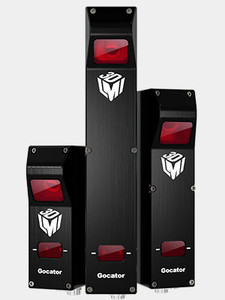
LMI Gocator 2300 Series Workhorse 3D Laser Line Profile Sensors
LMI Technologies


The ultimate 3D laser profiler for semiconductor, EV battery, and consumer electronics inspection. The Gocator 6300 Series combines over 6500 data points per profile, sub-2.1-micron X profile data intervals, and 0.15-micron Z repeatability in a smart sensor engineered for the most demanding precision applications.
The Gocator 6300 Series is LMI Technologies' precision-class smart 3D laser line profiler family, engineered from the ground up for ultimate 2D/3D scanning performance. Two optical models - the Gocator 6310 and Gocator 6320 - cover precision applications from silicon wafer warpage measurement to BGA solder ball inspection, mobile device glass thickness, semiconductor edge detection, and EV battery electrode coating. A telecentric line generation design and high numerical aperture custom camera lens deliver superior performance on the curved, shiny, and reflective surfaces that defeat conventional laser triangulation sensors.
Both models share the same telecentric optical design and core electronics. The 6310 delivers the finest X resolution at a tight 5.5 mm measurement range for small precision targets like wafers and BGAs. The 6320 trades a small amount of X interval and Z repeatability for over 3x the measurement range and double the field of view - ideal for larger curved parts like phone screens and automotive weld seams.
| Specification | Gocator 6310 | Gocator 6320 |
|---|---|---|
| Data Points Per Profile | > 6500 | > 6500 |
| Scan Rate (Full FOV/MR) | > 1700 Hz | > 1800 Hz |
| X Profile Data Interval | < 2.1 microns | < 4.3 microns |
| Linearity Z (+/- % of MR) | 0.015 | 0.015 |
| Repeatability Z | 0.15 microns | 0.30 microns |
| Clearance Distance (CD) | 18.15 mm | 57.50 mm |
| Measurement Range (MR) | 5.5 mm | 17 mm |
| Field of View (FOV) | 13.4 - 14.5 mm | 28 - 31 mm |
| Laser Class Options | 3R or 3B (405 nm blue) | 3R or 3B (405 nm blue) |
| Weight | 1.7 kg | 1.7 kg |
| Dimensions (L x W x H, mm) | 155.25 x 140.25 x 57.50 | 145.25 x 151.71 x 57.50 |
Data Points Per Profile and X Profile Data Interval specifications achieved with uniform spacing enabled. Scan rate calculated from default configuration (full field of view and full measurement range). Linearity Z and Repeatability Z achieved with LMI standard target and optimized sensor configuration. Refer to the Gocator 6300 Series official datasheet for full specifications.
Both Gocator 6300 Series models are stocked in two 405 nm blue laser configurations - Class 3R and Class 3B - in Side Mount orientation. The blue laser wavelength is purpose-selected for shiny, reflective surfaces like polished silicon, gold-plated BGA solder, and curved phone glass where red lasers struggle with specular reflection.
| Model | Laser Class | Wavelength | Mount | Part Number |
|---|---|---|---|---|
| Gocator 6310 | Class 3R | 405 nm blue | Side | 316310A-3R-B-01-S |
| Gocator 6310 | Class 3B | 405 nm blue | Side | 316310A-3B-B-01-S |
| Gocator 6320 | Class 3R | 405 nm blue | Side | 316320A-3R-B-01-S |
| Gocator 6320 | Class 3B | 405 nm blue | Side | 316320A-3B-B-01-S |
Class 2 (low-power, eye-safe) configurations and Top Mount orientations are available on request. Contact Automation Distribution at 1-888-600-3080 for custom configurations.
| Semiconductor Silicon wafer warpage and bow measurement, edge inspection, surface defect detection, die placement verification. The Gocator 6310's sub-2.1-micron X interval and 0.15-micron Z repeatability resolve features that conventional triangulation sensors cannot. |
Advanced Packaging BGA solder ball inspection, height and coplanarity measurement, ball count verification, void detection. The 6320's wider FOV scans full BGA arrays in a single pass. |
| EV Battery Electrode coating thickness measurement, cell stack height, weld quality on tab welds. The 405 nm blue laser cuts through reflective foil surfaces that red lasers cannot resolve. |
Consumer Electronics Mobile device screen thickness measurement, glass curvature inspection, frame flatness, adhesive bead profiling on assembled devices. |
| Automotive Weld seam profiling on curved body panels, gap and flush measurement, sealant bead inspection. Telecentric optics handle reflective painted surfaces where conventional sensors fail. |
Precision Optics and Metrology Lens and prism surface profiling, optical component edge inspection, micro-machined part measurement. |
Conventional laser triangulation sensors use a diverging laser line that fans out from the emitter. As parts curve away from the sensor axis, the projected line shifts position on the target, creating occlusions and edge artifacts. Telecentric line generation projects a parallel laser line across the entire field of view, eliminating angular projection error. Combined with a high numerical aperture lens that maximizes light collection from steep edges and shiny surfaces, the Gocator 6300 Series produces clean, accurate data on the target geometries that historically required confocal or interferometric instruments at ten times the cost and a fraction of the speed.
| Specification | Detail |
|---|---|
| Interface | 2.5 Gigabit Ethernet |
| Inputs | Differential encoder, laser safety enable, trigger |
| Outputs | 2x digital output, RS-485 serial (115 kBaud) |
| Industrial Protocols | EtherNet/IP, PROFINET, Modbus, ASCII, native Gocator protocol |
| Input Voltage / Power | +24 to +48 VDC, 30 watts |
| Housing | Gasketed metal enclosure, IP67 rated |
| Operating Temperature | 0 to 35 degrees C |
| Storage Temperature | -30 to 70 degrees C |
| Vibration Resistance | 10 to 55 Hz, 1.5 mm double amplitude in X, Y, Z, 2 hours per direction |
| Shock Resistance | 15 g, half sine wave, 11 ms, positive and negative for X, Y, Z directions |
Like every Gocator sensor, the 6300 Series ships with the complete LMI smart sensor ecosystem:
The Gocator 6300 Series is LMI Technologies' precision 3D laser line profiler family, engineered for high-accuracy inline inspection in semiconductor, EV battery, consumer electronics, automotive, and precision metrology applications. The 6310 model targets the finest precision applications like silicon wafer inspection and small-feature BGA measurement. The 6320 model targets larger curved targets like mobile device screens, automotive weld seams, and EV battery cell assemblies. View the Gocator 6300 Series at Automation Distribution.
Both models share over 6500 data points per profile, 0.015 percent linearity Z, the same 405 nm blue laser optics, and the same IP67 housing. The 6310 delivers the finest X profile data interval (under 2.1 microns) and Z repeatability (0.15 microns) at a tight 5.5 mm measurement range with 13.4 to 14.5 mm field of view - built for small precision targets. The 6320 trades a small amount of resolution (4.3 micron X interval, 0.30 micron Z repeatability) for a 17 mm measurement range and 28 to 31 mm field of view, plus a longer clearance distance - built for larger, curved, or harder-to-position targets.
The 405 nm blue laser wavelength reflects more diffusely from shiny, reflective, and metallic surfaces than red lasers (typically 660 nm). This dramatically improves data quality on silicon wafers, polished glass, gold-plated BGA solder balls, EV battery foil, and other surfaces that cause specular reflection problems with red lasers. Blue lasers also produce a smaller focused spot, contributing to the 6300 Series' higher X resolution.
A standard laser line projector emits a fan-shaped diverging line. As the line crosses curved or tilted surfaces, its position shifts and edges become harder to detect accurately. Telecentric line generation uses optics that project a parallel laser line across the entire field of view, so the line geometry remains consistent regardless of surface curvature or tilt. This minimizes occlusion and produces cleaner edge data on curved parts like phone screens, BGA solder balls, and silicon wafers.
Class 3R is the lower-power option suitable for most factory environments with standard laser safety protocols (interlocks, enclosed work cells, posted warnings). Class 3B is higher-power and required for scanning very dark, low-reflectivity, or absorptive surfaces where additional signal strength improves measurement accuracy - but mandates more rigorous laser safety controls including remote interlocks, key controls, beam attenuators, and emission indicators. For most semiconductor and electronics applications, Class 3R is sufficient. For demanding EV battery or dark surface applications, Class 3B may be necessary. Contact Automation Distribution at 1-888-600-3080 for application-specific guidance.
Yes. The 6300 Series supports the major industrial protocols natively, including EtherNet/IP, PROFINET, Modbus, ASCII, and the native Gocator protocol. The sensor also provides differential encoder input, laser safety enable, trigger input, two digital outputs, and RS-485 serial output. A 2.5 Gigabit Ethernet interface handles the high-throughput 3D data delivery to host systems.
Yes. Onboard multi-sensor alignment and networking support is built into every 6300 Series sensor. LMI Master network controllers (Master 100, 400, 800, 1200, and 2400) provide synchronized power, laser safety, encoder, and trigger distribution for 4, 8, 12, or 24 sensors. This enables full 360-degree wafer inspection, multi-station BGA scanning, and wide-coverage applications without complex calibration routines.
Automation Distribution's application engineers work directly with LMI Technologies to match the right precision sensor, laser class, and integration architecture to your application. Whether you are inspecting silicon wafers, measuring BGA solder ball height, or profiling curved automotive welds, we will help you get the configuration right the first time.
Request a quote or call 1-888-600-3080
LMI Technologies

LMI Technologies
LMI Technologies

LMI Technologies