
Posted by Automation Distribution Staff on May 26th 2026
How 3D Vision and Cobots Are Driving Pick-and-Place Automation
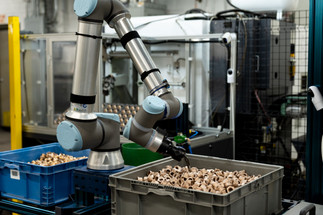
Pick-and-place is the workhorse application of collaborative robotics. From CNC machine tending to palletizing, the majority of cobot deployments on factory floors today come down to one core motion: locate a part, pick it up, and put it somewhere else. What separates a flexible, high-uptime cell from a fragile, fixture-heavy one is usually not the robot itself - it's the vision system feeding it coordinates.
Why Pick-and-Place Drives Cobot ROI
Pick-and-place automation moves parts between stations - from infeed conveyors to CNC fixtures, from production lines into shipping cartons, from bulk bins onto pallets. Whether parts are presented in fixed nests or arrive randomly, the cobot's job is the same: locate, grip, transport, place. The reason this single motion dominates collaborative robotics is straightforward - it accounts for the largest pool of repetitive, ergonomically taxing manual labor on factory floors, and it has the cleanest ROI math.
Most cells deploy a robotic arm equipped with a vacuum, pneumatic, or finger-style end-of-arm tool. The arm contacts the part, transports it without collision, and releases it at a defined drop point. The complexity scales with the part presentation - fixtured parts are straightforward, conveyors with positional drift are harder, and random bin-picking is the most demanding scenario in factory automation today.
Robots Can't See - Vision Systems Solve That
A cobot on its own cannot adapt to parts that move, rotate, or stack unpredictably. Without a vision input, every pick must start from a precisely fixtured position - which means custom nests, mechanical bowl feeders, and tight upstream tolerancing. That works for high-volume single-part runs, but it falls apart the moment you need to change SKUs, handle mixed cases, or pick from a bin where parts overlap.
A vision system gives the cobot the missing input. It locates the part in the cell, calculates its pose, and feeds coordinates to the robot controller. With vision in the loop, the cell becomes flexible: changeovers shrink from hours to minutes, parts can arrive in unfixtured orientations, and the same cobot can run multiple jobs without re-tooling. This is why most modern collaborative cells pair a robot with a vision system from day one rather than retrofitting later.
Why 3D Vision Outperforms 2D for Pick-and-Place
A 2D vision system can tell the robot where a part is on a flat plane - its X and Y coordinates and its rotation around the Z axis. That is sufficient when every part sits at a known height and never tilts, which is the case in a fixtured infeed but rarely the case anywhere else.
A 3D vision system adds depth (Z-axis) and full 3D orientation. That means the robot knows not only where the part is but how high it sits, whether it's tilted, and how it's oriented in space. For random bin-picking, mixed-SKU palletizing, and stacked-part handling, 3D is the requirement, not the upgrade. For 2.5D applications - sorting parts of varying heights on a flat surface, depth-aware pick-and-place where parts don't tilt significantly - a 2.5D system is often the right cost/capability balance.
When 2D, 2.5D, and 3D Are Each the Right Call
| Vision Type | Best Fit | Typical Limit |
|---|---|---|
| 2D | Flat, fixtured parts; label inspection; barcode reading | No depth - cannot handle stacked or tilted parts |
| 2.5D | Sorting parts of varying heights; stacked-but-not-overlapping handling | Limited orientation data; struggles with arbitrary 3D pose |
| 3D | Random bin-picking; mixed-case palletizing; full-pose handling | Higher cost; longer commissioning time |
Pairing Vision With a Universal Robots Cobot
Universal Robots is the most widely deployed cobot platform in pick-and-place, and the UR ecosystem - through the UR+ certified hardware program - supports a deep catalog of vision systems that mount directly to the arm or work alongside it. Universal Robots' lineup is organized into two families: the e-Series (UR3e, UR7e, UR12e, UR16e) for general collaborative automation, and the high-performance UR Series (UR8 Long, UR15, UR18, UR20, UR30) for heavier payloads and longer reaches. The choice of model is driven by payload, reach, and cycle-time targets:
- UR12e (formerly UR10e) - 12.5 kg payload, 1300 mm reach. The longstanding default for mid-payload pick-and-place, machine tending, and packaging. See the Universal Robots category for current UR12e configurations, or browse the UR10e legacy page for the prior-generation reference.
- UR16e - 16 kg payload, 900 mm reach. Heavy-duty tasks like nut driving, heavier machine tending, and palletizing in compact cells.
- UR15 - 15 kg payload (17.5 kg under boundary conditions), 1300 mm reach, 5 m/s TCP speed. The newest UR Series cobot, built for cycle-time-driven pick-and-place.
- UR20 - 20 kg payload, 1750 mm reach. Long-reach palletizing and heavier part transfer in larger workspaces.
- UR30 - 30 kg standard payload (up to 35 kg under certain motions in PolyScope 5.19), 1300 mm reach. The strongest cobot in the UR Series, built for the heaviest pick-and-place and machine tending applications.
Once the cobot is selected, the vision and end-of-arm tooling stack determines whether the cell handles fixtured infeed, semi-structured presentation, or true random pick.
Vision Systems for Vision-Guided Pick-and-Place
Automation Distribution carries vision-guided pick-and-place hardware that integrates cleanly with the UR platform and other major cobot brands:
The OnRobot Eyes 2.5D Vision System is one of the most accessible entry points into vision-guided robotics. It uses one-picture calibration, takes minutes to commission, and handles sorting, pick-and-place where orientation matters, and inspection tasks where depth perception is needed but full 3D pose is not. It mounts on the robot wrist or externally and integrates seamlessly with the OnRobot Quick Changer.
The Robotiq Wrist Camera Kit for Universal Robots is a plug-and-play 2D vision option built specifically for the UR platform. Object location setup takes about five minutes with no coding required, making it the fastest path to a vision-guided UR cell for fixtured-but-flexible applications.
End-of-Arm Tooling: The Gripper Is Half the Cell
A vision system tells the robot where the part is. The end-of-arm tool actually picks it up. The two have to be specified together - there is no use in a 3D vision pose if the gripper geometry can't reach the part in that pose.
Vacuum Grippers
Vacuum is the default for flat-faced parts, boxes, sheet stock, and most palletizing. Browse the full Robotiq gripper catalog for UR-certified options. The air-supply-free Robotiq EPick is the right call when compressed air isn't available - it connects directly to the cobot wrist with no external pneumatic line. For palletizing applications, Robotiq's PowerPick family covers the payload range: the PowerPick (11.5 kg payload), the PowerPick20 (18.2 kg, built for the UR20), and the PowerPick Multi (up to 30 kg, 24-cup array eliminating gripper changeovers across box sizes).
OnRobot's electric vacuum line covers similar applications without an air supply: the compact OnRobot VGC10 for smaller arms and tight envelopes, the OnRobot VGP20 for box and carton palletizing up to 20 kg, and SMC's ZXPE5 series electric vacuum gripper for UR-compatible pick-and-place where pneumatic infrastructure isn't available.
Finger and Parallel Grippers
When parts can't be picked by vacuum - round, porous, deformable, or oddly oriented - mechanical grippers take over. The Robotiq 2F-140 Adaptive Gripper (140 mm stroke) covers a wide range of part shapes and sizes with adaptive form-closure across parallel, encompassing, and inside grip modes. The SMC LEHR Series electric grippers offer a single-cable M8 deployment with universal cobot mounting and an integrated self-locking mechanism that holds parts even on power loss.
For palletizing applications that mix vacuum-friendly boxes with open totes and slip-sheet handling, the OnRobot 2FGP20 combines a wide-stroke electric gripper with an integrated vacuum for slip-sheet pickup, letting a single end-of-arm tool handle both operations.
Three Pick-and-Place Application Patterns
Almost every vision-guided cobot cell falls into one of three patterns. Knowing which one you are deploying determines both the vision class and the gripper choice.
1. Conveyor Pick-and-Place With Drift Compensation
Parts arrive on a conveyor in roughly known positions, but with some positional drift and possibly rotational variation. A 2D or 2.5D vision system locates each part and reports coordinates to the cobot, which picks and places onto a downstream nest, pallet, or carton. This is the most common cobot pick-and-place pattern and the lowest-risk first vision deployment.
2. Random Bin-Picking
Parts arrive jumbled in a bin or tote - overlapping, tilted, at varying heights. This requires true 3D vision to resolve part pose and a gripper geometry (often a vacuum cup on a compliant mount, or a mechanical finger gripper with adaptive form-closure) that can reach the picked part without colliding with neighbors. Bin-picking is the highest-value cobot deployment but also the highest-engineering-effort. Most successful deployments start with semi-structured presentation and migrate toward full random pick as the vision and motion planning are refined.
3. Structured Palletizing by Part Height
Finished products or assemblies are placed into pallet or tote patterns at defined positions, often stacked one to four layers high. Vision provides part-presence verification and orientation correction; the cobot uses pre-programmed pallet patterns plus vision-derived offsets to drop parts at the right clock angle and stack height. Pair a UR20 with a Robotiq PowerPick20 for cardboard palletizing, or pair a UR30 with the Robotiq PowerPick Multi for heavier loads and mixed box sizes.
FAQ
What is 3D vision-guided pick-and-place?
3D vision-guided pick-and-place is a robotic automation pattern where a 3D smart sensor or 3D camera identifies a part's full position (X, Y, Z) and orientation in space, then sends those coordinates to a robot - typically a cobot like the UR12e - to pick the part and place it at a target location. It handles randomly oriented or stacked parts that 2D vision cannot.
Do I need 3D vision, or will 2D work?
If parts arrive on a flat surface and are never stacked or tilted, 2D is enough. If parts arrive at varying heights but consistent flat orientation, 2.5D - such as the OnRobot Eyes 2.5D vision system - is usually the right cost/capability balance. If parts arrive jumbled, overlapping, or in arbitrary orientations (true random bin-picking), 3D is the requirement.
Which Universal Robots cobot is best for vision-guided pick-and-place?
The right model depends on payload and reach. The UR12e (formerly UR10e) covers most general pick-and-place at 12.5 kg payload and 1300 mm reach - browse current configurations in the Universal Robots catalog. For palletizing and heavier transfer, the UR20 or UR30 are better fits. For high-throughput cycle-time-driven cells, the newer UR15 brings 5 m/s TCP speed.
Vacuum gripper or mechanical gripper for pick-and-place?
Vacuum is the default for flat-faced or smooth-surfaced parts, boxes, and palletizing - see the Robotiq EPick or OnRobot VGC10. Mechanical finger grippers are the right call for round, deformable, porous, or oddly oriented parts - the Robotiq 2F-140 and SMC LEHR series cover most of these cases.
How long does it take to commission a vision-guided cobot cell?
For fixtured or semi-structured pick-and-place with a wrist-mounted 2D camera like the Robotiq Wrist Camera Kit, commissioning often runs days to a couple of weeks. 2.5D systems like the OnRobot Eyes commission in a similar window. True 3D random bin-picking is a longer commissioning project - typically weeks to months - because the vision parameters, motion planning, and gripper geometry all interact and need tuning against real parts.
Build Your Vision-Guided Cobot Cell With Automation Distribution
Automation Distribution is an authorized distributor of Universal Robots, Robotiq, OnRobot, and SMC, with deep application support across cobot integration, end-of-arm tooling selection, and vision-guided pick-and-place commissioning. Browse the full cobot gripper and vision catalog, or call 1-888-600-3080 to scope a cell for your application.