
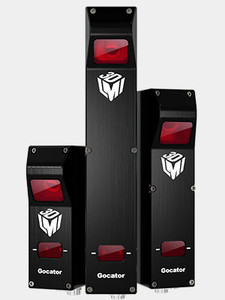
LMI Gocator 1300 Series High-Speed 3D Laser Point Profile Sensors
LMI Technologies


The only Gocator family built specifically for the wood products industry. A modular transverse scanning system that mixes 3D laser profile, tracheid detection, and color vision in one networked sensor architecture - designed for sawmills, planer mills, and lumber grading lines running at up to 300 feet per minute.
The Gocator 200 Series is LMI Technologies' family of multi-point profile scanners purpose-built for the wood products industry. Unlike the standard Gocator profiler families (which capture continuous laser line profiles for general manufacturing inspection), the 200 Series is a transverse scanning architecture: multiple sensors mounted across the width of a board conveyor capture parallel measurement points across the entire board surface as it moves through the line. Four model types (Gocator 205, 210, 230, and 250) combine in one networked system to deliver simultaneous 3D laser profile measurement, tracheid detection for wood grain analysis, and color vision for surface defect grading - all on the same hardware and software platform. The 200 Series is the standard automated grading sensor architecture for edger, trimmer, and planer mill applications across North American and international lumber operations.
Most Gocator product families consist of a single sensor type that you buy in different optical configurations. The 200 Series is fundamentally different - it is a system architecture where multiple sensor types work together to deliver capabilities no single sensor could match. A typical 200 Series installation includes:
This modular approach lets mill integrators build the exact sensor configuration each line requires. A high-throughput edger line might use a row of laser profilers with one or two 205 vision sensors for defect spotting. A grading line might use more 205 sensors for comprehensive surface assessment paired with a smaller number of laser profilers for dimensional measurement.
| Model | Type | Role in the System |
|---|---|---|
| Gocator 205 | Color vision + tracheid detection LED light bar, no laser |
Detects wood grain orientation through tracheid (grain pattern) analysis, identifies visual surface defects like knots, splits, and discoloration through high-resolution color cameras. Pairs with laser profilers in the same scanning station. |
| Gocator 210 | 3D laser multi-point profiler | Standard-range laser profiler for board dimensional measurement. Mounts in arrays across the conveyor width for transverse cross-section measurement. |
| Gocator 230 | 3D laser multi-point profiler | Extended-range laser profiler for thicker boards and larger working envelopes. Same modular networking architecture as the 210. |
| Gocator 250 | 3D laser multi-point profiler | Long-range laser profiler for the widest scanning envelopes - heavy timber lines, large dimensional lumber, structural component grading. |
All four sensor types share the same Gocator 200 Series networking architecture, the same Master controller compatibility, and the same browser-based configuration interface. They mix and match freely in one system.
Tracheid detection is a wood-specific 3D vision capability that has no equivalent in general manufacturing inspection. Wood is made of long fibrous cells called tracheids that align with the grain direction. When laser light strikes the surface of a board, it does not just reflect - some of it penetrates the wood, scatters along the tracheids, and re-emerges at a slight offset from the original beam path. The shape of this scatter pattern indicates the direction of the grain at every measurement point.
The Gocator 205 is engineered to measure this scatter pattern in real time, producing a grain-direction map across the entire surface of the board. This is critical for grading because wood grain direction directly determines structural strength. Boards with grain running parallel to the length are strong; boards with grain running at angles (called "slope of grain") are progressively weaker and downgraded accordingly. Tracheid detection automates a grading decision that was previously made by a human grader looking at the surface and making a subjective call. Combined with the 205's color vision cameras for visual defect identification, the 200 Series enables fully automated lumber grading at production line speed.
Standard Gocator laser profilers (the 2100, 2300, 2400, 2500, 2600 series) are longitudinal scanners - they project a laser line across the part, capture one cross-section per scan, and rely on the part moving past the sensor to build up a complete 3D profile. This works perfectly for parts that are smaller than the laser line and where motion is consistent.
Wood products inspection has different requirements. Boards are 4 to 20+ feet long, wider than any single laser line can span, and move through the line at speeds up to 300 feet per minute. The 200 Series uses transverse scanning: multiple sensors mounted across the conveyor width simultaneously capture parallel measurement points across the board surface. As the board moves through the array, each sensor captures its segment of the board at high scan rates. Combined data from all sensors in the array produces complete 3D coverage of the entire board at line speed - something a single longitudinal profiler cannot achieve.
| Edger Optimization Sawmill edger lines use 200 Series transverse scanning to measure rough board profiles and identify optimal edging cuts that maximize lumber yield from each cant. The system feeds dimensional and shape data to the edger optimizer for cut decisions made in milliseconds. |
Trimmer Optimization Trimmer lines use 200 Series sensors to identify defects (wane, splits, knots) and dimensional issues that determine optimal length cuts. Combined dimensional and surface defect data drives automated trim cut decisions. |
| Planer Mill Grading Planer mill grading lines deploy comprehensive 200 Series systems with tracheid detection, color vision, and 3D dimensional measurement to assign each board a final grade. Automates a process that previously required human graders. |
Structural Lumber MSR/MEL Machine Stress-Rated and Machine Evaluated Lumber lines use tracheid detection to assess grain direction (which determines structural strength). Combined with density measurement, this enables non-destructive structural grade assignment. |
| Veneer and Panel Inspection Veneer mills and panel production lines use 200 Series transverse scanning for dimensional QA and visual defect identification on plywood face veneers, oriented strand board surfaces, and laminated veneer lumber. |
Heavy Timber and Engineered Wood The longer-range Gocator 250 model enables scanning of heavy timber, glulam beams, and large engineered wood components on wider conveyor lines where standard-range profilers cannot cover the full width. |
The Gocator 200 Series is LMI Technologies' multi-point profile scanner family purpose-built for the wood products industry. Typical applications include sawmill edger optimization, trimmer optimization, planer mill automated grading, structural lumber MSR/MEL grading, veneer and panel inspection, and heavy timber dimensional measurement. The 200 Series combines 3D laser profile measurement, tracheid detection for wood grain analysis, and color vision for surface defect grading in one modular multi-sensor system running at up to 300 feet per minute. View the Gocator 200 Series at Automation Distribution.
The 2100 and 2300 Series are longitudinal laser line profilers - they project a laser line across a part, capture one cross-section per scan, and rely on motion to build a 3D point cloud. The 200 Series is a transverse multi-sensor system - multiple sensors mounted across a conveyor's width simultaneously capture parallel measurement points across the entire board surface. The 200 Series also includes the Gocator 205, which is a color vision and tracheid detection sensor (not a laser sensor) that pairs with the laser profilers for comprehensive wood grading. The 200 Series is wood-products-specific architecture; the 2100/2300 are general-purpose manufacturing inspection.
Tracheid detection measures the direction of wood grain by analyzing how laser light scatters along the wood fibers (tracheids). Wood grain direction directly determines structural strength - boards with grain parallel to the length are strong, boards with off-axis grain are progressively weaker. The Gocator 205 detects tracheid scatter patterns in real time, producing a grain-direction map across the entire surface of every board. This enables automated structural grading decisions that were previously made by human graders. Tracheid detection is unique to the 200 Series and has no equivalent in general manufacturing 3D inspection.
All three are 3D laser multi-point profilers with the same networking architecture and configuration interface. They differ in measurement range to match different lumber dimensions and line geometries. The Gocator 210 is the standard-range profiler for typical board dimensions. The Gocator 230 is an extended-range profiler for thicker boards and larger working envelopes. The Gocator 250 is the long-range profiler for the widest scanning applications - heavy timber, large dimensional lumber, structural components. Most mill installations use one model across the array for consistency, but the modular architecture allows mixing if the application benefits.
No. The Gocator 205 uses an LED light bar and color cameras - not a laser. It is purpose-built for tracheid detection (using the LED light source to illuminate the wood surface and observing the scatter pattern through the wood) and color vision for surface defect identification. The 205 is the only Gocator 200 Series sensor without a laser; the 210, 230, and 250 are all laser-based profilers. The 205 pairs with the laser profilers in the same scanning station to deliver combined dimensional, grain-direction, and visual defect data.
Up to 300 feet per minute for transverse board scanning applications - the standard production line speed for sawmill edger, trimmer, and planer mill operations. The system's scan rate scales with the encoder input and the sensor array configuration. Higher line speeds are achievable with optimized array layouts; specific maximum speeds depend on board dimensions, sensor model selection, and resolution requirements.
Yes. The 200 Series uses the same open-source Gocator SDK as the rest of the Gocator portfolio, with C-based libraries that integrate with existing edger optimizers, trimmer optimizers, planer mill grading systems, and mill management software. Industrial protocols (EtherNet/IP, PROFINET, Modbus) enable direct PLC integration for line control decisions. Mill staff already trained on standard Gocator interfaces will recognize the browser-based configuration GUI used by the 200 Series.
Because the 200 Series is a modular multi-sensor system rather than a single off-the-shelf product, configurations are quoted based on your specific line requirements: board width and thickness ranges, line speed, target defect identification capabilities, grading decision logic, and existing mill control system architecture. Contact Automation Distribution at 1-888-600-3080 to scope your 200 Series system. We work directly with LMI Technologies to size the sensor array, specify Master controllers, and recommend cordset lengths for your installation.
Automation Distribution's application engineers work directly with LMI Technologies and mill integrators to size 200 Series transverse scanning systems for edger optimization, trimmer lines, planer mill grading, structural lumber grading, and heavy timber inspection. Every installation is configured to your specific line speed, board dimensions, and grading decision requirements.
Request a system quote or call 1-888-600-3080
LMI Technologies

LMI Technologies

LMI Technologies
LMI Technologies