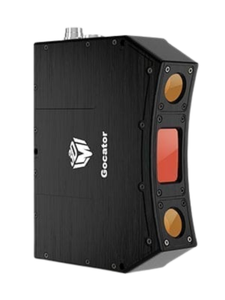
LMI Gocator 3210 Large Field-of-View 3D Snapshot Sensor
LMI Technologies


Metrology-grade 3D snapshot inspection in a single shot. The Gocator 3500 Series brings 5-megapixel stereo cameras and 12 micron accuracy to snapshot 3D inspection - the precision of laboratory metrology in a factory-floor smart sensor.
The Gocator 3500 Series is LMI Technologies' family of high-resolution 3D smart snapshot sensors - structured light 3D capture with 5-megapixel stereo cameras delivering metrology-grade XY resolution and Z accuracy that conventional vision systems require expensive lab instruments to match. Two active models cover distinctly different inspection envelopes: the Gocator 3506 targets small-parts precision inspection at 12 micron accuracy and 20 micron XY resolution; the Gocator 3520 extends the high-resolution snapshot approach to larger fields of view up to 282 x 175 mm for robot-driven inspection of automotive and industrial assemblies. Both deliver complete 3D point cloud capture in a single shot with no motion required, eliminating the cost and complexity of linear motion systems and removing vibration-induced measurement error.
The 3500 Series jumps from the 2-megapixel imager of the Gocator 3210 to 5-megapixel stereo cameras. That alone is a 2.5x increase in raw data density per snapshot. Combined with industrial blue LED structured light projection and a precisely calibrated optical baseline, the result is XY resolution down to 20 microns and VDI/VDE accuracy down to 12 microns on the Gocator 3506 - measurement performance previously available only on coordinate measuring machines, white light interferometers, or other dedicated metrology instruments costing 10 to 100 times more.
The 3500 Series brings four metrology-grade capabilities to the smart sensor form factor:
| Capability | Why It Matters |
|---|---|
| 5-megapixel stereo cameras | 2.5x more data density per snapshot than the 3210, enabling micron-level XY resolution and the data quality required for tight-tolerance dimensional measurement. |
| 3-way triangulation (3520) | The Gocator 3520's optical design triangulates three ways to minimize occlusion shadows on complex parts, capturing data on features that two-camera snapshot sensors miss. |
| High-intensity LED projector (3520) | Brighter projection output enables shorter exposure times, reducing motion blur when the target has residual vibration or jitter from upstream conveyor stops. |
| Single-snapshot 3D capture | No motion stage, no encoder, no linear axes - eliminates the mechanical components that introduce error in traditional metrology systems and dramatically reduces total cost of ownership. |
The two active models in the Gocator 3500 Series target opposite ends of the inspection envelope: the 3506 for the smallest, highest-precision parts; the 3520 for the largest, robot-mounted snapshot applications. Match the model to the part size and accuracy target.
| Specification | Gocator 3506 | Gocator 3520 |
|---|---|---|
| Capture Technology | Stereo structured light | Stereo + 3-way triangulation |
| Imager Resolution | 5 megapixel | 5 megapixel |
| Scan Rate | 3 Hz | 3 Hz |
| Clearance Distance | 87 mm | 203 mm |
| Measurement Range | 25 mm | 150 mm |
| Field of View (near) | 27 x 45 mm | 179 x 115 mm |
| Field of View (far) | 30 x 45 mm | 282 x 175 mm |
| Z Repeatability | 2.0 microns | 4.6 microns |
| XY Resolution | 20 - 25 microns | 74 - 121 microns |
| VDI/VDE Accuracy | 12 microns | Refer to datasheet |
| Light Source | Blue LED 465 nm | Blue LED 465 nm (high-intensity) |
| Dimensions (W x D x H) | 49 x 136 x 170 mm | 55 x 167 x 260 mm |
| Weight | 1.52 kg | 2.6 kg |
| Input Voltage / Power | +24 to +48 VDC, 25 watts | +24 to +48 VDC, 50 watts |
| Operating Temperature | 0 to 45 degrees C | 0 to 40 degrees C |
Both Gocator 3500 Series models use LED structured light - not lasers - so they do not carry laser class designations. The 465 nm blue LED projectors are eye-safe at normal working distances and do not require laser safety controls. All models share Gigabit Ethernet interface, IP67 aluminum housing, native Gocator industrial protocols (EtherNet/IP, PROFINET, Modbus, ASCII), and Universal Robots certification. The Gocator 3504 stereo snapshot sensor is also available in the 3500 Series for ultra-compact applications (12 x 13 mm FOV, 6.7 micron XY resolution) - contact Automation Distribution for special-order configurations.
The 3506 and 3520 are not just different sizes of the same sensor - they target genuinely different applications with different optical engineering choices behind them.
| Choose Gocator 3506 If... | Choose Gocator 3520 If... |
|---|---|
| Your target is small (under 30 x 45 mm) and the inspection demands the highest possible XY resolution and Z accuracy. | Your target is medium-to-large (up to 282 x 175 mm) and you need single-snapshot 3D capture of the entire part. |
| You are inspecting electronics enclosures, PCBs, battery and IC connectors, semiconductor packaging, or other small precision parts. | You are inspecting automotive components, engine components, larger machined parts, or multi-feature assemblies. |
| The application requires 12 micron VDI/VDE accuracy - the highest in the Gocator snapshot line. | The application requires occlusion-minimizing 3-way triangulation on complex part geometries. |
| You are replacing white light interferometers or coordinate measuring machines with a smart sensor at a fraction of the cost. | The target has residual vibration or jitter and you need the high-intensity LED projector's shorter exposure times to eliminate motion blur. |
| Measurement tasks involve step height, gap, surface roughness, and coplanarity at micron-level precision. | Measurement tasks involve robot-driven quality control, stop-and-go part verification, and volumetric inspection. |
| The sensor will be mounted in a fixed position over a precision conveyor or stage. | The sensor will be mounted on a Universal Robots cobot for hand-eye inspection at multiple stations. |
| Model | Architecture Revision | Light Source | Part Number |
|---|---|---|---|
| Gocator 3506 | B revision (current generation) | Blue LED 465 nm | 313506B-01 |
| Gocator 3520 | B revision (current generation) | Blue LED 465 nm (high-intensity) | 313520B-01 |
The Gocator 3504 (ultra-compact 12 x 13 mm FOV, 6.7 micron XY resolution stereo snapshot) is also available in the 3500 Series for the smallest precision applications. Contact Automation Distribution at 1-888-600-3080 for 3504 special-order configurations.
| Electronics and PCB Assembly (3506) Step-height measurement on PCB components, gap and coplanarity on connector pins, surface roughness on machined enclosures, dimensional QA on battery and IC connectors. The 3506's 12 micron accuracy resolves features that 2 MP snapshot sensors cannot capture reliably. |
Automotive Engine Inspection (3520) Piston bowl volume measurement, cylinder head feature verification, engine block multi-feature inspection. The 3520's 282 x 175 mm FOV captures full engine component geometry in a single snapshot. |
| Robot-Mounted Inspection (3520) Universal Robots certified for cobot mounting. The 3520's large FOV and high-intensity LED enable robot-driven quality control on automotive assemblies, captured at multiple inspection points along the production line. |
Semiconductor Packaging (3506) BGA ball coplanarity, advanced packaging substrate inspection, micro-connector dimensional QA. The 5 MP stereo cameras and 20 micron XY resolution match metrology-grade inspection requirements at smart-sensor pricing. |
| Stop-and-Go Part Verification (3520) The high-intensity LED projector enables short exposure times that handle residual conveyor vibration or part jitter. Verification of parts that pause briefly on indexing conveyors without requiring vibration isolation. |
Medical Device Manufacturing (3506) Implant feature measurement, surgical instrument dimensional QA, micro-feature inspection on assembled devices. 12 micron accuracy matches medical device tolerance requirements at production speed. |
| Volumetric Inspection (3520) Single-snapshot 3D capture is ideal for volume measurement of complex shapes - engine combustion chambers, cast part cavities, food product portion volumes. Built-in volumetric tools eliminate need for external processing. |
Lab-to-Floor Metrology Migration The 3500 Series enables manufacturers to move measurement from offline lab inspection (CMMs, white light interferometers) to inline production at smart-sensor cost. 100 percent inspection instead of statistical sampling. |
| Feature | Detail |
|---|---|
| Interface | Gigabit Ethernet |
| Inputs | Differential encoder, trigger |
| Outputs | 2x digital output, RS-485 serial, analog (4-20 mA) |
| Industrial Protocols | EtherNet/IP, PROFINET, Modbus, ASCII, native Gocator protocol |
| Housing | Gasketed aluminum enclosure, IP67 rated |
| Storage Temperature | -30 to 70 degrees C |
| Vibration Resistance | 10 to 55 Hz, 1.5 mm double amplitude in X, Y, Z, 2 hours per direction |
| Shock Resistance | 15 g, half sine wave, 11 ms, positive and negative for X, Y, Z directions |
| Universal Robots Certification | Certified for UR3, UR5, UR10, and UR e-series robots |
Round out your Gocator 3500 deployment with factory-correct hardware available through Automation Distribution: LMI Cordsets for power, I/O, and Ethernet; the GoMax Smart Vision Accelerator for offloaded point cloud processing and AI inference; and the GoPxL Anomaly Detector for AI-based defect detection on snapshot 3D data.
The Gocator 3500 Series is LMI Technologies' family of high-resolution, metrology-grade 3D smart snapshot sensors. The Gocator 3506 targets small-parts precision inspection - electronics, PCBs, battery and IC connectors, semiconductor packaging, medical devices, and any application requiring 12 micron VDI/VDE accuracy and 20 micron XY resolution. The Gocator 3520 targets larger-FOV robot-driven inspection - automotive engine components, piston bowl volume measurement, cylinder head verification, stop-and-go part inspection, and any application requiring up to 282 x 175 mm field of view with single-snapshot 3D capture. View the Gocator 3500 Series at Automation Distribution.
The Gocator 3210 uses a 2-megapixel stereo camera and is built for large-FOV, multi-feature inspection at 35 micron accuracy. The Gocator 3500 Series uses 5-megapixel stereo cameras and delivers metrology-grade accuracy (12 microns on the 3506) and higher XY resolution (20 microns on the 3506). Choose the 3210 when you need large-FOV multi-feature inspection on automotive assemblies at moderate accuracy. Choose the 3500 Series when you need metrology-grade precision for small parts (3506) or when you need both large FOV and high resolution with occlusion-minimizing 3-way triangulation (3520).
Standard stereo snapshot sensors (including the 3210 and 3506) use two cameras to triangulate the 3D scene. If a feature occludes one camera's view, that part of the scene becomes a data gap. The Gocator 3520 uses a 3-way triangulation design that captures the structured light pattern from three optical paths, dramatically reducing occlusion shadows on complex parts with protruding features, undercuts, or angled surfaces. This is particularly valuable for automotive components, engine parts, and other geometrically complex targets where conventional stereo snapshot leaves data gaps.
A brighter LED projector enables shorter camera exposure times for the same image quality. Shorter exposures mean less motion blur if the target has residual vibration or jitter - which is common in stop-and-go production environments where parts pause briefly on indexing conveyors but haven't fully settled. The high-intensity projector also enables the 3520 to work at its larger 203 mm clearance distance and 150 mm measurement range, where the structured light pattern has to travel further and spread across a larger area. The tradeoff is the 3520's higher power draw (50 watts vs 25 watts for the 3506).
Choose the Gocator 3506 if your target is small (under 30 x 45 mm), you need the highest available XY resolution (20-25 microns) and Z accuracy (12 microns), or you are replacing offline metrology instruments like CMMs or white light interferometers with an inline smart sensor. Choose the Gocator 3520 if your target is medium-to-large (up to 282 x 175 mm), you need single-snapshot capture of the entire part, you need 3-way triangulation for complex geometries, or the sensor will be mounted on a Universal Robots cobot for multi-station inspection.
No. Like the Gocator 3210, the 3500 Series uses an industrial blue LED (465 nm) structured light projector, not a laser. The sensors do not carry laser class designations (Class 2, 3R, 3B) and do not require the laser safety controls associated with laser-based Gocator sensors. The LEDs are eye-safe at normal working distances, simplifying integration into collaborative cells and operator-accessible workstations.
Both the 3506 and 3520 capture one complete 3D snapshot every 333 milliseconds (3 Hz). Each snapshot is a full 3D point cloud of the entire field of view. This is slower than laser line profilers (which can scan thousands of profile lines per second), but each snapshot represents complete 3D data of the entire FOV rather than one slice. For metrology-grade inspection of stationary or stop-and-go parts, the 3 Hz rate is more than sufficient for most cycle time requirements.
For many applications, yes. The Gocator 3506 delivers 12 micron VDI/VDE accuracy in a smart sensor form factor that costs a fraction of a coordinate measuring machine (CMM) and can be deployed inline rather than as an offline lab instrument. This enables 100 percent inspection at production speed instead of statistical sampling. CMMs remain the right choice for the most demanding sub-micron metrology applications, very large parts beyond the 3500 Series field of view, and probing-based measurement of internal features. For everything else - especially inline cosmetic inspection, dimensional QA, and surface measurement - the 3500 Series is a powerful and cost-effective alternative.
Yes. Both the 3506 and 3520 are certified for use with Universal Robots cobots through LMI's URCap integration. This allows direct mounting on UR3, UR5, UR10, and UR e-series cobot end effectors with standard URCap programming - no custom driver development required. The 3520's 2.6 kg weight is well within the payload capacity of UR10e and UR16e cobots; the lighter 1.52 kg 3506 is compatible with all current UR models.
Yes. Multiple 3506 or 3520 sensors can be deployed for simultaneous multi-station inspection. Standard Gocator multi-sensor networking handles synchronization, triggering, and data aggregation. Note that the GoMax accelerator supports only a single G3 snapshot sensor per GoMax unit - multi-snapshot deployments require either one GoMax per sensor or processing on the sensors themselves without acceleration.
Automation Distribution's application engineers work directly with LMI Technologies to size snapshot sensor deployments for metrology-grade inspection, automotive engine QA, robot-mounted scanning, and lab-to-floor metrology migration. Whether you are replacing a CMM with inline 100 percent inspection, scoping a Universal Robots cobot inspection cell, or comparing the 3506 against the 3520 for your specific application, we will help you get the configuration right the first time.
Request a quote or call 1-888-600-3080
LMI Technologies


LMI Technologies

LMI Technologies