
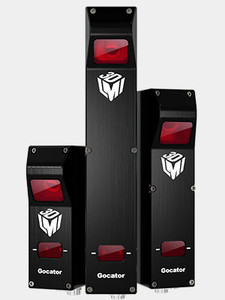
LMI Gocator 2300 Series Workhorse 3D Laser Line Profile Sensors
LMI Technologies


Shadow-free 3D inspection on steep angles, deep grooves, mirror-like surfaces, and transparent materials. Coaxial line confocal is the only 3D measurement technology that captures up to plus-or-minus 85 degree slope angles with zero triangulation shadow - and the Gocator 4000 Series brings it to inline factory inspection.
The Gocator 4000 Series is LMI Technologies' family of smart 3D coaxial line confocal sensors, engineered specifically for the inspection challenges that defeat triangulation-based laser profilers: steep-angled features, deep grooves, BGA solder balls, polished and mirror-finished surfaces, transparent adhesives, and any target geometry where shadowing or specular reflection creates data gaps in conventional 3D scanning. The coaxial optical design eliminates the triangulation shadow that limits standard laser profilers, capturing usable 3D data at slope angles up to plus-or-minus 85 degrees - a capability no laser triangulation sensor can match. Four optical models cover semiconductor, consumer electronics, EV battery, and precision manufacturing applications. All four ship with GoPxL IIoT Vision Inspection Software onboard for browser-based configuration and integration.
Every other 3D laser sensor in the Gocator portfolio - the 2100, 2300, 2400, 2500, 2600, 2880, 6300 - uses laser triangulation. A laser line projects onto the target at one angle, a camera observes the line at a different angle, and the sensor calculates Z height from the geometric offset between the two. This works beautifully on flat or moderately angled surfaces, but it has a fundamental limitation: when a feature is too steep, too deep, or shadows the camera's view of the laser line, you get a data gap.
The Gocator 4000 Series uses a fundamentally different optical architecture - coaxial line confocal imaging. The illumination source and the camera detector share the same optical axis, looking straight down at the target through a precision-calibrated chromatic lens. Z height is measured not by triangulating an offset, but by detecting which wavelength of light is in focus at the target surface (each wavelength has a slightly different focal distance through the lens). Because there is no triangulation angle, there is no triangulation shadow:
| Laser Triangulation | Coaxial Line Confocal |
|---|---|
| Maximum slope angle limited to roughly plus-or-minus 30-45 degrees before features shadow the camera's view of the laser line. | Maximum slope angle up to plus-or-minus 85 degrees - measures near-vertical walls, steep BGA ball sides, and deep groove flanks that triangulation cannot reach. |
| Specular reflections on polished or mirror-like surfaces cause blooming, washouts, and missing data. | Coaxial illumination handles shiny and mirror-like surfaces - polished metal, semiconductor wafers, gold-plated BGAs - without specular failure. |
| Cannot measure through transparent materials - the laser reflects off the top surface only. | Can measure transparent and translucent materials - measures top and bottom surfaces of transparent adhesives, glass coatings, plastic film layers. |
| Z resolution typically limited by the triangulation angle and camera pixel size. | Z resolution down to 0.2 microns - the chromatic principle delivers sub-micron Z precision regardless of triangulation geometry. |
| Optimized for general 3D inspection across all industries. | Optimized for semiconductor, consumer electronics, EV battery, and precision applications where conventional triangulation fails. |
The 4000 Series consists of four models in two generations. The newer Gocator 4011 and 4021 feature an advanced optical design that delivers superior data quality, repeatability, and linearity on challenging targets like semiconductor BGAs - significantly outperforming both LMI's previous-generation 4010/4020 models and competing line confocal technologies. LMI explicitly recommends the 4011 and 4021 for the majority of applications. The original 4010 and 4020 remain available for niche cases requiring additional sensitivity (shorter exposure times for higher scan speeds) or increased detection angle on highly reflective targets.
| Model | Generation | Working Envelope | Best Suited For |
|---|---|---|---|
| Gocator 4011 Recommended |
Current generation, advanced optics | Smaller FOV / measurement range | The recommended sensor for most precision applications. Superior data quality on semiconductor BGAs, wire bonding, fine consumer electronics features. Best linearity and repeatability in the family. |
| Gocator 4021 Recommended |
Current generation, advanced optics | Larger FOV / measurement range | The recommended sensor when application requires the larger working envelope. Same advanced optical design as the 4011, scaled to handle larger parts and longer standoff distances. |
| Gocator 4010 Specialty |
Original generation | Smaller FOV / measurement range | Niche applications requiring additional sensitivity for shorter exposure times (higher scan speeds), or increased detection angle on highly reflective targets where the 4011 cannot achieve required throughput. |
| Gocator 4020 Specialty |
Original generation | Larger FOV / measurement range | Niche applications at the larger working envelope requiring additional sensitivity or detection angle that the 4021 cannot deliver. |
Download the Official Datasheet
Get the full Gocator 4000 Series technical datasheet with detailed per-model specifications, dimensional drawings, and 4011/4021/4010/4020 comparison data.
Download the LMI Gocator 4000 Series datasheet (PDF) Revision: 2025
| Specification | Value |
|---|---|
| Capture Technology | Coaxial line confocal (chromatic confocal imaging) |
| Data Points per Profile | 1920 |
| X Resolution (best) | 1.9 microns |
| Z Resolution (best) | 0.2 microns |
| Maximum Slope Angle | Plus or minus 85 degrees |
| Field of View (largest) | Up to 5.0 mm |
| Scan Rate (limited MR, with acceleration) | Up to 16 kHz+ |
| Scan Rate (full MR) | Up to 4 kHz+ |
| Onboard Software | GoPxL IIoT Vision Inspection Software (browser-based) |
| Interface | Gigabit Ethernet |
| Industrial Protocols | EtherNet/IP, PROFINET, Modbus, ASCII, native Gocator protocol |
| Acceleration Compatibility | GoMax NX, GoMax ORIN, GoMax ORIN+ (required for 16 kHz+ scan rates) |
Detailed clearance distance, measurement range, weight, dimensions, and per-model specifications vary by Gocator 4000 model. Contact Automation Distribution at 1-888-600-3080 for the official datasheet for your selected model and application-specific recommendations on 4011 vs 4021 vs 4010 vs 4020 model selection.
| Semiconductor BGA Inspection Ball Grid Array solder ball coplanarity, ball height, and ball-edge geometry require measurement of near-vertical sphere sides. Triangulation sensors lose data on the far side of each ball; the 4000 Series captures complete BGA geometry with no shadow. |
Wire Bonding Wire bond loop height, position, and shape - critical features in semiconductor packaging. The 4011's advanced optics deliver the data quality required for production wire bonding QA. |
| Deep Groove Measurement Channel depths, slot bottoms, and routed cavities in consumer electronics housings. Triangulation cannot reach the bottoms of deep features; coaxial confocal looks straight down without shadowing. |
Wafer Dicing and Scribe Inspection Semiconductor wafer cutting grooves, scribe lines, and edge features. Polished silicon surfaces are highly reflective and steep - the coaxial design handles both challenges. |
| Transparent Adhesive Inspection Adhesive bead height, coverage, and continuity on consumer electronics assemblies. The confocal principle measures both top surface of the adhesive and the substrate underneath - a measurement triangulation cannot make. |
EV Battery Cell Stack Edges Electrode edge inspection on EV battery cell stacks - steep edges, mixed metallic and dielectric materials, fine feature sizes. The 4011/4021's combination of slope angle and X resolution handles this where triangulation cannot. |
| Mirror-Finished Mechanical Parts Polished precision bearings, mirror-finished optical seats, surgical instrument surfaces. Specular reflections that defeat triangulation are handled cleanly by coaxial confocal. |
Multi-Layered Transparent Films Layer thickness in laminated glass, plastic film layers, transparent coatings. The chromatic confocal principle resolves each layer's top surface and underlying interfaces independently. |
The Gocator 4000 Series is one of two line confocal sensor families in the Gocator portfolio. Each addresses a different inspection priority:
| Family | Primary Differentiator | Best For |
|---|---|---|
| Gocator 4000 Series Coaxial line confocal |
Coaxial optical design eliminates triangulation shadow. Plus or minus 85 degree slope angle. Single confocal axis. | Inspection where slope angle, deep grooves, mirror reflections, or shadowing defeat conventional sensors. Single-axis 3D height and intensity data. |
| Gocator 5500 Series Dual-axis line confocal |
Patented dual-axis confocal design produces 3D topography, 3D tomography, and 2D intensity data simultaneously. | Multi-layered, transparent, translucent, and mixed-material inspection where layer thickness and sub-surface structure matter as much as surface topology. |
Both families share the line confocal principle and complement each other. For most semiconductor BGA, deep-groove, and steep-angle applications, the 4000 Series is the right choice. For multi-layered glass thickness, semiconductor wafer subsurface measurement, and tomography applications, the 5500 Series is the right choice.
Round out your Gocator 4000 Series deployment with factory-correct hardware available through Automation Distribution: LMI Cordsets for power, I/O, and Ethernet; the GoMax Smart Vision Accelerator for high-speed scan rate operation and AI-based defect inference; and the GoPxL Anomaly Detector for AI surface defect detection. The 4000 Series pairs particularly well with the Gocator 6300 Series precision telecentric profilers for applications requiring both coaxial confocal coverage on shadowed features and high-resolution laser profile data on diffuse surfaces.
The Gocator 4000 Series is LMI Technologies' family of smart 3D coaxial line confocal sensors, used for inline inspection in semiconductor manufacturing (BGA inspection, wire bonding, wafer dicing), consumer electronics (deep groove measurement, transparent adhesive inspection, polished surfaces), EV battery cell stack inspection, and precision mechanical parts with mirror finishes or steep angles. The defining capability is shadow-free 3D scanning at slope angles up to plus or minus 85 degrees - a measurement that no triangulation-based laser sensor can achieve. View the Gocator 4000 Series at Automation Distribution.
Laser triangulation projects a laser line at one angle and views it from a different angle through a camera, calculating Z height from the geometric offset. This works on flat or moderately angled surfaces but cannot measure features where one feature shadows another from the camera's view. Coaxial line confocal uses a single optical axis - illumination and detection both look straight down at the target through a chromatic lens. Z height is measured by detecting which wavelength of light is in focus at the target surface. Because there is no triangulation angle, there is no triangulation shadow - features at steep angles, deep grooves, and shiny surfaces that defeat triangulation are captured cleanly.
Slope angle refers to the tilt of a feature surface relative to horizontal. Conventional laser triangulation sensors typically lose data when features tilt beyond 30 to 45 degrees because the camera can no longer see the laser line on the tilted surface. The Gocator 4000 Series can capture measurement data on surfaces tilted up to 85 degrees from horizontal - effectively near-vertical walls. In practice this means the 4000 Series can measure the sides of BGA solder balls, the walls of deep grooves, the sides of cutting scribe lines, and other near-vertical features that triangulation cannot capture.
For most applications, the Gocator 4011 is the recommended sensor. The 4011 features an advanced optical design that delivers superior data quality, repeatability, and linearity on challenging targets like semiconductor BGAs and wire bonding - significantly outperforming the original-generation 4010 and competing line confocal technologies. Choose the 4010 only when your application requires additional sensitivity (shorter exposure times for higher scan speeds) or increased detection angle on highly reflective targets where the 4011 cannot achieve required throughput. The same logic applies to 4021 vs 4020 in the larger working envelope. Contact Automation Distribution at 1-888-600-3080 for application-specific guidance.
Both are line confocal sensor families but use different optical architectures. The Gocator 4000 Series uses a coaxial single-axis design optimized for shadow-free 3D topography and 2D intensity capture on the target surface. The Gocator 5500 Series uses a patented dual-axis design that simultaneously captures 3D topography, 3D tomography (sub-surface layer structure), and 2D intensity data. Choose the 4000 Series for surface inspection where slope angle and shadowing are the primary challenges. Choose the 5500 Series when multi-layered structures, transparent material thickness, or sub-surface defects are the inspection target.
Yes. The chromatic confocal principle measures Z height by detecting which wavelength is in focus, which works on transparent and translucent materials where conventional laser triangulation fails. This makes the 4000 Series capable of measuring transparent adhesive bead heights, glass coating thicknesses, plastic film layers, and other transparent surface features. For multi-layered transparent measurements with sub-surface detail, the Gocator 5500 Series is the dedicated solution.
For scan rates above the sensor's onboard processing capacity (up to 16 kHz+ at limited measurement range), yes - either a GoMax Smart Vision Accelerator or PC-based acceleration is required. For lower-speed applications running on the sensor's onboard processor, GoMax is not strictly required. GoMax is also valuable if you intend to deploy the GoPxL Anomaly Detector for AI-based defect detection on the confocal data. Contact Automation Distribution for sizing recommendations based on your specific cycle time and data volume requirements.
Yes. The Gocator 4000 Series ships with GoPxL IIoT Vision Inspection Software onboard - LMI's latest-generation browser-based vision platform. No additional software purchase is required for basic operation. GoPxL provides setup, measurement tool building, real-time 3D visualization, and onboard measurement tools through any standard web browser. For AI-based defect detection capabilities, the optional GoPxL Anomaly Detector licensed dongle adds deep-learning defect identification on top of GoPxL.
Yes. The 4000 Series supports standard Gocator multi-sensor networking through LMI Master controllers for synchronized power, laser safety, encoder input, and external trigger distribution across multiple sensors. Multi-sensor configurations enable parallel inspection of multiple parts on the same line or comprehensive coverage of complex multi-feature targets where one sensor's FOV is insufficient.
Automation Distribution's application engineers work directly with LMI Technologies to scope coaxial line confocal applications. Whether you are inspecting semiconductor BGAs, measuring deep grooves on consumer electronics, scanning EV battery cell stacks, or evaluating polished mechanical parts that defeat conventional 3D sensors, we will help you determine if the 4000 Series is the right technology and which specific model fits your application. Contact us for current order availability and lead times.
Request a quote or call 1-888-600-3080
LMI Technologies

LMI Technologies
LMI Technologies

LMI Technologies