
Posted by Automation Distribution Staff on Apr 16th 2026
One Cable, Full Diagnostics: How Fieldbus Valve Manifolds Replace Hard Wiring
Every valve on a manifold needs power to its solenoid. In a traditional hard-wired setup, that means individual conductors running from each solenoid back to PLC output cards, through terminal blocks, and into wire ducts inside the control panel. For a 16-station SY5000 manifold, that's a minimum of 16 discrete wires — plus commons, plus sensor returns if you're monitoring cylinder position. It works. It has worked for decades. But the labor, panel space, and troubleshooting overhead it carries are no longer necessary.
Fieldbus-enabled valve manifolds from SMC — specifically the EX600 modular platform and the EX260 integrated serial interface — replace that bundle of discrete wires with a single communication cable. The valves still fire the same way. The cylinders still move. But the architecture behind them is fundamentally different, and the benefits compound across installation, commissioning, diagnostics, and long-term maintenance.
This article breaks down what changes when you move from hard-wired valve manifolds to fieldbus communication and IO-Link, which SMC products support each major industrial protocol, and where traditional hard wiring still makes sense.
Fieldbus Protocols and IO-Link: What They Are and How They Work Together
Fieldbus protocols and IO-Link operate at different layers of the communication stack, and understanding the distinction matters when specifying a valve manifold.
Industrial Ethernet protocols — EtherNet/IP, PROFINET, EtherCAT, and others — are the controller-level communication networks that connect devices like valve manifolds directly to PLCs. They run on standard Ethernet cabling and give the PLC native visibility into every solenoid output and digital input on the manifold, just as if it were a local I/O card in the rack. The SMC EX600 supports all the major protocols: EtherNet/IP for Rockwell/Allen-Bradley systems, PROFINET for Siemens, EtherCAT for Beckhoff and other high-speed motion platforms, PROFIBUS-DP for legacy Siemens installations, CC-Link and CC-Link IE Field for Mitsubishi, DeviceNet, and POWERLINK. The protocol is determined by which SI unit you order — the manifold hardware and I/O modules are the same regardless of network.
IO-Link is the device-level communication layer — a standardized point-to-point serial protocol (IEC 61131-9) that connects smart sensors and actuators to an IO-Link master. The EX600 IO-Link module acts as that master, bridging IO-Link devices into whatever fieldbus network the SI unit is running. Up to 9 IO-Link units can be connected per EX600, supporting a total of 36 IO-Link devices. This means pressure sensors, flow sensors, grippers, and proportional regulators can all share the same communication node as the valves — one network address, one cable run back to the switch.
The two layers are complementary, not competing. The fieldbus protocol handles controller-to-device communication. IO-Link handles device-to-sensor communication underneath it. Together, they eliminate discrete wiring at both levels — and because IO-Link is vendor-agnostic, the same IO-Link sensors work whether the upstream network is EtherNet/IP, PROFINET, or EtherCAT.
What Changes When You Eliminate Hard Wiring
Installation and Panel Space
A hard-wired 16-station manifold requires 16+ conductors routed through wire duct, landed on terminal blocks, and individually verified. Each wire is a potential point of failure and a labor line item. The EX600 or EX260 replaces all of that with a single Ethernet cable from the SI unit to the nearest network switch — or daisy-chained to the next node.
The panel impact is significant. Terminal blocks for 16 solenoid outputs, plus common terminals, plus any digital inputs for cylinder sensors, consume real DIN rail space. The EX260 is only 28mm wide and rated IP67, which means the manifold can move out of the panel entirely and mount directly on the machine frame. No enclosure needed. No wire duct. No terminal blocks.
For OEM machine builders producing in volume, this translates to a measurable reduction in panel build time per machine. For end users adding a new manifold to an existing line, it means the installation doesn't require opening up a crowded control panel to find space for another 16 terminals.
Commissioning and Startup
Hard-wired manifolds require point-to-point verification during commissioning: energize each PLC output, confirm the correct solenoid fires, confirm the correct cylinder moves. On a 16-station manifold, that's a minimum of 16 individual checks — more if you count sensor feedback channels. Miswiring is common enough that most commissioning procedures explicitly include a solenoid-by-solenoid walkdown.
With a fieldbus manifold, the SI unit handles the solenoid-to-output mapping internally. The PLC addresses outputs by their position on the manifold — station 1 through station 16 — through the fieldbus protocol. There is no physical wire to land on the wrong terminal. The commissioning check becomes: verify Ethernet connectivity, confirm the device appears in the PLC's I/O tree, and test the first and last station to validate the manifold is functioning.
IO-Link adds another commissioning advantage: automatic parameter download. When an IO-Link device is connected to a master port, the master can store the device's parameter set. If a sensor or device is replaced, the master automatically writes the stored parameters to the new device — no manual reconfiguration, no laptop required at the machine.
Diagnostics and Predictive Maintenance
This is where fieldbus and IO-Link create capabilities that hard wiring physically cannot provide. A hard-wired solenoid is binary: the PLC energizes the output, and either the solenoid fires or it doesn't. If a solenoid fails, the maintenance tech knows only that a cylinder isn't moving. Finding the root cause — open coil, short circuit, stuck spool, low supply pressure — requires a multimeter, a trip to the machine, and potentially shutting down the line to troubleshoot.
The EX600 platform provides device-level diagnostics through the fieldbus protocol. The SI unit reports per-solenoid status including short-circuit detection, open-load detection, and over-current conditions. The PLC — and by extension, any connected HMI or SCADA system — knows exactly which station faulted, what the fault type is, and when it occurred. Maintenance doesn't need to open the panel or walk to the machine to identify the problem. They show up with the right replacement part.
IO-Link-connected devices extend this further. An IO-Link pressure sensor on the manifold's supply line can report actual supply pressure, allowing the control system to flag a gradual pressure drop before it causes a cylinder speed issue. An IO-Link proportional regulator can report its actual output pressure versus commanded pressure, catching regulator degradation early. And IO-Link devices provide cycle count data and operating hours, enabling condition-based maintenance scheduling instead of time-based replacement.
Decision Matrix: Which SMC Platform Fits Your Application
Manager Summary
If you're evaluating whether to move from hard-wired valve manifolds to fieldbus communication, the decision usually comes down to three variables: the number of solenoids on the manifold, the value of diagnostic data to your maintenance program, and the total installed cost including labor.
For manifolds with 8 or more solenoids, the installed cost of an EX260 or EX600 SI unit plus a single Ethernet cable is typically lower than the material and labor cost of individual hard wiring — especially when you factor in panel space, terminal blocks, and commissioning time. For manifolds with fewer than 4 solenoids, hard wiring often remains more economical.
The diagnostic and predictive maintenance capabilities are where the long-term ROI lives. If unplanned downtime on a packaging line, palletizing cell, or assembly station costs thousands of dollars per hour, knowing that station 7 has an open coil before the line goes down pays for the SI unit many times over.
SMC EX600: Full-Featured Modular Platform
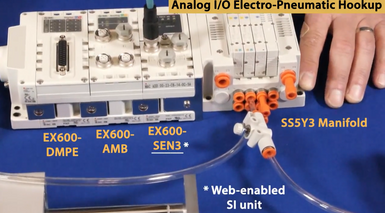
The EX600 is SMC's flagship fieldbus system for valve manifolds. It's modular — the SI unit provides the network connection, and you add digital I/O modules, analog I/O modules, and IO-Link master modules to build exactly the I/O configuration the application requires.
Key capabilities:
- Protocols: EtherNet/IP, PROFINET, EtherCAT, PROFIBUS-DP, CC-Link, DeviceNet, POWERLINK, CC-Link IE Field
- Up to 9 I/O units in any combination per SI unit, plus up to 9 remote D-sub manifolds
- Digital input modules (8 or 16 channel, PNP or NPN) for cylinder sensors and limit switches
- Digital output modules for external solenoids or indicator lights
- IO-Link master modules — up to 9 per manifold, 36 IO-Link devices total
- Built-in web server for browser-based status checks, parameter settings, and forced output (EtherNet/IP, PROFINET, EtherCAT SI units)
- QuickConnect (~0.5s communication startup) for robotic tool changer applications (EtherNet/IP)
- OPC UA server with encrypted communication for direct SCADA/HMI/edge connection (PROFINET EX600-SPN31)
- Compatible with SY series, JSY series, SV series, VQC series, and S0700 series valves
- Valve plate brackets available for direct SY series mounting
The EX600's SI unit determines the protocol — swap the SI unit and you change networks without changing the manifold, I/O modules, or wiring. Integration is native across platforms: Rockwell/Allen-Bradley users get an Add-On Profile (AOP) in Studio 5000 for the EtherNet/IP SI units (EX600-SEN7 PNP, EX600-SEN8 NPN — both dual-port with DLR support). Siemens users import a GSDML file into TIA Portal for the PROFINET SI units (EX600-SPN3 PNP, EX600-SPN4 NPN, or EX600-SPN31 with OPC UA). EtherCAT users (EX600-SEC3 PNP, EX600-SEC4 NPN) get an XML file for TwinCAT or any standard EtherCAT master. In each case, the configuration tool auto-maps the I/O structure — no manual byte-level mapping required.
SMC EX260: Compact Integrated Interface
The EX260 is a more compact, cost-effective fieldbus solution designed specifically for valve output control. It integrates directly onto SY, SV, VQC, and S0700 manifold bases at only 28mm wide.
Key capabilities:
- Protocols: EtherNet/IP, PROFINET, EtherCAT, IO-Link, PROFIBUS-DP, DeviceNet, POWERLINK
- IP67 rated — designed for on-machine mounting without an enclosure
- Drives up to 32 solenoids
- Daisy-chain wiring supported
- IO-Link compatible for integration as a sub-device
The EX260 is the right choice when you need fieldbus communication for valve outputs but don't need the mixed I/O modularity of the EX600. It's smaller, less expensive, and easier to specify for straightforward manifold applications.
Valve Series Compatibility Quick Reference
The SY series (SY3000, SY5000, SY7000) is SMC's most widely specified 5-port solenoid valve family. Flow rates up to 80% higher than predecessor models, 0.35W power consumption, 100 million cycle life. Compatible with both EX600 and EX260.
The JSY series is purpose-built for robotic end-of-arm tooling. Three body sizes — JSY1000 (6.4mm, the world's smallest 5-port valve width), JSY3000 (10mm), and JSY5000 (15mm). Plug-in type JSY manifolds are directly compatible with EX600 and EX260 communication modules.
The SV series uses cassette-style manifold bases with multi-connector internal wiring. The VQC series offers five wiring package options with IP67-rated enclosures and multi-pin connectors.
When Hard Wiring Still Makes Sense
Fieldbus is not universally the right answer. There are legitimate use cases where traditional discrete wiring remains the better choice:
Small manifolds (2–4 solenoids). The cost of an SI unit, Ethernet cable, and network switch port exceeds the cost of a few wires and terminal blocks. The crossover point depends on labor rates, but for most facilities, manifolds under 6 stations don't justify fieldbus hardware.
Safety-rated circuits. Emergency stop and safety interlock circuits typically need to bypass the communication network entirely. Hardwired safety relays and safety-rated contactors provide the deterministic, independently verified signal path that safety standards (ISO 13849, IEC 62061) require. That said, the EX600 does offer the EX600-SEN safety module for safety-rated I/O over the fieldbus — consult your safety engineer for category and performance level validation.
Legacy PLC platforms. If the controlling PLC doesn't support any of the protocols the EX600/EX260 offers — or if adding a communication module to an older rack isn't cost-effective — fieldbus may not be practical for that particular machine. That said, the EX600 covers eight protocol families, so compatibility issues are increasingly rare with modern controllers from Rockwell, Siemens, Beckhoff, Mitsubishi, Omron, and others.
Retrofit with no network infrastructure. Installing a fieldbus manifold in a facility with no existing Ethernet backbone near the machine means running network cable, adding a managed switch, and potentially extending the plant network. For a single manifold retrofit, the infrastructure cost may not pencil out.
Getting Started
Moving from hard-wired manifolds to fieldbus and IO-Link doesn't require replacing every manifold in the plant at once. The most common starting point is a new machine build or a major retrofit where the panel is already being redesigned. Specify the EX600 with an EtherNet/IP SI unit for applications that need mixed I/O alongside valve outputs, or the EX260 for straightforward valve manifold communication. PROFINET users should specify the EX600-SPN3, and EtherCAT users the EX600-SEC3 or EX600-SEC4.
Automation Distribution stocks the full SMC EX600 modular platform — SI units for every major protocol, I/O modules, IO-Link master modules, endplates, and valve mounting brackets — alongside the complete SY, JSY, SV, and VQC valve families. If you need help specifying the right SI unit, selecting valve plate brackets, or mapping your existing hard-wired I/O to a fieldbus configuration, contact us for application engineering support.
Frequently Asked Questions
What is the difference between IO-Link and industrial Ethernet protocols like EtherNet/IP or PROFINET? Industrial Ethernet protocols (EtherNet/IP, PROFINET, EtherCAT, etc.) are controller-level networks that connect devices like valve manifolds to PLCs over standard Ethernet cabling. IO-Link is a device-level point-to-point serial protocol (IEC 61131-9) that connects smart sensors and actuators to an IO-Link master. In an SMC EX600 system, the industrial Ethernet protocol carries data between the manifold's SI unit and the PLC, while IO-Link carries data between individual sensors or devices and the EX600's IO-Link master module. They operate at different layers and are complementary — not interchangeable.
Which PLC platforms does the SMC EX600 support? The EX600 supports all major industrial protocols through interchangeable SI units: EtherNet/IP for Rockwell/Allen-Bradley (with Add-On Profile for Studio 5000), PROFINET for Siemens (with GSD file for TIA Portal), EtherCAT for Beckhoff and other motion platforms (with ESI file for TwinCAT), plus PROFIBUS-DP, CC-Link, CC-Link IE Field for Mitsubishi, DeviceNet, and POWERLINK. The manifold hardware and I/O modules are identical across protocols — only the SI unit changes.
How many valves can one EX600 manifold control? A single EX600 SI unit can control the valve outputs on its directly mounted manifold, and with D-sub output blocks, up to 9 remote manifolds can connect to one SI unit. The total solenoid count depends on valve series and manifold size — a fully loaded SY5000 manifold with 20 stations using double solenoids would be 40 solenoid outputs on that manifold alone.
Do SMC fieldbus manifolds work outside the control cabinet? Yes. The EX260 is rated IP67 and designed specifically for on-machine mounting without an enclosure. The EX600 with M8 or M12 connector I/O modules also achieves IP67. This allows the manifold to be located closer to the cylinders it controls, reducing pneumatic tubing runs and response time.
What cable do I need for an SMC EX600 fieldbus manifold? For Ethernet-based protocols (EtherNet/IP, PROFINET, EtherCAT), standard Cat5e or Cat6 Ethernet cable with M12 D-coded connectors (4-pin). The current-generation EtherNet/IP SI units (EX600-SEN7/8) and PROFINET SI units (EX600-SPN3/4/31) are dual-port and support ring topology for network redundancy — EtherNet/IP via DLR, PROFINET via MRP. Power is supplied separately through the endplate connector (7/8-inch, 5-pin). IO-Link devices connect via standard unshielded M12 cables up to 20m in length.